Topic 5.12 Notes – Exploring Behaviors of Implicit Relations
What an Implicit Relation Is and How We Differentiate It
An implicit relation looks like
Example: .
We don’t solve for . Instead, we differentiate both sides with respect to .
Key idea: treat as a function of . So whenever you differentiate a -term, multiply by .
Quick example:
Differentiate .
- → product rule
So:
Now solve algebraically for .
Every time you find , that expression gives the slope of the tangent line to the curve at a point.
Critical Points of an Implicit Relation
A critical point is any point on the curve where:
- , or
- does not exist.
Same definition as with explicit functions.
How to Find Them
- Compute .
- Set it equal to 0.
- Usually this means set the numerator = 0, while denominator ≠ 0.
- Find where it’s undefined.
- Usually where the denominator = 0, while numerator ≠ 0.
- Plug back into the original equation to find actual points .
You must report points, not just x-values.
Why Undefined Slopes Matter
Undefined slopes often mean vertical tangents.
For example, consider the circle .
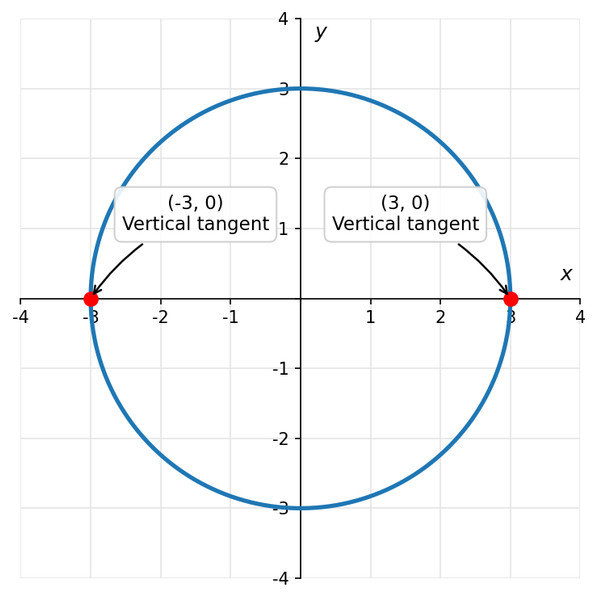
Circle with vertical tangents
- At and , the slope is undefined.
- These are critical points.
- They are not automatically maxima or minima.
That’s where sign analysis comes in.
Classifying Critical Points Using the First Derivative
Use the First Derivative Test exactly like before.
- If changes from positive to negative → relative maximum.
- If it changes from negative to positive → relative minimum.
- If there is no sign change → neither.
Subtle but important:
For implicit curves, a vertical tangent might not correspond to a local max or min because the curve could approach that x-value from only one side or behave differently along different branches.
On FRQs, you must justify your conclusion using sign changes, not just say “it’s a maximum.”
Concavity and the Second Derivative
To analyze concavity, differentiate again.
You start with your expression for , then take again.
Important: the second derivative may involve:
That’s normal.
Interpreting
- → concave up
- → concave down
A possible inflection point occurs where:
- or undefined
- AND concavity changes sign.
You must show a sign change in concavity to justify an inflection point.
AP graders look for explicit reasoning like:
“Since changes from positive to negative at (a,b), the curve changes concavity, so there is an inflection point.”
Extending Derivative Applications to Implicit Functions
Everything you learned about derivatives still works:
- Increasing/decreasing behavior
- Relative extrema
- Concavity
- Inflection points
It also connects to related rates.
If both and depend on time :
That chain rule connection is huge. Many related rates setups start with an implicit equation and require this exact idea.
Common Mistakes That Cost Points
- Forgetting to multiply by when differentiating -terms.
- Setting both numerator and denominator equal to zero.
- Calling every vertical tangent a max or min.
- Forgetting to verify points satisfy the original equation.
- Claiming an inflection point without proving a concavity change.
- Stopping at when the question asks for .
