Topic 7.1 Notes – Modeling Situations with Differential Equations
What a differential equation is
A differential equation is an equation that relates a function and one or more of its derivatives.
On the AP exam (and in this unit), you’ll mostly see first-order differential equations, which involve:
- A function like , , ,
- Its derivative like , ,
Example form:
This says: the rate of change of with respect to time depends on itself.
Big idea:
- The derivative represents a rate
- The equation tells you what that rate depends on
You’re modeling how something changes.
Identifying the rate
Every problem starts by identifying:
- What is changing?
- With respect to what?
If the problem says:
- “Rate of change of temperature with respect to time” →
- “Rate at which area changes as radius increases” →
The rate always goes on the left side of the equation.
Be careful with wording.
“With respect to time” means the denominator is . Students sometimes accidentally write the wrong variable underneath.
Proportional relationships
Most modeling questions in this topic use proportionality language.
You must translate these phrases correctly.
Directly proportional
If a rate is proportional to something:
Examples:
- “The rate is proportional to ”
- “The rate of change of is proportional to ”
- “Proportional to the product of and ”
Multiply by . Always include the constant.
Inversely proportional
If a rate is inversely proportional to something:
Examples:
- “Inversely proportional to ”
- “Inversely proportional to the square of ”
Inverse means divide.
Proportional to a power
Watch for powers in wording:
- “Square of ” →
- “Cube of ” →
- “Square root of ” →
Example:
AP questions love hiding exponents in words.
Finding the constant of proportionality
Often you’ll be given a specific data point to determine .
Here’s the process:
- Write the general model with .
- Substitute the given numerical values.
- Solve for .
- Rewrite the full differential equation.
Example
Suppose:
“The rate of change of bacteria population with respect to time is proportional to . When , the population is increasing at 10 units per hour.”
Step 1:
Step 2:
Step 3:
Final model:
Important:
You stop here. Do not solve for . That’s a later topic.
What modeling really means
A differential equation models how one quantity changes depending on another.
Visually, think about the differential equation . Its slope field looks like this:
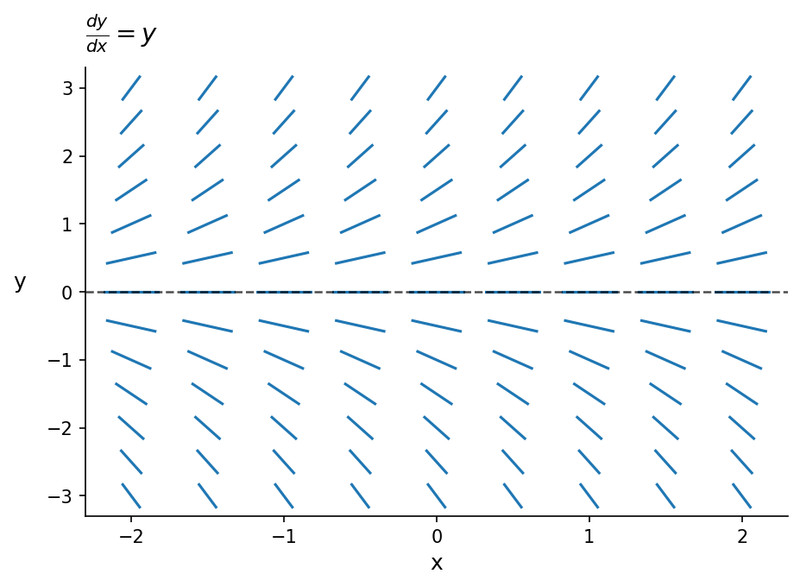
Slope field for
At every point, the slope depends only on the value of . When is positive, the segments tilt upward. When is negative, they tilt downward. As gets larger, the slopes get steeper.
That’s what “rate proportional to the quantity” actually means.
Even though you aren’t solving yet, you’re describing the structure of how change behaves.
Common mistakes
- Forgetting the constant
- Mixing up direct vs. inverse proportionality
- Leaving out variables mentioned in the problem
- Solving the differential equation instead of just writing it
- Ignoring powers like “square” or “square root”
On free-response questions, you earn points for the correct differential equation even if you never solve it.
