Topic 1.12 Notes – Confirming Continuity over an Interval
What It Means to Be Continuous on an Interval
A function is continuous on an interval if it is continuous at every single point in that interval.
Recall what continuity at requires:
- exists
- exists
If even one point fails, the function is not continuous on that interval.
Open vs. Closed Intervals
- On an open interval : check continuity at all interior points.
- On a closed interval :
- Continuous on
- Right-continuous at
- Left-continuous at
That endpoint detail shows up on FRQs when they’re being precise.
Functions That Are Continuous on Their Domains
There are families of functions you should immediately recognize as continuous wherever they are defined:
- Polynomials
- Rational functions
- Power functions
- Exponential functions
- Logarithmic functions
- Trigonometric functions
The key phrase is on their domains.
That means your real job is often this:
Is every number in the given interval actually in the function’s domain?
If yes, the function is continuous there.
If not, it cannot be continuous on that whole interval.
This saves time on multiple choice. Don’t overcomplicate it.
Domain Restrictions That Break Continuity
Before checking limits, scan for domain problems.
Rational functions
Denominator cannot equal 0.
If that excluded value lies inside the interval → not continuous there.
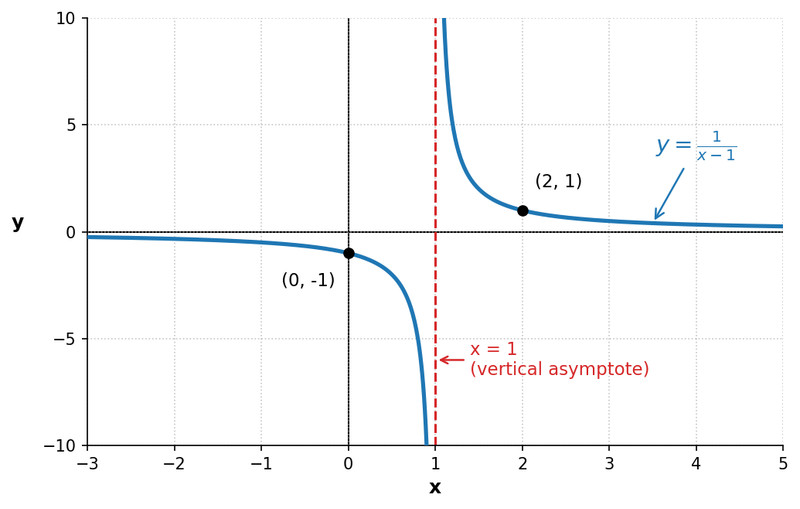
Graph of
In this example, the vertical asymptote at means the function is not continuous on any interval containing 1.
Even roots
Expressions like require the inside ≥ 0.
If the interval includes values where the radicand is negative, continuity fails because the function isn’t defined there.
Logarithms
The argument must be .
For example, is only defined for . Any interval that crosses 3 cannot be a full interval of continuity.
Trig functions with restrictions
and are undefined where .
That creates infinitely many discontinuities.
Piecewise Functions on an Interval
Each piece is usually continuous by itself. The only possible issue is where the formula changes.
Suppose
Both expressions are polynomials, so they’re continuous on their own. The only question is at .
You check:
- Left-hand limit
- Right-hand limit
- Function value
If all three match, it’s continuous at that point.
From the graph, the line approaches 7 as , and the parabola approaches 7 as . The filled dot at shows that .
Since both sides approach 7 and , the function is continuous at 4.
Then you conclude about the entire interval.
On FRQs, you must actually show the limits and value. Just stating “they match” is not enough.
Determining Intervals of Continuity
When asked to determine intervals over which a function is continuous, you:
- Identify the domain.
- Break the number line at excluded values.
- Write intervals between those breaks.
Example:
If ,
Denominator at .
So the function is continuous on:
Those intervals are where the function exists and has no breaks.
How This Gets Tested
- Multiple choice often hides a domain restriction inside a complicated expression.
- Free response requires limit justification at a switching point.
- Graph questions expect you to identify breaks visually.
If you see a function type you recognize, think domain first. That’s the fastest path.
