Topic 5.1 Notes – Using the Mean Value Theorem
5.1 Using the Mean Value Theorem
The Mean Value Theorem (MVT) is an existence theorem. It tells you that if a function behaves nicely on an interval, then somewhere inside that interval, the instantaneous rate of change equals the overall average rate of change. You often won’t know exactly where that point is-but you can prove it exists.
The Mean Value Theorem
If a function is:
- continuous on ,
- differentiable on ,
then there exists at least one number such that
That fraction is the average rate of change over the interval.
The derivative is the instantaneous rate of change.
So MVT says:
At some point inside the interval, the tangent line slope equals the secant line slope.
Here’s what that looks like geometrically:
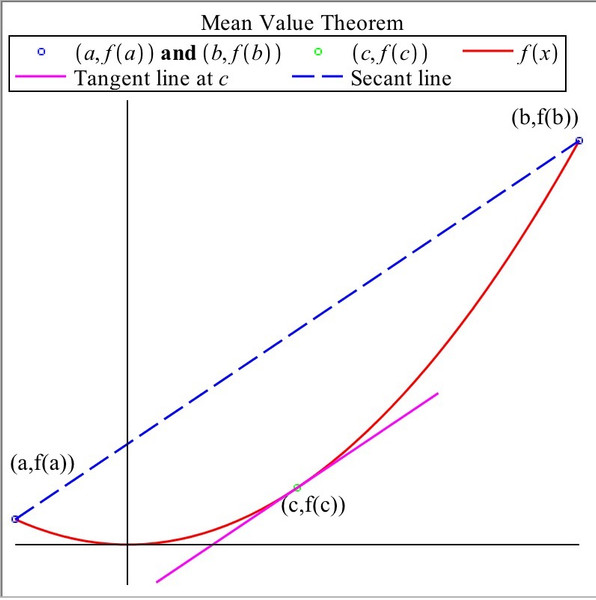
Geometric interpretation of the Mean Value Theorem
The dashed blue line is the secant line through and . The pink line is the tangent line at some interior point . They are parallel, so their slopes are equal.
That parallel relationship is the whole theorem in one picture.
What the Conditions Actually Mean
You must check both conditions before applying MVT.
Continuous on
- No holes
- No jumps
- No asymptotes
- Includes the endpoints
Polynomials, exponentials, trig functions are continuous everywhere.
Piecewise and rational functions require checking.
Differentiable on
- No corners
- No cusps
- No vertical tangents
- No discontinuities inside
Remember: differentiability implies continuity, but not the other way around.
On FRQs, you’re expected to state this explicitly, even if it feels obvious:
Since is continuous on and differentiable on , the Mean Value Theorem applies.
If one condition fails, you cannot use MVT. That alone can determine the entire problem.
How to Apply MVT
When they give you a function and interval and ask for the value(s) of , the process is mechanical.
- Verify conditions
Brief justification. - Compute average rate of change
- Differentiate
Find . - Set equal to the average slope
- Solve for
Only keep solutions inside .
Quick Example
Let on .
- Polynomial → continuous and differentiable everywhere → MVT applies.
- Average slope:
- Derivative:
Set equal to 2:
Since , the value is .
There could be more than one solution. MVT guarantees at least one.
Justifying Whether Has a Solution
This is a very common AP-style question.
You’re given endpoint values and asked whether there must be a point where .
The only derivative value MVT guarantees is the average rate of change.
If:
Then yes, MVT guarantees a solution.
If it doesn’t equal , MVT does not guarantee it. That doesn’t mean it’s impossible-it just means MVT can’t prove it.
Students lose points by saying “Yes” just because the function is differentiable. The average slope has to match.
What MVT Guarantees (and What It Doesn’t)
Guarantees
- At least one exists
- is strictly inside the interval
- Tangent slope equals secant slope
Does NOT Guarantee
- Where is
- That there’s only one solution
- That any random derivative value occurs
- Anything if conditions fail
This is why it’s called an existence theorem. It proves something happens without locating it.
