Topic 2.6 Notes – Derivative Rules: Constant, Sum, Difference, and Constant Multiple
Derivative Rules for Linear Combinations of Functions
A linear combination just means functions connected by addition, subtraction, or constant multiples. Derivatives behave nicely with these operations.
Constant Rule
If , where is a number,
A constant has no change. Graphically, it’s a horizontal line with slope 0, so its derivative is 0 everywhere.
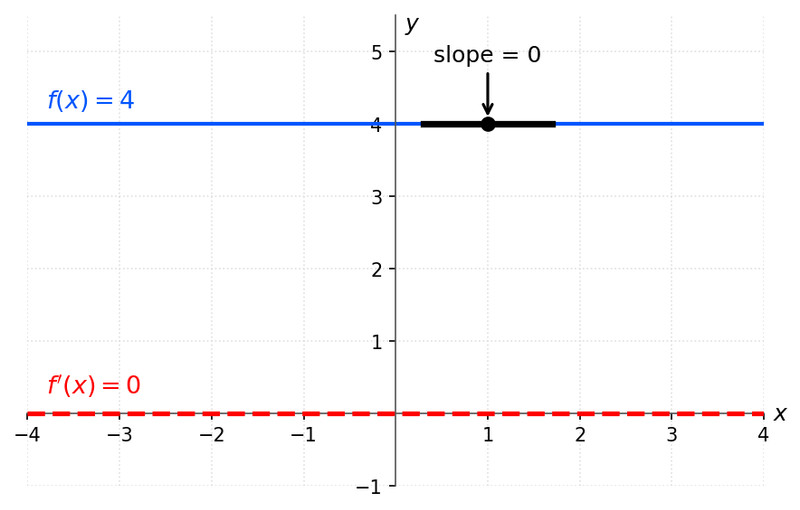
Constant function and its zero derivative
On quizzes, students often accidentally carry the constant down. Don’t. It disappears.
Sum Rule
If
then
The derivative distributes across addition. You differentiate each piece separately and keep the plus sign.
Difference Rule
If
then
Same idea as the sum rule. The minus sign stays attached to the term. Losing that negative is one of the most common mistakes on tests.
Constant Multiple Rule
If
then
The constant just comes along for the ride.
Example: If , then
You multiply the coefficient by the exponent. Don’t just lower the exponent.
Combining These with the Power Rule
Most of the time, you’ll use these rules together with the power rule:
If , then
Polynomials are just sums of constant multiples of powers of . That’s why this topic is foundational.
A general polynomial:
Its derivative:
The constant term vanishes.
Differentiating Polynomial Functions
When you see only powers of connected by + or −, you’re in this topic. No product rule. No chain rule.
Example:
Differentiate term by term:
So,
That’s the entire process.
Structural Pattern to Recognize
Any polynomial fits this general structure:
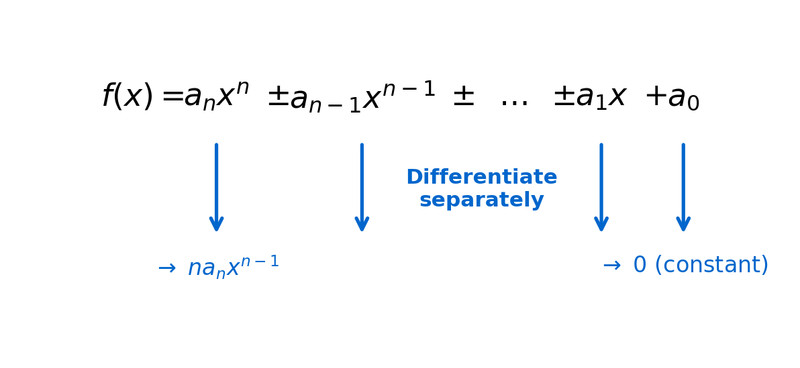
General polynomial structure and term-by-term differentiation
Your brain should automatically think: “Differentiate each term separately and keep the signs.”
This is especially helpful on AP multiple choice where speed matters. Polynomial derivatives should take seconds.
Common Errors That Cost Easy Points
- Forgetting to multiply coefficients
, not - Dropping negatives
- Messing up exponents
Exponent decreases by 1.
If exponent is 1, you get a constant.
If exponent is 0, derivative becomes 0. - Overcomplicating
If terms are added, do not use product rule. Rewrite first if needed.
Why This Matters for BC
These rules are the backbone for:
- Finding critical points
- Analyzing graphs
- Setting up differential equations
- Taylor and Maclaurin polynomials later in BC
If you can differentiate polynomials instantly and accurately, harder problems become manageable because this step won’t slow you down.
