Topic 3.2 Notes – Implicit Differentiation
What Implicit Differentiation Is
An explicit equation looks like . You can just differentiate directly.
An implicit equation mixes and together, like
Here, depends on , but it’s not isolated. Instead of solving for (which could be messy or impossible), we differentiate both sides with respect to .
The key idea:
- Treat as a function of .
- Every time you differentiate a term with , multiply by .
- This is just the chain rule in disguise.
For example:
You are differentiating the outside first, then multiplying by the derivative of the inside, which is .
You’ll usually write the derivative as or . Stick with that notation.
The Process for Finding
When you see an implicit equation, the steps are mechanical.
- Differentiate both sides with respect to
Apply derivative rules to every term. - Use the chain rule for all -terms
Attach every time you differentiate something involving . - Collect all terms on one side
- Factor out
- Solve algebraically
Let’s try one:
Differentiate both sides:
- For , use product rule:
So we get:
Group the terms:
Factor:
Solve:
Notice the final answer contains both and . That’s normal.
Rules You Must Apply Correctly
Implicit differentiation still uses all the usual derivative rules.
- Power rule with
- Product rule
- Trig functions
- Exponential
If it would require the chain rule normally, it still does here.
Geometry and Tangent Lines
Implicit differentiation often appears with curves like circles or ellipses.
For example:
This circle has radius 5 and is centered at the origin. Suppose we want the slope of the tangent line at the point .
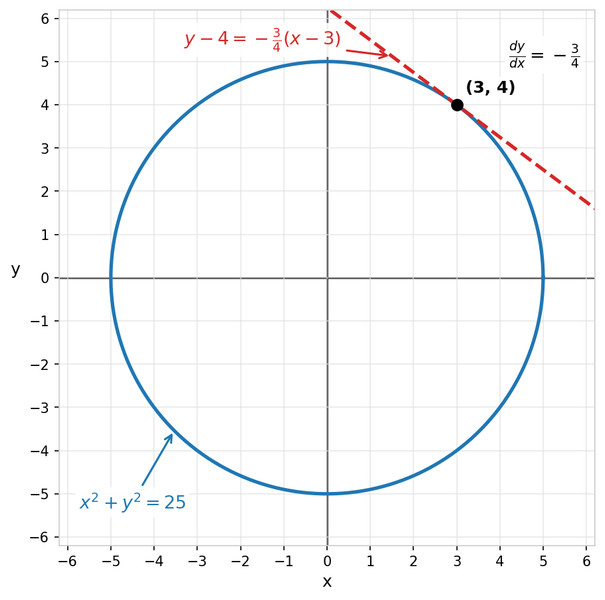
Tangent line to at
Differentiate both sides with respect to :
Solve for :
Now evaluate at :
Use point-slope form to write the tangent line:
On FRQs, you often:
- Find
- Evaluate it at a point
- Write the tangent line
Be careful to plug the point into the derivative expression, not the original equation.
When You Use This
Implicit differentiation is helpful when:
- Solving for would create messy radicals
- The equation represents multiple branches (like a circle)
- The algebra to isolate would waste time
The AP likes equations you could solve but shouldn’t. Implicit differentiation is faster and cleaner.
Common Mistakes
- Forgetting to multiply by on -terms
- Missing product rule on mixed terms like
- Trying to plug numbers in before solving for
- Losing track of algebra when isolating
Most errors are algebra mistakes, not calculus mistakes.
