Topic 10.11 Notes – Finding Taylor Polynomial Approximations of Functions
What a Taylor polynomial is
A Taylor polynomial is a polynomial that matches a function’s value and derivatives at a specific point .
It’s built from the derivatives of evaluated at .
The general form is:
Written out:
Lock these in:
- The coefficient of is .
- .
- A Maclaurin polynomial is just centered at .
- Higher degree → matches more derivatives → usually better approximation near .
Think of it as forcing a polynomial to have the same value, slope, concavity, and higher-order behavior as the function at one point.
Here’s the visual idea:
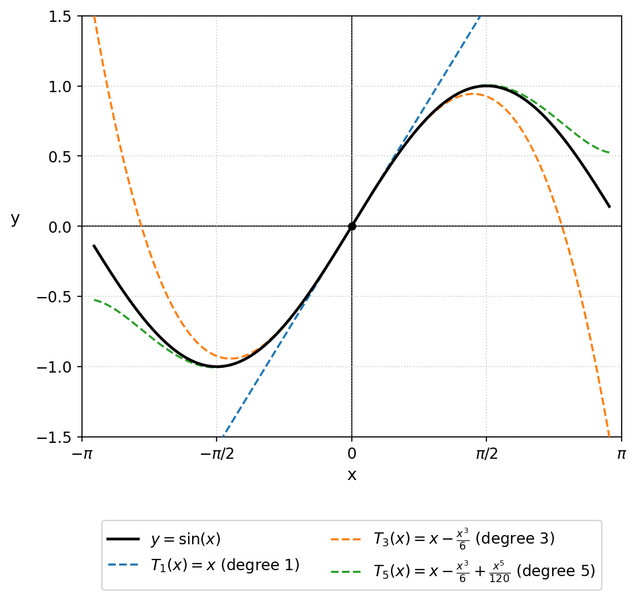
Maclaurin polynomials for (degrees 1, 3, and 5)
Notice how they agree closely near 0 but drift away farther out. Taylor polynomials are local approximations.
How to build a Taylor polynomial
When you’re asked for, say, the 3rd-degree Taylor polynomial centered at , the structure is always the same.
Step-by-step
- Compute derivatives up to the 3rd derivative.
- Evaluate each at .
- Plug into
- Add terms from to .
Quick example
Find the second-degree Taylor polynomial for centered at .
Derivatives:
Evaluate at 2:
Build the polynomial:
Every coefficient came directly from . That’s the core skill.
On tests, most errors happen from:
- Forgetting the factorial
- Using instead of
- Stopping at the wrong degree
What improves as degree increases
Each added term forces another derivative to match at .
So as increases:
- The graphs agree more tightly near .
- The polynomial often stays accurate over a slightly larger interval.
- The approximation error typically shrinks near the center.
But this is always near . Far away, even high-degree polynomials can behave wildly.
That idea connects to the larger theme of Unit 10: power series represent functions over certain intervals. A Taylor polynomial is just a finite “snapshot” of that full series.
Using a Taylor polynomial to approximate values
Taylor polynomials are used to approximate when is close to .
Example idea: suppose you built a third-degree Maclaurin polynomial for :
To approximate , plug in . That’s it.
Key idea:
- The closer is to , the better the approximation.
- Higher degree usually improves accuracy.
On the AP exam, this often shows up as:
- “Use the third-degree Taylor polynomial to approximate…”
- Calculator section problems where you evaluate your polynomial numerically.
- FRQs where you must actually write the polynomial first, then substitute.
