Topic 5.7 Notes – Using the Second Derivative Test to Determine Extrema
What the Second Derivative Test Says
First, quick grounding.
A critical point occurs where:
- , or
- does not exist (but exists).
The second derivative tells you about concavity:
- → concave up (bowl shape)
- → concave down (hill shape)
Here’s the key idea:
If and exists, then
- → local minimum
- → local maximum
- → inconclusive
Why this makes sense visually:
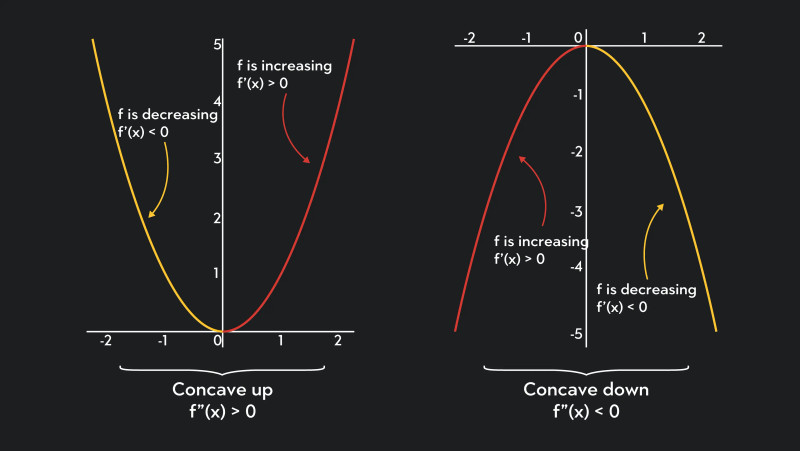
On the left, the graph is concave up. Notice how the slope is negative before the vertex and positive after it, so the flat point is a minimum.
On the right, the graph is concave down. The slope is positive before the vertex and negative after it, so the flat point is a maximum.
This is often faster than building a full sign chart for .
How to Use the Second Derivative Test
Let’s walk through the mechanics with a concrete example.
Suppose
1. Find
2. Find critical points
Set :
Divide by 3:
Factor:
Critical points: ,
3. Find
4. Evaluate
- → negative → local max
- → positive → local min
On a free-response question, don’t just say “max” or “min.” Write something like:
“Since , the function is concave down at , so has a local maximum there.”
That justification language earns the point.
When the Test Is Inconclusive
The test only works when:
- , and
If , you cannot conclude anything.
Example:
- → critical point at
The test fails. But is actually a local minimum. You’d need the First Derivative Test to confirm.
Important:
does not automatically mean inflection point. Concavity must change sign for that.
On multiple choice, they love giving a point where and seeing if you jump to the wrong conclusion.
Connecting Local and Absolute Extrema
Here’s a powerful theorem you’re expected to use in explanations.
If a function is:
- Continuous on an interval, and
- Has exactly one critical point in that interval, and
- That point is a local extremum,
then that point is also the absolute extremum on that interval.
Why this works:
If there’s only one place where the slope is zero, there’s no other peak or valley competing with it.
This shows up a lot in optimization FRQs. You’ll often see wording like:
“Explain why this value gives the absolute maximum.”
A strong response mentions:
- continuity,
- one critical point,
- and that it is a local maximum,
- therefore it must be absolute.
If endpoints are involved, remember that this theorem applies to the interval given. Always pay attention to whether the interval is open or closed.
