Topic 3.1 Notes – The Chain Rule
1. Composite Functions and What the Chain Rule Says
A composite function happens when the output of one function becomes the input of another.
If
- is the inner function
- is the outer function
- The whole expression is “ of ”
Here’s the structure visually.
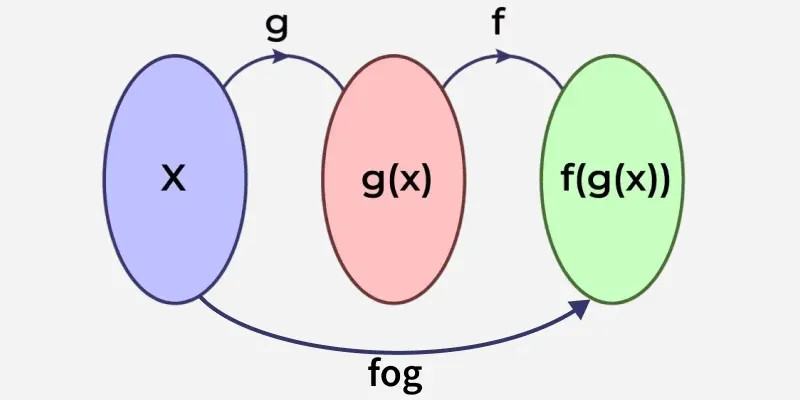
Function composition diagram
The derivative rule for this situation is the Chain Rule.
The Chain Rule formula
If , then
Another common notation is
Both say the same thing:
- Differentiate the outer function
- Keep the inside unchanged
- Multiply by the derivative of the inner function
Think: outer derivative × inner derivative
2. How to Apply the Chain Rule
Any time you see “something inside something,” your Chain Rule radar should go off.
Let’s walk through the logic clearly.
Step 1 Identify the layers
Ask yourself:
- What operation is happening last?
- What expression is being treated as a single unit?
For example:
Outer = power of 7
Inner =
Outer = sine
Inner =
Step 2 Differentiate the outer function
Pretend the inner expression is just a variable like .
Examples:
Do not touch the inside yet.
Step 3 Multiply by the derivative of the inner function
Now differentiate the inside with respect to , and multiply.
Quick Example
Differentiate
- Outer derivative:
- Inner derivative:
Final answer:
Notice the inside stayed intact until the multiplication step.
3. Common Chain Rule Structures on AP Exams
These patterns show up constantly on quizzes, FRQs, and both calculator and no-calculator MCQs.
a. Power of a polynomial
Derivative:
This is the most common Chain Rule trigger.
b. Exponentials
Derivative:
The exponential part stays the same. Students often forget the .
c. Natural logarithms
Derivative:
On FRQs, this often appears inside bigger expressions.
d. Trig functions
Example:
You must multiply by the derivative of the angle.
e. Radicals
Rewrite first:
Then apply power rule + Chain Rule.
Multiple layers
If you see something like
There are three layers:
- Power of 3
- Cosine
You take three derivatives and multiply them all.
This is where students miss a factor.
4. When to Use It and Common Mistakes
When you need the Chain Rule
- A function raised to a power and the base is not just
- A trig/log/exponential function with more than just inside
- Any clear “function inside a function”
If parentheses are doing real work, you probably need it.
Common mistakes
- Forgetting the inner derivative
This is the number one lost point on tests. - Differentiating the inside too soon
Outer first. Always. - Missing layers
Especially with trig powers like . - Dropping parentheses
Keep the inside grouped until the end.
On the AP exam, many derivatives look simple but are layered. They test whether you truly see structure.
