Topic 9.9 Notes – Finding the Area of the Region Bounded by Two Polar Curves
Area Between Two Polar Curves
Quick reminder from one-curve area:
That comes from the area of a tiny circular sector.
When two curves bound a region, you subtract the smaller sector from the larger one:
This is the polar version of “top minus bottom.”
- = farther from the origin
- = closer to the origin
- Bounds are θ-values, not x-values
If you forget to square the radii, the entire setup is wrong. The squaring is not optional.
Identifying Outer and Inner Radius
This is where most mistakes happen.
You’re comparing distance from the origin, not which equation looks “bigger.”
Compare values directly
Pick a test angle in the interval and plug it into both functions.
Example:
If and ,
try .
Whichever gives the larger number is outer at that θ.
Visualizing from the origin
Think of standing at the origin and shining a flashlight at angle .
- First curve the light hits → inner
- Next curve → outer
Here’s the geometric idea. A single ray at a fixed angle intersects the inner curve first and the outer curve second.
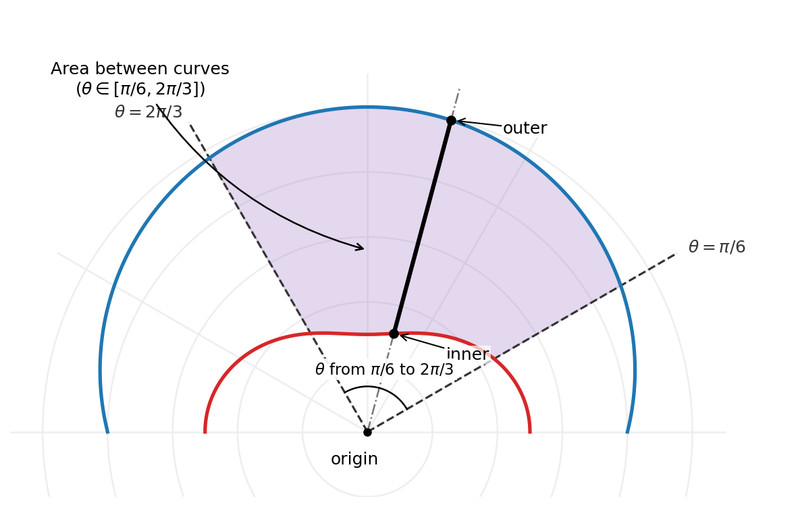
Inner and outer curves along a fixed angle
When curves switch roles
Sometimes curves intersect and trade positions.
If that happens:
- Solve
- Split the integral at those θ-values
- Reassign outer/inner on each interval
If you don’t split when needed, your answer will be wrong even if your algebra is perfect.
Finding the Bounds of Integration
Bounds are always angles.
1. Intersection points
Set the equations equal:
Solve for .
These angles often become your limits.
Be comfortable solving trig equations like:
- etc.
Solve over , then choose the relevant ones.
2. Restricted regions
If the problem says:
- “First quadrant” →
- “Upper half” →
Always radians. If your calculator is in degree mode, disaster.
3. Sketching helps
Even a rough sketch prevents wrong bounds.
Here’s an example with two curves that intersect and switch which one is outer:
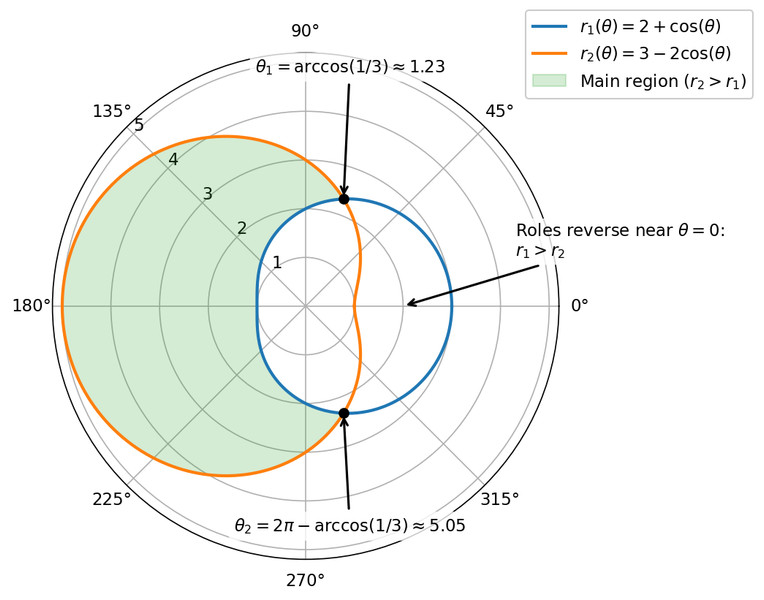
Intersecting polar curves with shaded region
You’re checking:
- Where they cross
- Which one is outer
- Whether symmetry can simplify things
In this sketch, the curves intersect at two angles and the outer curve changes depending on θ. That tells you the integral may need to be split.
Only use symmetry if the region actually repeats cleanly.
Full Setup Process
When you see one of these on a quiz or FRQ, this is the mental checklist:
- Write both equations clearly.
- Solve for intersection angles.
- Determine the correct θ-interval.
- Decide outer vs inner (test value or sketch).
- Set up
- Expand carefully.
- Square everything fully.
- Use trig identities if needed.
- Integrate and evaluate.
On non-calculator sections, integrals are usually designed to simplify nicely. If it explodes algebraically, you probably missed an identity.
On calculator sections, sometimes the setup earns most of the credit. Don’t skip directly to decimals without writing the correct integral.
Common Mistakes
- Forgetting the
- Using instead of squaring
- Mixing up which curve is outer
- Not splitting the interval when curves cross twice
- Using degree mode
- Assuming symmetry without checking the actual graph
If your final area is negative, outer and inner are reversed.
Big Picture
Rectangular coordinates accumulate vertical strips .
Polar coordinates accumulate circular sectors .
You’re always thinking:
From the origin outward, what part of each ray belongs to the region?
