Topic 10.4 Notes – Integral Test for Convergence
What the Integral Test Says
Suppose you have a series
and you can write , where:
- is continuous
- is decreasing on
Then:
either both converge or both diverge.
That’s the whole theorem.
If the improper integral is finite → the series converges.
If the improper integral is infinite → the series diverges.
Why This Makes Sense
Picture the series as stacking rectangles of width 1 and height . The integral is the smooth area under the curve. In the diagram below, the rectangles use right endpoints, so each rectangle’s height is .
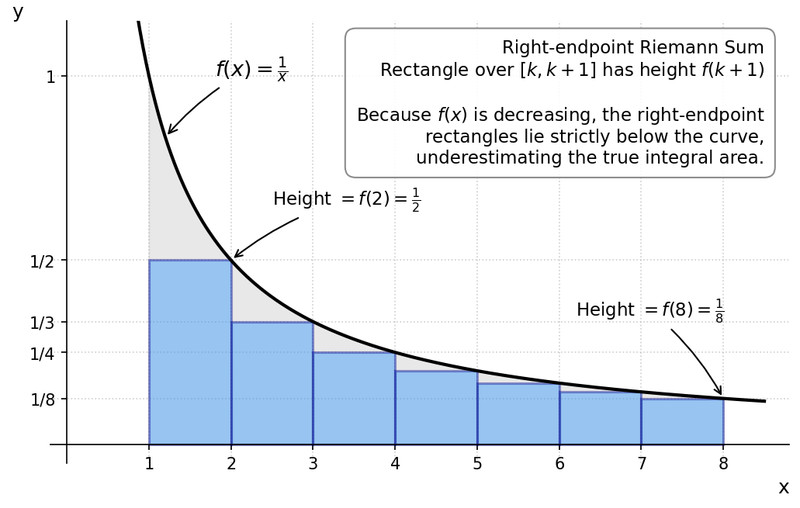
Right-endpoint Riemann sum for a decreasing function
Because the function is decreasing, each right-endpoint rectangle lies below the curve on its interval.
- The rectangles and the curve trap each other.
- If the total area under the curve is finite, the rectangle sum must also be finite.
- If the area blows up, the rectangles do too.
That geometric connection is what justifies the test.
When You’re Allowed to Use It
Before integrating anything, mentally check:
- Positive?
- Decreasing? Usually check or argue logically
- Continuous? No gaps on
- Match?
If a series alternates signs, this test is off the table. Use the Alternating Series Test instead.
This test is designed for positive-term series only.
How to Apply It
Here’s the flow you’ll use on quizzes and FRQs:
Rewrite the terms with :
If , defineState that is continuous, positive, and decreasing for .
Set up the improper integral:
Rewrite using a limit:
Evaluate (this one uses ):
Apply limits:
This is finite.
So the series converges.
Notice we never found the exact sum. We only determined convergence.
Connection to p-Series
You already know:
- Converges if
- Diverges if
The Integral Test is how that result is proven.
It’s especially useful when a series looks close to a p-series but has extras, like logarithms:
- → diverges
- → converges
Those are classic Integral Test examples and show up a lot in multiple choice.
What the Integral Test Does Not Do
- It does not give the exact sum.
- It does not work for negative or alternating series.
- It can be more algebra-heavy than Comparison or Ratio Tests.
If the integral looks ugly but comparison looks easy, switch methods. The AP does not care which valid test you use, as long as it’s justified.
