Topic 1.8 Notes – Determining Limits Using the Squeeze Theorem
The Squeeze Theorem
Here’s the formal statement:
If
- for all near (except possibly at ), and
- ,
then
In plain language: if a function is trapped between two others that both head to the same number, it’s forced to go there too.
Here’s what that looks like graphically. Notice how stays between and near , and all three approach the same value.
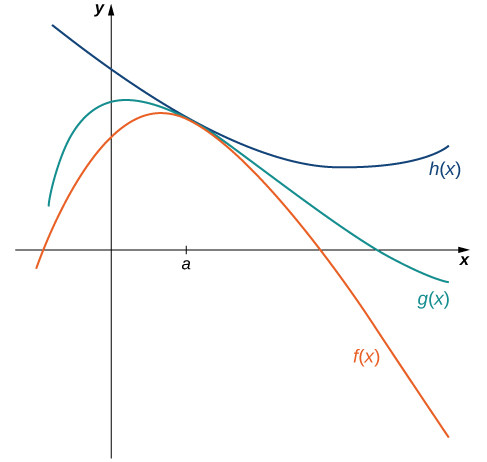
Visual model of the Squeeze Theorem
Important details students miss
- The inequality must hold in an open interval around , not just at one point.
- The functions do not need to be equal at .
- This proves the limit, not automatically the function value.
- The bounding functions must approach the same limit.
The Trig Bounds You Need
Most squeeze problems on quizzes and the AP exam involve trig.
1. Sine and cosine are bounded
For all real :
That’s your starting point almost every time.
2. Oscillating functions like
As , and :
- Oscillate infinitely fast
- Do not have limits by themselves
- Stay between −1 and 1
Here’s what that wild oscillation looks like near .

Graph of near
The graph never settles as approaches 0 from either side. That’s why direct substitution fails.
Classic Example Pattern
Consider
We know:
Multiply everything by . Near 0, we handle both sides carefully:
(Using absolute value avoids sign issues.)
Now take limits:
Both outer functions go to 0. So by the Squeeze Theorem:
Big pattern to remember:
Small number × bounded oscillation → 0
You’ll see this exact structure in multiple choice.
Special Limits You Should Recognize Instantly
Two limits are foundational:
The first is actually proven using the Squeeze Theorem (with geometry on the unit circle). On the AP exam, you’re allowed to use it without re-proving it.
These show up later in BC with series and L’Hôpital’s Rule, so they’re not random facts.
Using Squeeze to Show Continuity
Sometimes you’re given:
- and are continuous at
Since continuous functions satisfy
both outer limits match. So the Squeeze Theorem gives:
If equals that same value, then is continuous at .
This type of reasoning shows up more in free response than multiple choice because you have to justify it clearly.
When to Use It
Use the Squeeze Theorem when:
- Direct substitution fails.
- The function oscillates.
- You see , , or similar.
- A trig function is multiplied by something shrinking to 0.
If factoring or algebra works cleanly, that’s usually faster. Don’t force Squeeze where it’s unnecessary.
