Topic 9.3 Notes – Finding Arc Lengths of Curves Given by Parametric Equations
1. Arc Length of a Parametric Curve
Suppose a curve is defined by
The arc length of this curve from to is
That square root expression is the key. It represents the speed of the particle moving along the curve.
Where this comes from
If you zoom in on a tiny piece of the curve:
- Horizontal change ≈
- Vertical change ≈
By the Pythagorean Theorem,
Now divide by :
So arc length is just:
That connection to accumulation of change is straight Unit 6 thinking. We are adding up tiny distance pieces over an interval.
If you remember the Cartesian formula
,
this is the parametric version where both coordinates are changing.
2. How to Compute Arc Length
When this shows up on a quiz or FRQ, the process is very consistent.
Step-by-step
Find the derivatives
Build the speed
Set up the definite integral
Simplify before integrating
Especially with trig expressions.
Quick Example
Let
Derivatives:
Inside the radical:
Speed =
Arc length:
This makes sense. That’s half a circle of radius 3, so length should be .
On non-calculator sections, they often design it so a trig identity collapses everything nicely like this.
3. Geometric and Physical Meaning
It helps to picture what’s happening.
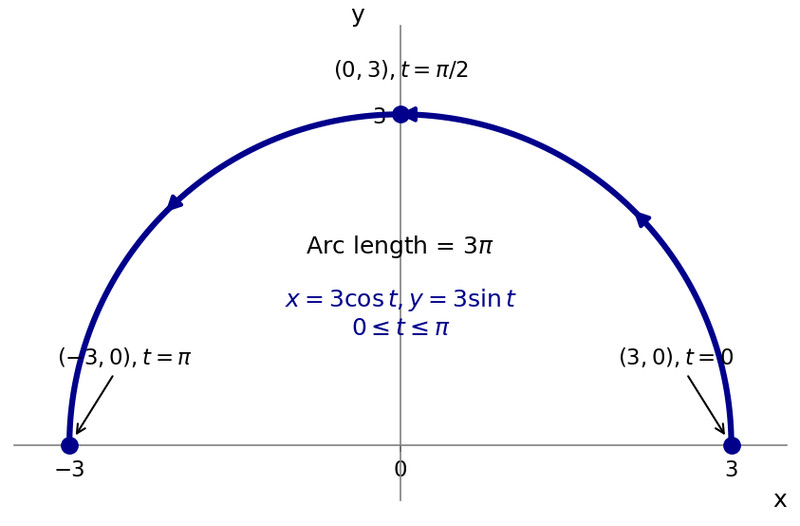
Upper semicircle traced by
As increases, the particle moves along the curve.
The formula measures how much ground it covers.
Two interpretations show up in problems:
- Geometric: “Find the length of the curve.”
- Physical: “Find the total distance traveled.”
Those are the same computation. Distance traveled is the integral of speed.
Special Situations
1. One coordinate constant
If , then .
The formula becomes:
You’re just moving vertically.
2. When the integral isn’t nice
Sometimes
doesn’t simplify.
- On calculator-active parts, you may evaluate numerically.
- On FRQs, they may leave the answer as a definite integral.
Do not force an antiderivative that doesn’t exist in elementary form.
Common Errors I See
- Forgetting to square both derivatives.
- Dropping the square root.
- Using -bounds instead of -bounds.
- Forgetting trig identities like .
- Mixing this up with in 1D motion. Here speed already accounts for both components.
