4m left·0%
Reading Time: 4 min
Last Updated: March 26, 2026
Main Ideas: 5
Reading Time: 4 min
Last Updated: March 26, 2026
Main Ideas: 5

Topic 10.8 Notes – Ratio Test for Convergence

Verified for 2027 AP® Calculus BC Exam
Read aloud
It’s especially useful when factorials or expressions raised to the nnth power appear. The test helps you decide whether a series converges absolutely, diverges, or leaves you needing another method.

The Ratio Test

For a series ∑an\sum a_n, define

L=lim⁡n→∞∣an+1an∣. L = \lim_{n \to \infty} \left| \frac{a_{n+1}}{a_n} \right|.

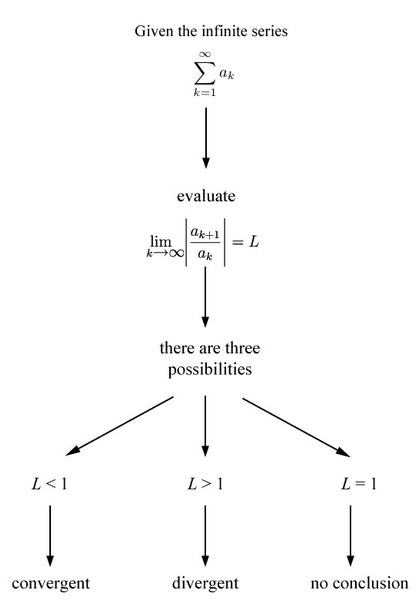
Here’s what the value of LL tells you:

  • If L<1L < 1 → the series converges absolutely
  • If L>1L > 1 (or L=∞L = \infty) → the series diverges
  • If L=1L = 1 → the test is inconclusive

Why this works: you’re checking how each term compares to the one before it.
If the terms are shrinking by a consistent factor less than 1, the series behaves like a geometric series with ∣r∣<1|r| < 1, which converges.

The diagram below summarizes the full decision process.
Study guide illustration

Ratio Test decision flowchart

How to Apply the Ratio Test

When you actually do one of these, the algebra matters.

  1. Write ana_n clearly.
    For example, if the series is ∑3nn!\sum \frac{3^n}{n!}, then
    an=3nn!a_n = \frac{3^n}{n!}.

  2. Find an+1a_{n+1} by replacing every nn with n+1n+1.
    Be careful inside exponents and factorials.

  3. Form the ratio
    an+1an \frac{a_{n+1}}{a_n}

  4. Simplify completely before taking the limit.
    This is where most of the magic happens:

    • (n+1)!=(n+1)n!(n+1)! = (n+1)n!
    • cn+1=c⋅cnc^{n+1} = c \cdot c^n

    For the example above:

    an+1an=3n+1(n+1)!3nn!=3n+1(n+1)!⋅n!3n=3n+1. \frac{a_{n+1}}{a_n} = \frac{\frac{3^{n+1}}{(n+1)!}}{\frac{3^n}{n!}} = \frac{3^{n+1}}{(n+1)!} \cdot \frac{n!}{3^n} = \frac{3}{n+1}.

  5. Take the limit as n→∞n \to \infty
    lim⁡n→∞3n+1=0. \lim_{n\to\infty} \frac{3}{n+1} = 0.

Since 0<10 < 1, the series converges absolutely.

Notice how everything canceled cleanly. That’s a sign you picked the right test.

When the Ratio Test Is the Best Choice

You should think “Ratio Test” almost automatically when you see:

  • Factorials like n!n!
  • Exponentials like 5n5^n, (−2)n(-2)^n
  • Expressions raised to the nnth power, such as (2n3n+1)n(\frac{2n}{3n+1})^n
  • Combinations of factorials and exponentials

The reason is growth rates:

Factorials grow faster than exponentials, which grow faster than polynomials. \text{Factorials grow faster than exponentials, which grow faster than polynomials.}

That growth behavior is exactly what the ratio compares.

For example, if an=n!4na_n = \frac{n!}{4^n}, the ratio becomes

an+1an=(n+1)!4n+1⋅4nn!=n+14. \frac{a_{n+1}}{a_n} = \frac{(n+1)!}{4^{n+1}} \cdot \frac{4^n}{n!} = \frac{n+1}{4}.

As n→∞n \to \infty, this goes to infinity. Since L>1L > 1, the series diverges.

You can see the factorial in the numerator eventually “wins.”

What If L = 1

If
lim⁡n→∞∣an+1an∣=1, \lim_{n\to\infty} \left| \frac{a_{n+1}}{a_n} \right| = 1, the Ratio Test gives you no information.

This often happens with:

  • Rational expressions like n+2n2+1\frac{n+2}{n^2+1}
  • p-series forms
  • Polynomial over polynomial terms

In those cases, switch to another test from Unit 10 such as comparison, limit comparison, integral test, alternating series test, or the nth-term test for divergence.

On an FRQ, it’s completely correct to write that the Ratio Test is inconclusive and then move on.

Common Mistakes

  • Forgetting the absolute value.
  • Plugging into the limit before simplifying.
  • Making errors when finding an+1a_{n+1}.
  • Not canceling factorials fully.
  • Saying “converges” instead of “converges absolutely.”

On multiple choice, the trap answer is often based on a tiny algebra mistake in the ratio. Slow down during simplification.

Key Takeaways

The Ratio Test uses L=lim⁡n→∞∣an+1an∣L = \lim_{n\to\infty} \left| \frac{a_{n+1}}{a_n} \right| to compare consecutive terms.
If L<1L < 1, the series converges absolutely; if L>1L > 1, it diverges; if L=1L = 1, the test is inconclusive.
Factorials and expressions raised to the nnth power almost always signal the Ratio Test.
Simplify the ratio completely before taking the limit.
Always include absolute value and state “converges absolutely” when L<1L < 1.

AP® is a trademark registered by the College Board, which is not affiliated with, and does not endorse this website.

Notes

1 credit used · 5/5 remaining