Topic 8.11 Notes – Volume with Washer Method: Revolving Around the x- or y-Axis
The Washer Method for Volumes of Revolution
When you rotate a region between two curves around an axis, each cross-section perpendicular to that axis looks like a washer.
A washer is a circle with a smaller circle removed.
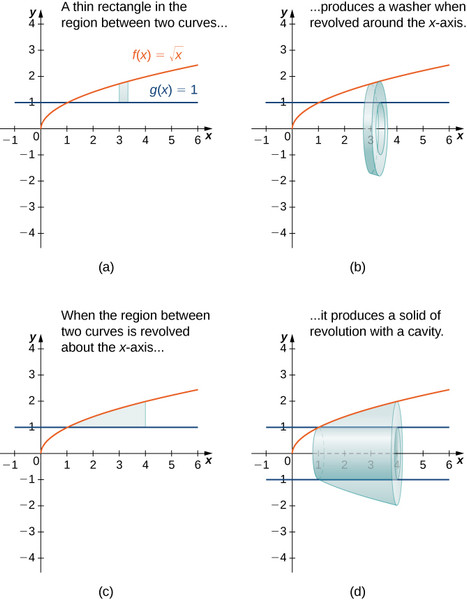
The diagram above shows a region between two curves being revolved about the x-axis. A thin vertical slice turns into a washer with a hole, and all those washers stack to form a solid with a cavity.
The area of one washer is:
- R = outer radius (farther from the axis)
- r = inner radius (closer to the axis)
To turn area into volume, we integrate:
If there’s no hole (so ), this becomes the disk method.
This connects directly to the big idea of Unit 8: definite integrals accumulate cross-sectional area into volume.
Outer and Inner Radius
The most important phrase in this whole topic:
Radius = distance to the axis of rotation
Not “top minus bottom.” Not “bigger function.”
Distance to the axis.
Rotating Around the x-axis
You usually use vertical slices and integrate with respect to .
If the axis is :
- = upper function
- = lower function
Volume:
If rotating around , then radii become:
You must subtract the axis.
Rotating Around the y-axis
Now you use horizontal slices and integrate with respect to .
You may need to rewrite equations as .
Again, radii are distances to the axis.
Seeing Outer vs Inner Clearly
Here’s a simple example of a region rotated around the x-axis.
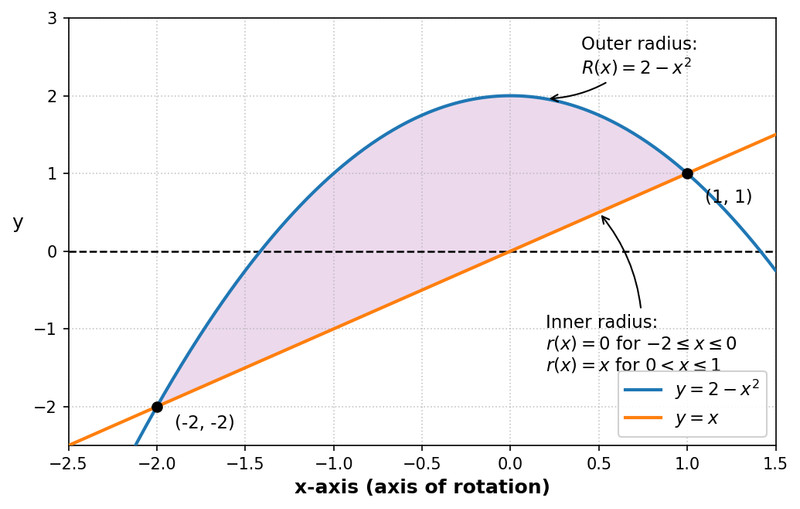
Region between and rotated about the x-axis
In this graph, the axis of rotation is the x-axis. On the interval shown, is farther from the x-axis than , so it forms the outer radius. The line is closer to the axis, so it forms the inner radius.
If we rotated around , the outer function could change because the distances would change.
Always think in terms of distance from the axis.
How to Set Up a Washer Problem
When this shows up on a quiz or FRQ, the setup is where most points are earned.
- Sketch the region and axis.
- Find intersection points for bounds.
- Decide outer and inner by comparing distances to the axis.
- Write radii carefully (include subtraction from axis if needed).
- Set up .
- Integrate and evaluate.
On calculator-active problems, bounds may require numerical solving.
Square First, Then Subtract
This is the mistake I see every year:
Correct:
Incorrect:
Example: if and ,
Correct area:
Wrong method gives:
You square each radius before subtracting. Order matters.
When the Washer Method Is the Right Choice
Use washers when:
- The region is between two curves, and
- Rotating creates a hole.
If the region touches the axis, use disks instead.
On the AP exam, they often expect you to choose between disk, washer, or shell. Washer is natural when slices perpendicular to the axis produce rings.
Common Mistakes That Cost Points
- Forgetting to subtract the axis (especially when it’s not or ).
- Choosing outer based on “top” instead of distance.
- Mixing and .
- Getting a negative answer because outer and inner were swapped.
If volume comes out negative, something is reversed.
