Topic 8.13 Notes – The Arc Length of a Smooth, Planar Curve and Distance Traveled
1. Arc Length of a Smooth Planar Curve
Suppose you have a function with a continuous derivative on . The arc length from to is
Here’s where that expression comes from.
Over a tiny horizontal change , the curve forms a small right triangle:
- Horizontal leg:
- Vertical leg:
- Hypotenuse ≈ tiny piece of arc length
By the Pythagorean Theorem:
Add up all those tiny pieces with an integral.
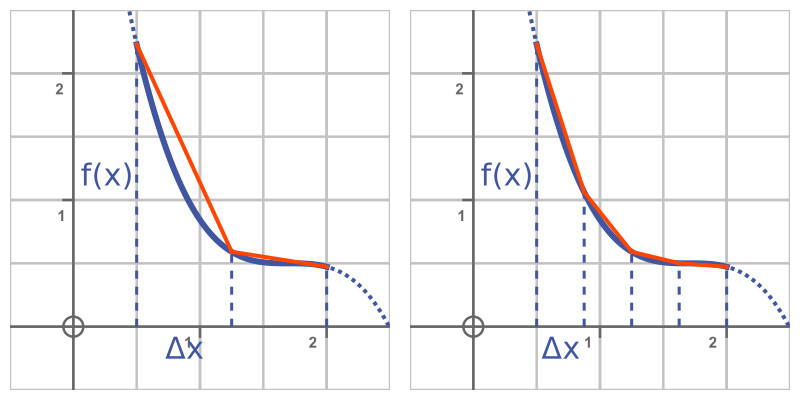
Polygonal approximations to a curve’s arc length
In the diagrams, the orange line segments approximate the curve over small intervals of . Using more and smaller segments makes the approximation closer to the true arc length.
A few things to notice:
- The integrand is always ≥ 1.
- Arc length is always nonnegative.
- The function must be smooth so the derivative exists and doesn’t jump.
2. Determining Length with a Definite Integral
This is another example of accumulation. Just like area adds up rectangles, arc length adds up tiny diagonal segments.
When the curve is given as :
- Compute .
- Square it.
- Add 1.
- Take the square root.
- Integrate over the interval.
Quick example so you see it in action:
Find the arc length of from 0 to 1.
- Plug into formula:
That integral requires a trig substitution. On a calculator-active question, you’d evaluate numerically. On a no-calculator question, sometimes it simplifies nicely, but often the setup is the main goal.
On FRQs, a correct setup with the right integrand earns most of the credit even if the integral is messy.
3. Distance Traveled
Now connect this to motion.
If an object moves along a curve , the distance traveled along the path from to is exactly the arc length.
In one dimension, if position is , then velocity is . Distance traveled from to is
That absolute value matters because distance counts all movement, even if velocity is negative.
Displacement vs Distance
| Quantity | Formula | Can be Negative? | What It Means |
|---|---|---|---|
| Displacement | Yes | Net change in position | |
| Distance Traveled | No | Total ground covered |
Here is a concrete example. The particle starts at 0, moves right to 3, then turns around and ends at 1.
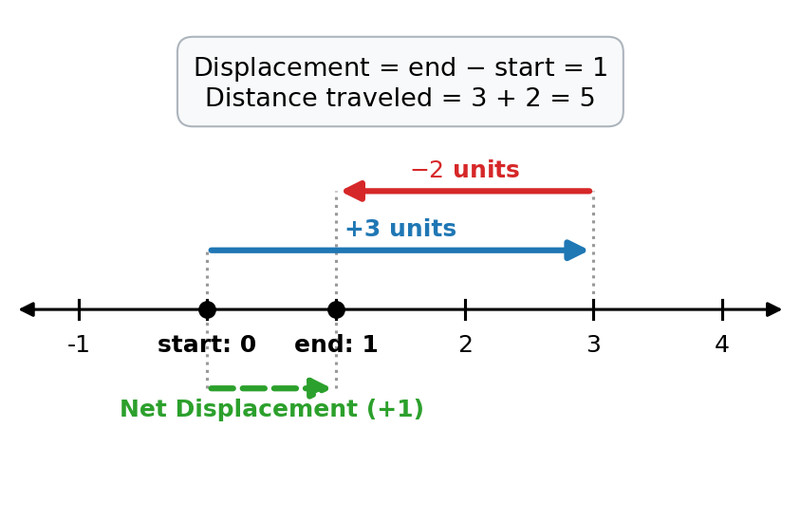
Displacement is end minus start, which is . Distance traveled is . Same motion, two very different answers.
Students lose points when they forget the absolute value and accidentally compute displacement instead of distance.
If velocity changes sign, you must either:
- Use absolute value, or
- Split the integral at where .
4. Common Errors to Avoid
These show up every year:
- Writing instead of .
- Forgetting the square root entirely.
- Using wrong bounds.
- Trying to compute straight-line distance between endpoints instead of arc length.
- Expecting the integral to be easy. Many arc length integrals are not elementary.
If the question says “length of the curve” or “distance along the path,” your brain should immediately think of
.
