Topic 2.2 Notes – Defining the Derivative of a Function and Using Derivative Notation
1. The Derivative as a Limit
You already know the average rate of change on an interval :
That fraction is called the difference quotient. Geometrically, it’s the slope of a secant line through two points on the graph.
To get the instantaneous rate of change, we shrink the interval:
This limit, if it exists, defines the derivative.
Key ideas to lock in:
- The derivative is a function.
- gives the slope of the tangent line at each .
- If the limit does not exist, the function is not differentiable at that point.
Here’s the geometry behind it. The graph below shows a curve (like ) with a secant line through two points and the tangent line at one of them.
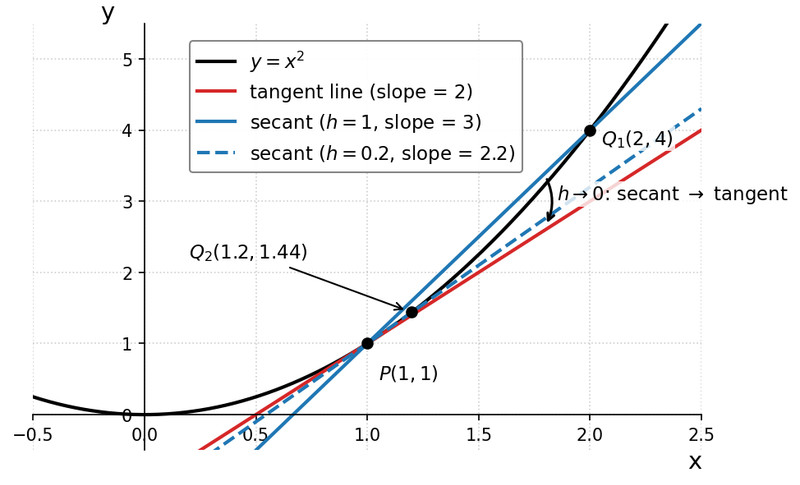
Secant lines approaching a tangent line as
As , the secant line becomes the tangent line. That visual connection is the entire reason the limit definition matters.
2. Derivative Notation
If , all of these mean the same thing:
They just emphasize different viewpoints:
- : derivative as a function
- : a number (the slope at )
- : rate language, “change in with respect to ”
On quizzes and the AP exam, notation switches constantly. If a problem says “find ,” it’s not a different task. It’s the derivative.
3. Using the Limit Definition to Find the Derivative
If a problem says “use the definition,” you must start with the limit. No shortcuts.
The Process
- Write
- Carefully compute . This is where most mistakes happen.
- Expand completely.
- Combine like terms.
- Factor out from the numerator.
- Cancel the .
- Take the limit by plugging in .
If the doesn’t cancel, check your algebra.
Quick Example
Let .
- Expand:
- Subtract , simplify:
- Factor:
- Cancel , take the limit:
This process shows up often on no-calculator multiple choice because it tests algebra control.
4. Tangent Lines
The derivative at a point gives the slope of the tangent line:
To find the equation of the tangent line at :
- Find .
- Compute .
- Use point-slope form:
Example:
If and you want the tangent line at :
- Point is
Tangent line:
On FRQs, missing point-slope form or using the wrong point is a common way students lose easy points.
If the graph has a corner, cusp, vertical tangent, or discontinuity, the derivative does not exist there.
5. Multiple Representations of the Derivative
You need to recognize derivatives in four forms.
Graphical
- Positive derivative → function increasing
- Negative derivative → decreasing
- Zero derivative → horizontal tangent
Numerical
Estimate with small difference quotients:
Smaller intervals give better approximations.
Analytical
Using the limit definition to produce a formula for .
Verbal
Interpreting meaning in context:
- “The rate at which water depth is rising at time .”
- “Instantaneous velocity.”
The AP exam loves switching between these without warning. If you truly understand the derivative, the representation doesn’t matter.
