Topic 1.5 Notes – Determining Limits Using Algebraic Properties of Limits
The Algebraic Properties of Limits
Suppose
When those limits exist, you can treat them like numbers.
Limit Theorems
- Sum Rule
- Difference Rule
- Constant Multiple Rule
- Product Rule
- Quotient Rule (as long as )
- Power Rule (positive integers )
- Root Rule
The big idea: limits distribute across algebraic operations.
If each piece has a limit, the whole expression usually does too.
Direct Substitution and When It Works
Most of the time in this topic, you’ll just plug in .
Direct substitution works immediately for:
- Polynomials
- Rational functions where the denominator is not zero at
- Expressions built from sums, products, powers, and roots of “nice” functions
Example:
Just plug in:
No tricks. Polynomials are continuous everywhere, so substitution works.
Rational Example
Plug in:
The denominator isn’t zero, so the quotient rule applies cleanly.
If plugging in gives you a denominator of 0, you cannot use the quotient rule directly. That’s when later techniques (factoring, conjugates, etc.) come in.
Constant Functions
If there’s no variable, nothing changes.
The limit of a constant is just the constant.
One-Sided Limits and Algebra
A one-sided limit means approach from only one direction:
- from the left
- from the right
If the expression is purely algebraic and defined at , substitution gives the same value from both sides.
You need to think more carefully when:
- The function is piecewise
- The denominator becomes zero
- There’s behavior that depends on direction
Here’s a simple visual reminder of what left and right mean. In the graph, approaches 7 from both sides, and approaches 8 even though there is an open circle at that point.
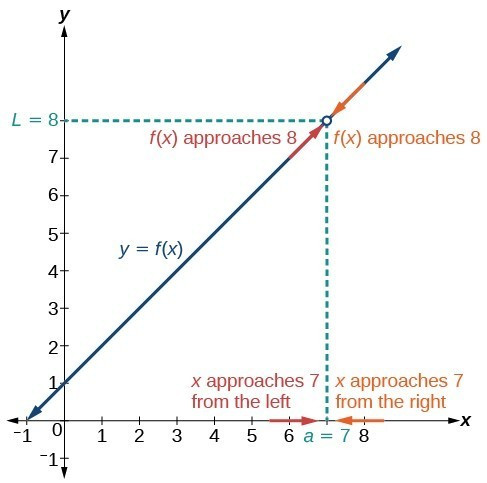
Left- and right-hand limits approaching the same value
A two-sided limit exists only if the left-hand and right-hand limits are equal. If they don’t match, the limit is DNE.
On FRQs, if they ask for a one-sided limit, make sure you’re using the correct piece of a piecewise function.
Limits of Composite Functions
Limits also work inside other functions.
If
and the outside function is continuous at , then
In practice:
- Find the inside limit.
- Plug that result into the outside function.
Example:
First evaluate inside:
Then apply the root:
Same idea with exponents:
Inside limit: .
So the whole limit becomes .
The structure is always “inside first, then outside.”
Common Mistakes That Cost Points
- Using the quotient rule when the denominator’s limit is 0. The rule requires the denominator limit to be nonzero.
- Raising to a power before evaluating the inside limit. Evaluate the inside first.
- Forgetting that a two-sided limit requires matching one-sided limits.
- Doing extra algebra when substitution works immediately.
On multiple-choice, these often show up as tempting wrong answers. If plugging in works cleanly, trust it.
