Topic 8.12 Notes – Volume with Washer Method: Revolving Around Other Axes
1. Washer Method Around a Horizontal or Vertical Line
When you rotate a region and there’s empty space between the region and the axis, you get washers.
Picture a slice perpendicular to the axis. In the example below, the region is revolved around the vertical line , creating ring-shaped cross sections with an outer and inner radius.
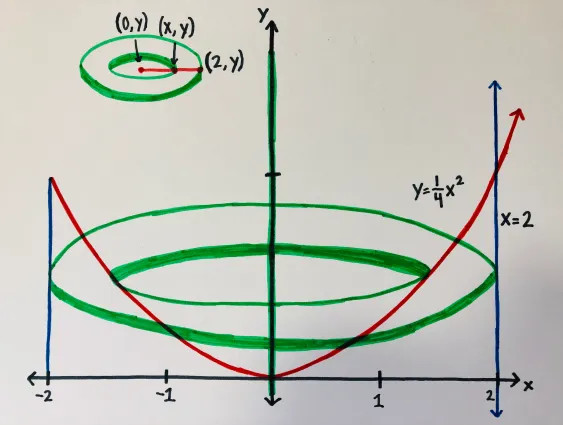
Washer cross sections formed by rotating a region around
The volume comes from adding up areas of these rings:
- = outer radius (farther from axis)
- = inner radius (closer to axis)
- Always outer² − inner²
The radius is always a distance from the curve to the axis of rotation.
Rotating Around a Horizontal Line
- Radii are vertical distances
- Use vertical slices
- Integrate with respect to x
Rotating Around a Vertical Line
- Radii are horizontal distances
- Use horizontal slices
- Integrate with respect to y
Everything comes back to distance from the axis.
2. How to Set Up the Integral Correctly
This is where most points are lost, not in the integration.
Step-by-step setup
-
Sketch the region and axis

Region between and revolved about the line y = 1
In the example shown, the region between and is revolved about the x-axis, producing washers. Seeing the picture makes it clear which curve is farther from the axis.
-
Find intersection points
- Solve where the curves are equal.
- These become your limits of integration.
-
Identify outer and inner radii
- Outer = farther from axis
- Inner = closer to axis
- Write them as distances (include subtracting the axis value).
-
Write the formula
-
Quick check
- Correct variable?
- Outer minus inner?
- Axis subtraction included?
- Bounds match variable?
On FRQs, a wrong setup usually means zero for that part, even if your algebra is perfect.
3. Choosing dx or dy
You slice perpendicular to the axis of rotation.
| Axis of Rotation | Slice Direction | Integrate With |
|---|---|---|
| Horizontal | Vertical slices | |
| Vertical | Horizontal slices |
If rotating around a vertical line and your functions are given as , you may need to rewrite them as . That rewrite is often the hint that you should be integrating with respect to .
On no-calculator sections, clean variable choice makes a huge difference.
4. Special Structures You Should Recognize
Rotating Around the x- or y-Axis
That just means or .
Example: rotating around gives .
Still subtract the axis, even if it’s zero.
Rotating Around a Line Above or Below
If rotating around , then:
Subtracting a negative becomes addition. This is one of the most common sign mistakes on quizzes.
Disc Case (No Hole)
If the region touches the axis, then:
So volume simplifies to:
Same method. Just no inner radius.
5. Common Mistakes
- Writing instead of
- Forgetting to subtract the axis value
- Choosing “top” and “bottom” instead of checking distance from the axis
- Using the wrong variable (dx vs dy)
- Getting negative volume because radii were reversed
If your integrand is negative before integrating, something is wrong.
