Topic 5.4 Notes – Using the First Derivative Test to Determine Relative (Local) Extrema
What the First Derivative Test Says
Remember:
- If , the function is increasing.
- If , the function is decreasing.
A local extremum happens when the function switches direction.
The First Derivative Test focuses on what happens to the sign of around a critical point.
A critical point is where:
- , or
- does not exist (but is defined).
Here’s the core idea:
- changes positive → negative → local maximum
- changes negative → positive → local minimum
- No sign change → no local extremum
You are not just checking if the derivative is zero. You are checking whether the function changes from increasing to decreasing or vice versa.
The Process in Action
When you’re given a formula and asked for relative extrema, the work follows a clear pattern.
1. Differentiate
Find .
2. Find critical points
Solve .
Also check where is undefined.
These are the only possible locations of local extrema.
3. Make a sign chart
Place the critical points on a number line. Then test one value in each interval to determine the sign of .
A typical sign chart looks like this:
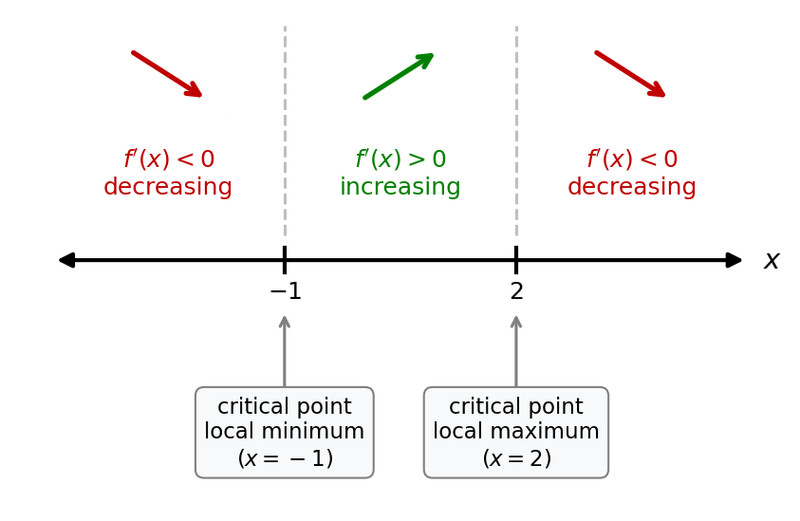
Sign chart showing local minimum at x = −1 and local maximum at x = 2
From this chart:
- At : negative → positive → local minimum
- At : positive → negative → local maximum
That sign change is your justification.
On FRQs, graders want to see wording like:
“Since changes from positive to negative at , has a local maximum at .”
Multiplicity and Factored Derivatives
If is factored, you can predict sign changes without plugging in tons of numbers.
Example structure:
Two rules save time:
- Odd power factor → sign changes at that zero
- Even power factor → sign does not change
So here:
- (power 2) → no sign change → not an extremum
- (power 1) → sign changes → extremum
This shows up a lot in multiple choice. If you ignore multiplicity, you’ll misclassify points.
Special Situations
Derivative equals zero but no extremum
If the derivative is zero and the sign does not change, the graph flattens but keeps moving in the same direction.
That gives a horizontal tangent, not a max or min.
A classic example is at :

with a horizontal tangent at (0,0)
Derivative undefined
If does not exist, still test the sign on both sides.
Corners and cusps can be local extrema if the sign changes.
What This Test Does and Does Not Do
The First Derivative Test finds local extrema only.
It does not guarantee absolute extrema unless you also check endpoints on a closed interval. That’s a different process from earlier in Unit 5.
This topic is about justifying behavior using derivatives. You are connecting:
- sign of derivative
- increasing/decreasing behavior
- existence of turning points
That chain of reasoning is what the AP exam cares about.
