6m left·0%
Reading Time: 6 min
Last Updated: March 10, 2026
Main Ideas: 5
Reading Time: 6 min
Last Updated: March 10, 2026
Main Ideas: 5

Topic 6.8 Notes – Finding Antiderivatives and Indefinite Integrals: Basic Rules and Notation

Verified for 2027 AP® Calculus BC Exam
Read aloud
You define what an antiderivative is, learn the notation for indefinite integrals, and use the derivative rules you already know to build basic integration rules. This is all about pattern recognition and clean algebra.

1. What an Antiderivative and Indefinite Integral Are

An antiderivative of f(x) f(x) is a function F(x) F(x) such that

F′(x)=f(x). F'(x) = f(x).

If you differentiate F F , you get back f f . That’s the entire idea.

When we write

∫f(x) dx=F(x)+C \int f(x)\,dx = F(x) + C

we’re writing an indefinite integral, which represents the entire family of antiderivatives of f f .

Why the +C is required

If F′(x)=f(x) F'(x) = f(x) , then

(F(x)+C)′=f(x) (F(x) + C)' = f(x)

for any constant C C , because the derivative of a constant is 0.

So:

  • All antiderivatives of a function differ by a constant.
  • No bounds means you must include +C +C .
  • Definite integrals (with limits) do not include +C +C .

Big idea

Finding an antiderivative is asking:

What function has this as its derivative?

That’s it. Everything here comes from derivative rules you already know.

2. Core Rules for Finding Antiderivatives

These are just reversed derivative rules.

Reverse Power Rule

For n≠−1 n \ne -1 ,

∫xn dx=xn+1n+1+C \int x^n \, dx = \frac{x^{n+1}}{n+1} + C

You:

  1. Add 1 to the exponent.
  2. Divide by the new exponent.

Does not work for n=−1 n = -1 .

Examples of rewriting first:

  • 1x3=x−3 \frac{1}{x^3} = x^{-3}
  • x=x1/2 \sqrt{x} = x^{1/2}

Constant Multiple Rule

∫c f(x) dx=c∫f(x) dx \int c\,f(x)\,dx = c \int f(x)\,dx

Pull constants completely outside before integrating.

Sum and Difference Rule

∫[f(x)±g(x)] dx=∫f(x) dx±∫g(x) dx \int [f(x) \pm g(x)]\,dx = \int f(x)\,dx \pm \int g(x)\,dx

You integrate term-by-term. This is huge on both quizzes and the AP exam.

Special Antiderivatives You Must Know

These are straight memorization.

Exponential

  • ∫exdx=ex+C \int e^x dx = e^x + C

Logarithmic

  • ∫1xdx=ln⁡∣x∣+C \int \frac{1}{x} dx = \ln |x| + C
    The absolute value matters.

Basic Trig

  • ∫cos⁡x dx=sin⁡x+C \int \cos x\,dx = \sin x + C
  • ∫sin⁡x dx=−cos⁡x+C \int \sin x\,dx = -\cos x + C
  • ∫sec⁡2x dx=tan⁡x+C \int \sec^2 x\,dx = \tan x + C
  • ∫csc⁡2x dx=−cot⁡x+C \int \csc^2 x\,dx = -\cot x + C
  • ∫sec⁡xtan⁡x dx=sec⁡x+C \int \sec x \tan x\,dx = \sec x + C
  • ∫csc⁡xcot⁡x dx=−csc⁡x+C \int \csc x \cot x\,dx = -\csc x + C

Inverse Trig Forms

  • ∫11+x2dx=tan⁡−1x+C \int \frac{1}{1+x^2} dx = \tan^{-1} x + C
  • ∫11−x2dx=sin⁡−1x+C \int \frac{1}{\sqrt{1-x^2}} dx = \sin^{-1} x + C

These often show up exactly in this form on multiple choice.

3. How to Actually Do the Process

When you see something like

∫(4x3−5x2+6)dx \int \left(4x^3 - \frac{5}{x^2} + 6\right) dx

Here’s the thought process:

  1. Rewrite:
    5x2=5x−2 \frac{5}{x^2} = 5x^{-2}

  2. Separate:

    ∫4x3dx−∫5x−2dx+∫6dx \int 4x^3 dx - \int 5x^{-2} dx + \int 6 dx

  3. Pull constants:

    4∫x3dx−5∫x−2dx+6∫dx 4\int x^3 dx - 5\int x^{-2} dx + 6\int dx

  4. Apply reverse power rule:

    • 4⋅x44 4 \cdot \frac{x^4}{4}
    • −5⋅x−1−1 -5 \cdot \frac{x^{-1}}{-1}
    • 6x 6x
  5. Clean up and add one +C +C :

x4+5x−1+6x+C x^4 + 5x^{-1} + 6x + C

Only one +C +C at the end.

4. When Basic Rules Work and When They Don’t

These rules work smoothly when:

  • You have polynomials.
  • You have sums of powers.
  • The integrand matches a memorized trig/exponential form.
  • It simplifies into one of those.

They do not work when:

  • You see a product like xcos⁡x x\cos x .
  • You see a messy quotient.
  • There’s a composition like sin⁡(4x) \sin(4x) . That requires substitution, which is next topic.

Important BC idea

Many functions do not have closed-form antiderivatives using elementary functions.

A classic example is

∫e−x2dx \int e^{-x^2} dx

The graph of y=e−x2 y = e^{-x^2} is the familiar bell-shaped curve centered at 0.
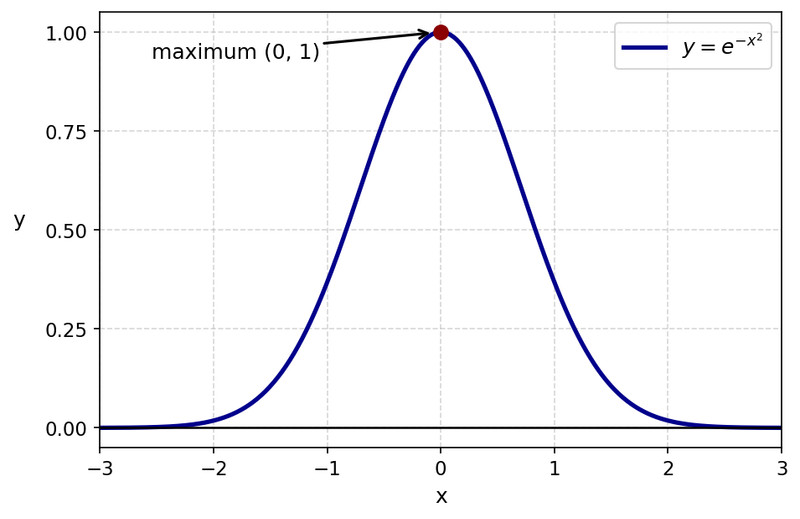
Graph of y=e−x2 y = e^{-x^2}

There’s no simple expression for its antiderivative using polynomials, trig, logs, or exponentials.

On the AP exam, if basic rules don’t apply and no other method has been taught yet, the answer may legitimately stay in integral form.

5. Common Mistakes

  • Forgetting +C +C on indefinite integrals.
  • Using the power rule on 1x \frac{1}{x} instead of switching to ln⁡∣x∣ \ln |x| .
  • Forgetting absolute value in ln⁡∣x∣ \ln |x| .
  • Dividing by the original exponent instead of the new one.
  • Adding multiple +C +C ’s.
  • Trying to split products using the sum rule. You can’t.

Key Takeaways

An indefinite integral represents a family of functions, so always write +C +C .
The reverse power rule is ∫xndx=xn+1n+1+C \int x^n dx = \frac{x^{n+1}}{n+1} + C for n≠−1 n \ne -1 .
∫1xdx=ln⁡∣x∣+C \int \frac{1}{x} dx = \ln |x| + C is the exception to the power rule.
Integration rules here come directly from derivative rules you already know.
Some functions, like e−x2 e^{-x^2} , do not have elementary antiderivatives.

AP® is a trademark registered by the College Board, which is not affiliated with, and does not endorse this website.

Notes

1 credit used · 5/5 remaining