Topic 8.8 Notes – Volumes with Cross Sections: Triangles and Semicircles
Volumes from known cross sections
If a solid has a base region in the plane and every slice perpendicular to an axis has a known shape, its volume comes from accumulation:
- is the area of one cross section at position
- are the bounds of the base region
- is the tiny thickness
So the whole problem becomes this:
- Express the length that determines the shape.
- Write the area formula using that length.
- Integrate.
If slices are perpendicular to the x-axis, integrate with respect to x.
Perpendicular to the y-axis, integrate with respect to y.
Here’s the picture you should have in your head. A plane slices through the solid, and each slice has a consistent shape:

Vertical cross section of a solid
The vertical segment in the base becomes the side or diameter of your cross section.
Triangular cross sections
Everything depends on the side length of the triangle, which usually equals the distance between curves.
If the base is bounded by (top) and (bottom), then
Equilateral triangles
Area formula:
So if ,
The square applies to the entire difference.
Right isosceles triangles
Area formula:
Here is one of the equal legs. Most AP problems define the leg as the vertical distance between curves.
Same structure. Different constant.
On FRQs, most mistakes happen before the integral even starts. If the area expression is wrong, the rest collapses.
Semicircular cross sections
For a semicircle:
The distance between curves usually gives the diameter, not the radius.
If
then
Substitute carefully:
After simplifying, this becomes
That shows up constantly. If you’re missing the 8, you forgot to halve the diameter.
Picture a solid whose slices perpendicular to the -axis are semicircles. Each vertical slice has diameter , which determines the area formula above.
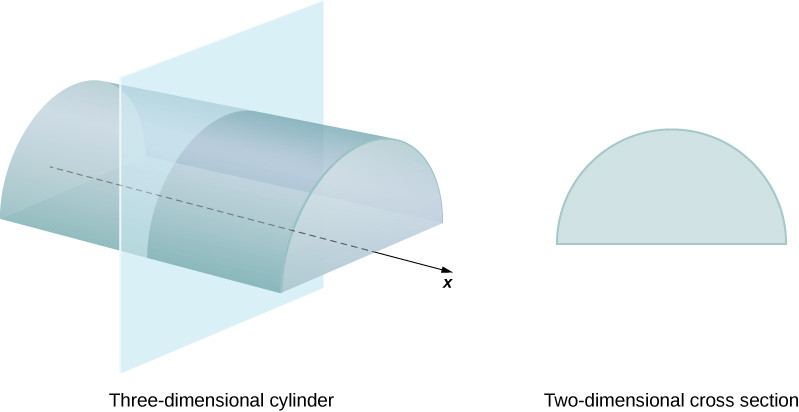
Solid with semicircular cross sections
Setting up the integral
When given two curves and a cross section type, your flow should feel automatic:
- Find intersection points by setting the curves equal. Those are your bounds.
- Determine whether slices are vertical or horizontal.
- Write the length as top minus bottom or right minus left.
- Plug into the correct area formula.
- Integrate.
Sometimes the problem skips geometry and gives you directly. Then you just compute
This showed up on past free-response questions where the cross-sectional area was defined by a function instead of a named shape.
You may also see full circular cross sections, like modeling a funnel. Then use and express in terms of the base variable.
Common traps
- Squaring only one function instead of the whole difference
- Forgetting radius is half the diameter
- Mixing up which curve is on top
- Integrating with respect to the wrong variable
On no-calculator sections, algebra mistakes are the biggest time drain. Simplify before integrating when possible.
