4m left·0%
Reading Time: 4 min
Last Updated: March 20, 2026
Main Ideas: 5
Reading Time: 4 min
Last Updated: March 20, 2026
Main Ideas: 5

Topic 9.5 Notes – Integrating Vector-Valued Functions

Verified for 2027 AP® Calculus BC Exam
Read aloud
Studies how to integrate vector-valued functions to recover velocity or position from a given rate. You’ll use the same integration rules you already know, but apply them component by component. Most questions ask you to find a particular position function using initial conditions.

What Integrating a Vector-Valued Function Means

A vector-valued function describes motion in the plane or space:

r(t)=⟨x(t),y(t)⟩or⟨x(t),y(t),z(t)⟩ \mathbf{r}(t)=\langle x(t), y(t) \rangle \quad \text{or} \quad \langle x(t), y(t), z(t) \rangle

Think of it as tracking a particle’s coordinates over time.

You already know:

  • Velocity: v(t)=r′(t)\mathbf{v}(t)=\mathbf{r}'(t)
  • Acceleration: a(t)=v′(t)=r′′(t)\mathbf{a}(t)=\mathbf{v}'(t)=\mathbf{r}''(t)

Integration moves you backward through that chain:

  • Integrate acceleration → get velocity
  • Integrate velocity → get position

The key fact:

∫v(t) dt=⟨∫vx(t) dt,  ∫vy(t) dt,  ∫vz(t) dt⟩ \int \mathbf{v}(t)\,dt = \left\langle \int v_x(t)\,dt,\; \int v_y(t)\,dt,\; \int v_z(t)\,dt \right\rangle

You integrate each component separately. Nothing fancy beyond that.

Indefinite and Definite Integrals of Vectors

Indefinite Integrals

If
v(t)=⟨f(t),g(t)⟩\mathbf{v}(t)=\langle f(t), g(t) \rangle,

then

∫v(t) dt=⟨∫f(t) dt,  ∫g(t) dt⟩ \int \mathbf{v}(t)\,dt = \langle \int f(t)\,dt,\; \int g(t)\,dt \rangle

Each component gets its own constant:

r(t)=⟨F(t)+C1,  G(t)+C2⟩ \mathbf{r}(t)=\langle F(t)+C_1,\; G(t)+C_2 \rangle

In 3D, you’ll have three constants.

Students often forget this and write just one CC. On a free-response question, that costs points.

Definite Integrals

∫abv(t) dt=⟨∫abvx(t) dt,  ∫abvy(t) dt⟩ \int_a^b \mathbf{v}(t)\,dt = \left\langle \int_a^b v_x(t)\,dt,\; \int_a^b v_y(t)\,dt \right\rangle

This represents displacement, meaning:

r(b)−r(a) \mathbf{r}(b)-\mathbf{r}(a)

It tells you the net change in position, not how far the particle traveled.

That distinction shows up a lot on quizzes and the AP exam.

Solving an Initial Value Problem for Motion

This is the main skill for this topic.

You’re typically given:

  • A rate vector (velocity or acceleration)
  • An initial condition like r(0)=⟨2,−1⟩\mathbf{r}(0)=\langle 2,-1\rangle

The Process

  1. Identify what you're given

    • Acceleration → integrate to get velocity.
    • Velocity → integrate to get position.
  2. Integrate component-wise

    • Add constants C1,C2,(C3)C_1, C_2, (C_3).
  3. Use the initial condition

    • Plug in the given time.
    • Solve for each constant separately.
  4. Write the particular solution

    • No constants left.

Quick Example

Suppose
v(t)=⟨4t,cos⁡t⟩\mathbf{v}(t)=\langle 4t, \cos t \rangle
and r(0)=⟨3,2⟩\mathbf{r}(0)=\langle 3,2\rangle.

Integrate:

r(t)=⟨2t2+C1,  sin⁡t+C2⟩ \mathbf{r}(t)=\langle 2t^2 + C_1,\; \sin t + C_2 \rangle

Apply r(0)=⟨3,2⟩\mathbf{r}(0)=\langle 3,2\rangle:

  • 2(0)2+C1=3⇒C1=32(0)^2 + C_1 = 3 \Rightarrow C_1=3
  • sin⁡0+C2=2⇒C2=2\sin 0 + C_2 = 2 \Rightarrow C_2=2

Final answer:

r(t)=⟨2t2+3,  sin⁡t+2⟩ \mathbf{r}(t)=\langle 2t^2 + 3,\; \sin t + 2 \rangle

That’s the complete particular position function.

Position vs Displacement vs Distance

These get mixed up constantly.

Position

r(t)\mathbf{r}(t)
The location at time tt.

Displacement

∫abv(t) dt \int_a^b \mathbf{v}(t)\,dt

A vector from starting point to ending point.

Total Distance Traveled

This uses speed, which is the magnitude of velocity:

∣v(t)∣=(vx)2+(vy)2 |\mathbf{v}(t)|=\sqrt{(v_x)^2+(v_y)^2}

Distance=∫ab∣v(t)∣ dt \text{Distance}=\int_a^b |\mathbf{v}(t)|\,dt

Notice the absolute value bars. That makes it a scalar.

If the problem says “how far,” they usually mean total distance, not displacement.

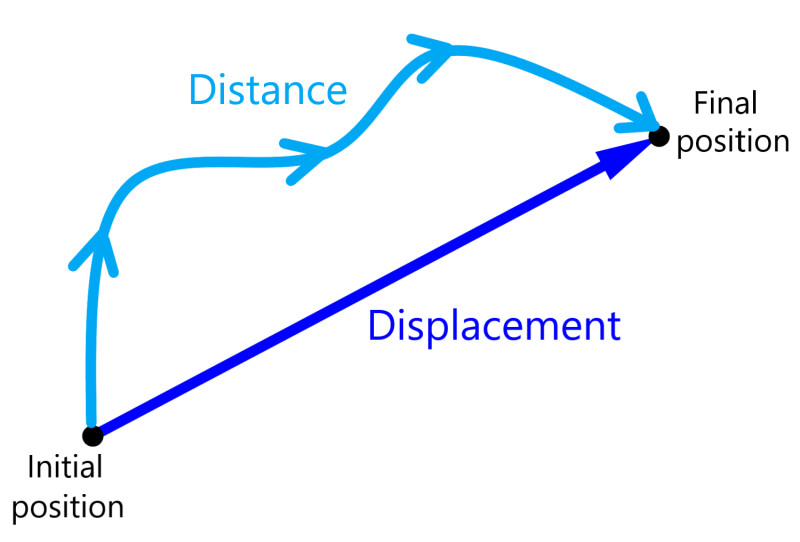
Visualizing the Difference

Here’s the idea geometrically.
Study guide illustration

Distance versus displacement

The curved path length is total distance.
The straight arrow is displacement.

Key Takeaways

Integrate vector-valued functions component by component.
Each component gets its own constant C1,C2,C3C_1, C_2, C_3.
∫abv(t) dt=r(b)−r(a)\int_a^b \mathbf{v}(t)\,dt = \mathbf{r}(b)-\mathbf{r}(a).
Total distance uses ∫∣v(t)∣ dt\int |\mathbf{v}(t)|\,dt, not ∫v(t) dt\int \mathbf{v}(t)\,dt.
Acceleration → integrate twice to get position.
Always apply initial conditions after integrating, not before.

AP® is a trademark registered by the College Board, which is not affiliated with, and does not endorse this website.

Notes

1 credit used · 5/5 remaining