Topic 6.3 Notes – Riemann Sums, Summation Notation, and Definite Integral Notation
What a Riemann Sum Is
A Riemann sum approximates the definite integral, which represents the signed area under a curve on an interval .
You:
- Break into subintervals (a partition).
- Build rectangles on each subinterval.
- Add their areas.
Each rectangle has:
- Width
- Height where is some chosen point in that subinterval (left, right, or anywhere).
The general form is:
That’s literally “add up height × width.”
If the partition is equal:
- A common sample point formula is
Here’s the geometric picture. Focus on how the rectangles use either the left endpoints or the right endpoints to determine height:
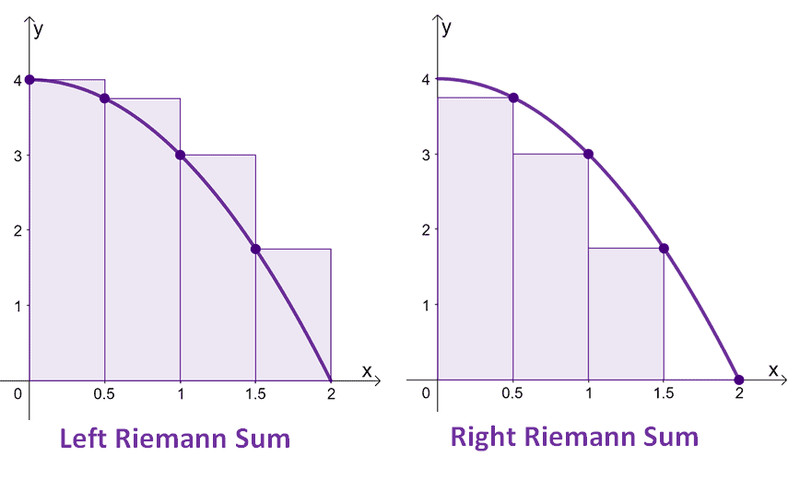
Left and right Riemann sums for a decreasing function
Because the function shown is decreasing, the left-endpoint sum overestimates the area and the right-endpoint sum underestimates it.
With a finite number of rectangles, this is an approximation.
Writing Riemann Sums in Sigma Notation
Sigma notation just makes the repeated addition compact.
Suppose you’re told:
- Interval
- equal subintervals
- Right endpoints
You build it systematically:
Compute width
Write the sample point
Plug into the function and multiply by width:
Left endpoints usually use:
Small detail that matters on tests:
Right sums often run to . Left sums often run to . Don’t mix those.
On quizzes, you’ll either:
- Be asked to write the sum from a function and interval, or
- Be given a sigma expression and asked what integral it represents.
You need to move both directions comfortably.
The Definite Integral as a Limit
Now the key idea.
As the number of rectangles increases, widths shrink and the approximation improves.
When the widths approach 0:
For equal partitions, this becomes:
where .
Geometrically, you can picture the rectangles getting thinner and more numerous, so the jagged approximation hugs the curve more closely:
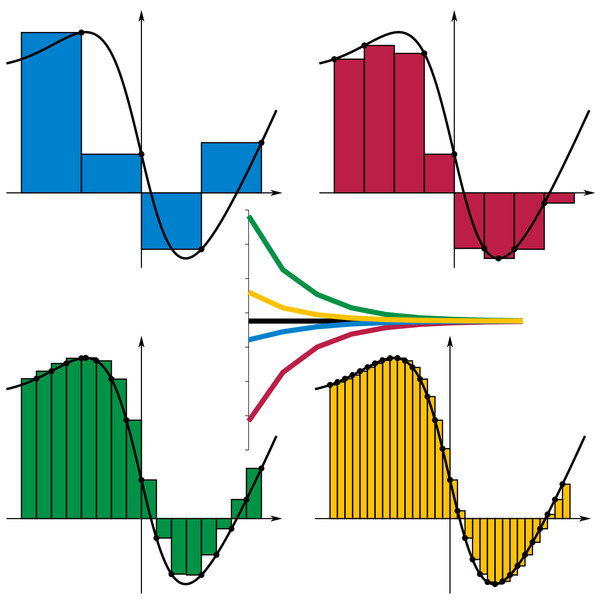
Riemann sums converging to a definite integral
Finite gives an approximation.
Letting gives the exact signed area.
For AP purposes, this works cleanly when is continuous on .
Converting Between Riemann Sums and Definite Integrals
Integral → Limit of a Riemann Sum
Given
Rewrite it as:
Everything must be written in terms of . That’s where students slip.
Limit of a Riemann Sum → Integral
If you see something like:
Notice:
- Lower bound is 2
- So upper bound is
That equals:
AP multiple choice loves disguising the interval inside that expression. Always extract:
- Lower bound
- Width formula
- Upper bound
