Topic 1.2 Notes – Defining Limits and Using Limit Notation
What a Limit Is
When we write
we are saying:
- As gets closer and closer to
- The function values get closer and closer to
- We do not require that
- We do not require that
This is about approach, not plugging in.
A more precise way to think about it:
The limit of as equals if we can make as close to as we want by choosing sufficiently close to (but not equal to ).
You are not required to know the formal epsilon-delta definition for the AP exam, but you should understand the idea of “arbitrarily close.”
Key Clarifications
- does not equal in the limit process.
- The limit depends on values near , not necessarily at .
- The limit must approach a real number to exist in this context.
Limit Notation and One-Sided Limits
The standard notation is:
Read it as:
“the limit of as approaches .”
Sometimes we care about only one direction.
Left-hand limit
This means approaches from values less than .
Right-hand limit
This means approaches from values greater than .
The full limit exists only if:
If those two numbers are different, the limit does not exist (DNE).
On quizzes, teachers love giving piecewise graphs where the two sides don’t match. Always check both sides mentally.
Representing Limits in Different Ways
You need to be comfortable seeing limits analytically, numerically, and graphically. The AP exam moves between these constantly.
Analytical Representation
If the function is something nice like a polynomial, direct substitution usually works.
Example:
Just substitute:
For many functions that are continuous at ,
Later you’ll see cases where substitution gives something like . That does not mean the limit is 0. It means more algebra is needed in the next topic.
Numerical Representation
A table helps you see what the function is approaching.
Suppose you're investigating . You might use:
| x (left of 2) | f(x) | x (right of 2) | f(x) |
|---|---|---|---|
| 1.9 | ? | 2.1 | ? |
| 1.99 | ? | 2.01 | ? |
| 1.999 | ? | 2.001 | ? |
You’re looking for:
- Do the outputs settle toward the same number?
- Are both sides heading to the same value?
If yes → that number is the limit.
If they head to different values → DNE.
Numerical tables show up on calculator sections and occasionally inside FRQs where you must justify what value the function appears to approach.
Graphical Representation
Here’s what a limit looks like on a graph. In this example, focus on what happens as gets close to 1.
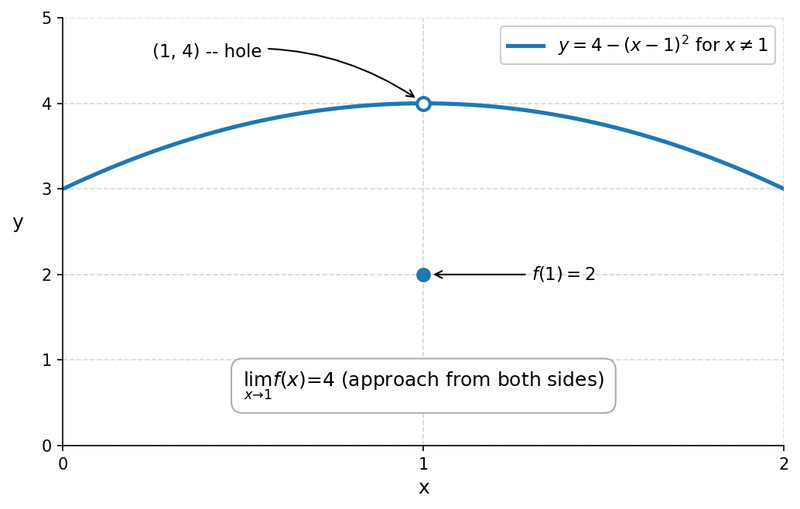
Limit vs. function value at
Notice:
- The curve approaches 4 from both sides.
- There’s a hole at .
- There’s a filled dot at .
So:
This is one of the most common AP tricks. The dot does not determine the limit. The approach determines the limit.
When a Limit Does Not Exist
A limit fails to exist when:
- Left and right limits differ (jump discontinuity)
- The function increases or decreases without bound near
- The function oscillates and never settles toward one value
On multiple choice, if you see a graph with a jump, your brain should immediately think “check left and right.”
