Topic 1.10 Notes – Exploring Types of Discontinuities
What continuity at a point requires
A function is continuous at only if all three of these are true:
- is defined.
- exists.
- .
That’s the definition. On FRQs, you justify continuity by checking these explicitly.
A few reminders about limits:
- The limit exists only if and both are finite numbers.
- If the function heads toward , the limit does not exist as a finite value.
If even one of the three conditions fails, the function is discontinuous at . The type of failure tells you the type of discontinuity.
Removable discontinuity
This happens when the limit exists, but the function value doesn’t match it (or isn’t defined).
So:
- exists
- But either is undefined or
Here’s what that looks like on a graph:
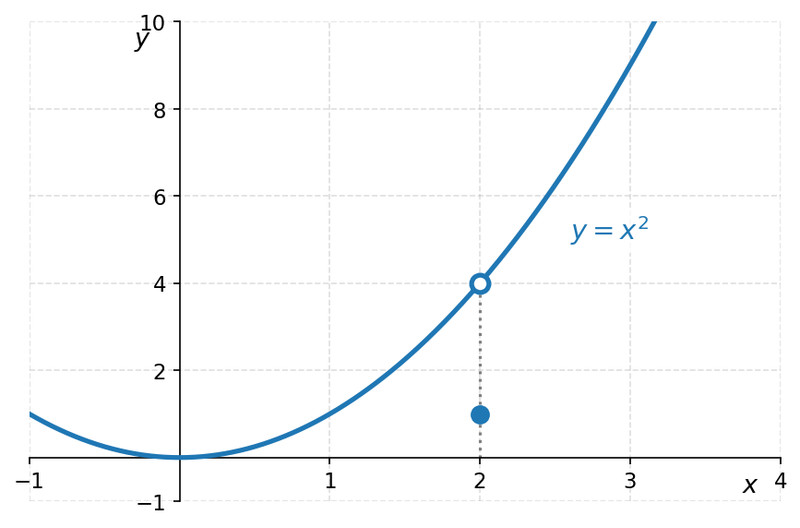
Removable discontinuity at
At , the limit is 4, but the function value is 1. The graph has a hole at the limit value.
Common causes:
- A rational function where a factor cancels, like (after canceling, it behaves like , except at )
- A piecewise function that assigns a different value at one point
It’s called removable because you could redefine to equal the limit and make the function continuous.
Jump discontinuity
This happens when the left- and right-hand limits are different.
That means the limit does not exist.
Look at the piecewise example below.
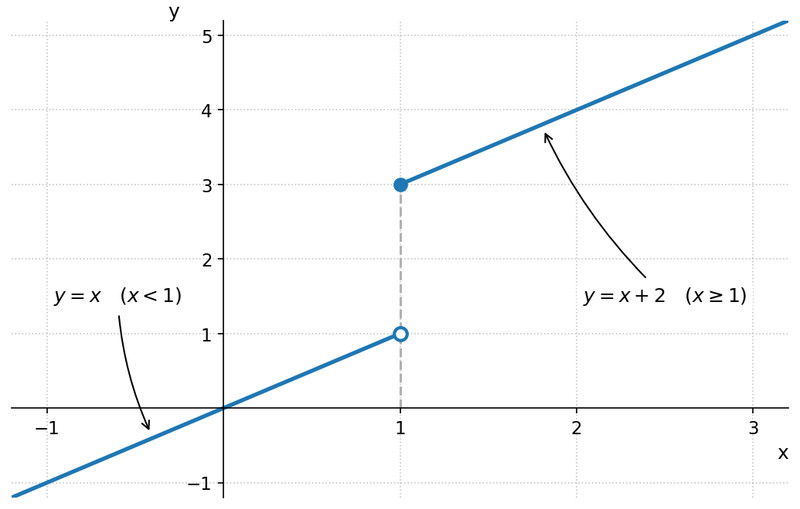
Jump discontinuity at
As , the graph approaches 1. As , it approaches 3. Since those one-sided limits are different, the overall limit does not exist.
There’s a visible vertical gap between the two sides. Even if one of the points is filled in, it doesn’t matter. If the one-sided limits don’t agree, continuity fails at condition 2.
These almost always come from piecewise functions where the formulas don’t line up at the breakpoint.
Discontinuity due to a vertical asymptote
This occurs when at least one one-sided limit approaches infinity.
Examples:
- Both sides approach
- One side → , the other →
Here’s a classic example with a vertical asymptote at :
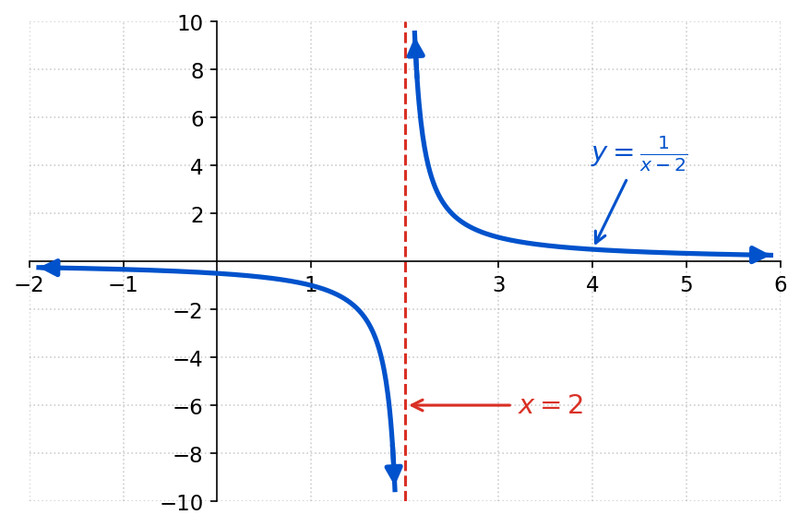
As approaches 2, the graph shoots upward on one side and downward on the other without bound. Because the limit is not finite, condition 2 fails.
Common sources:
- Denominator equals zero and does not cancel
- Logarithmic functions at domain edges
On AP problems, you’ll often detect this algebraically before even graphing.
How to justify continuity on a test
When a question says “justify your answer,” use the definition language.
For continuity:
- State that exists.
- Show left- and right-hand limits are equal.
- Conclude that the limit equals .
For discontinuity:
- Clearly identify which condition fails.
- “The left- and right-hand limits are not equal, so the limit does not exist.”
- “The limit exists, but it does not equal .”
Just saying “there’s a hole” won’t earn full credit. The rubric looks for reasoning from the definition.
