Topic 4.4 Notes – Introduction to Related Rates
What a Related Rates Problem Is
A related rates problem involves:
- Two or more quantities changing over time
- An equation connecting those quantities
- At least one known rate (like )
- One unknown rate you must find
Every variable is a function of time , even if the equation doesn’t show .
For example, if a circle’s radius changes over time, its area also changes over time. The radius and area are related through a formula, so their rates are related through derivatives.
The key idea from earlier units comes back here:
That extra is the chain rule in action. That’s the foundation of this whole topic.
The Core Structure of Every Problem
No matter how wordy the setup is, the structure is always the same.
1. Assign Variables
Define every changing quantity.
If water level is rising, call it .
If a car is moving horizontally, call its distance .
Write what each rate means:
- = rate height changes
- = horizontal speed
Keep units attached. If something is decreasing, its rate is negative.
2. Write an Equation Connecting the Variables
This equation must involve the quantity whose rate you want.
Common sources:
- Geometry formulas
- Pythagorean Theorem
- Volume formulas
- Distance formula
Example relationships you should recognize instantly:
- Circle:
- Sphere:
- Right triangle:
- Rectangle:
Here’s the classic sliding ladder setup. The ladder has fixed length , with bottom distance from the wall and height up the wall.

Sliding ladder forming a right triangle
This gives:
3. Differentiate With Respect to Time
This is where students lose points.
You differentiate both sides with respect to . Even if the equation has no .
Example:
Differentiate:
Both and depend on time. That’s why each term gets a chain rule factor.
You may also need:
- Product rule
- Quotient rule when variables are divided
AP questions absolutely expect you to recognize when those are required.
4. Substitute Numbers After Differentiating
This order matters.
First differentiate symbolically.
Then plug in:
- Given rates
- Given dimensions at that instant
- Any missing variable values (solve for them using the original equation first)
If you plug in too early, you eliminate variables and their rates.
Typical AP Scenarios
You’ll usually see one of these patterns:
Expanding Shapes
Given , find or .
Pure chain rule.
Sliding Triangle Problems
One side increasing, one decreasing.
Expect opposite signs.
Uses Pythagorean Theorem.
Changing Volume
Water filling a tank or balloon inflating.
Often you must rewrite everything in terms of one variable before differentiating.
Distance Between Moving Objects
Two objects moving in perpendicular directions.
Think of two cars on perpendicular roads, with and representing their distances from the intersection and the distance between them.
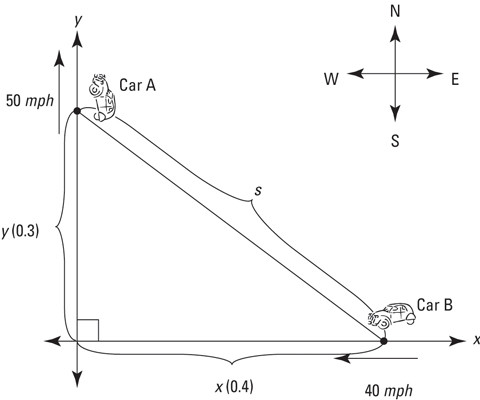
Two cars moving on perpendicular roads
Use:
Then differentiate implicitly.
Common Mistakes That Cost Points
- Treating variables like constants
- Forgetting a chain rule factor
- Missing product/quotient rule
- Substituting before differentiating
- Forgetting units
- Ignoring sign meaning
A negative answer often means “decreasing.” That interpretation matters on free-response questions.
