Topic 4.1 Notes – Interpreting the Meaning of the Derivative in Context
What a derivative means in context
You already know that is the instantaneous rate of change of with respect to . In context, that translates to:
- How fast the output is changing
- At a specific input value
- Measured per unit of the input variable
If
- represents some quantity (population, revenue, volume, temperature, etc.), and
- represents the independent variable (time, distance, years, etc.),
then:
That rule never changes.
Examples of units
- Liters and seconds → liters per second
- Dollars and weeks → dollars per week
- Bacteria and hours → bacteria per hour
If you ever forget what a derivative represents, just think:
“How fast is this quantity changing right now?”
Instantaneous vs average rate of change
Students mix these up constantly, especially on multiple choice.
Here’s the difference clearly:
| Average Rate of Change | Instantaneous Rate of Change |
|---|---|
| Over an interval | At one specific value |
| Uses two points | Uses one point |
| Slope of a secant line | Slope of a tangent line |
In the diagram below, the orange line is the secant line connecting two points on the curve, and the pink line is the tangent line touching the curve at one point.
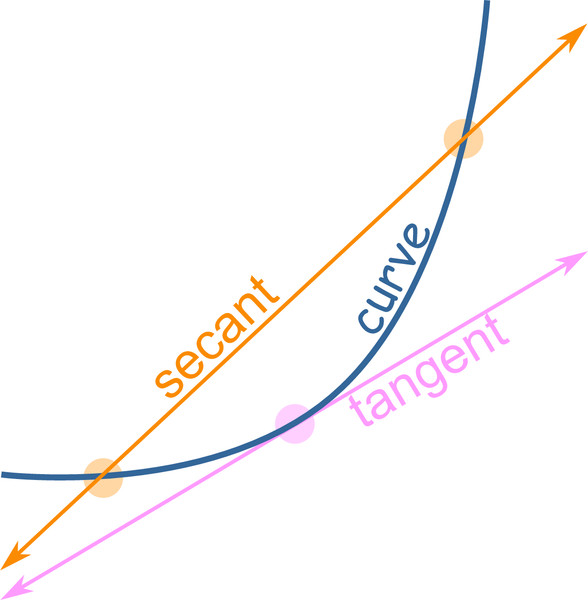
Secant line vs. tangent line on a curve
If the problem says:
- “At time ” → that’s instantaneous → derivative.
- “From to ” → that’s average rate.
On FRQs, they will absolutely test whether you know which one they’re asking for.
How to interpret in words
When asked to interpret , follow this logic every time.
1. Identify what the function represents
What is being measured? Include units.
Example:
Suppose is the revenue in dollars earned days after launching a product.
2. Identify what the input variable represents
Here, is time in days.
3. Translate the derivative
If , then you would say:
At days, revenue is increasing at a rate of 320 dollars per day.
That sentence includes:
- The time (when)
- The quantity (what)
- The direction (increasing/decreasing)
- The units (correctly divided)
Sign matters
- If → the quantity is increasing.
- If → the quantity is decreasing.
- If → the quantity is not changing at that instant.
Negative values are a common trap. If a derivative is −15, that means the quantity is decreasing at 15 units per input unit.
Reading meaning from magnitude and sign
The number itself tells a story.
- Large magnitude → changing quickly
- Small magnitude → changing slowly
- Positive → rising
- Negative → falling
- Zero → horizontal tangent (possibly a max or min, but not guaranteed)
The derivative describes what is happening at that exact moment, not what happens later.
Common AP traps
These are the mistakes that cost points every year.
1. Giving an amount instead of a rate
If , don’t say:
The company made 120 dollars.
Correct:
At day 3, profit is increasing at 120 dollars per day.
The derivative is never a total.
2. Messing up units
If the function is measured in miles and time is in hours, your answer must say miles per hour.
AP graders look for units. Missing them can lose a point on an FRQ.
3. Ignoring the time reference
Always attach the interpretation to the specific input value.
“At ” must appear in your explanation.
