Topic 2.1 Notes – Defining Average and Instantaneous Rates of Change at a Point
Average Rate of Change
Think “slope between two points.” If a function is defined on , the average rate of change over that interval is
That’s just rise over run.
What it represents
- Change in output divided by change in input
- Slope of the secant line through and
- Units: output units per input unit
Equivalent forms you’ll see:
They all mean the same thing: slope between two distinct x-values.
How it looks on a graph
On a graph, this is the slope of the secant line connecting the two points on the curve.
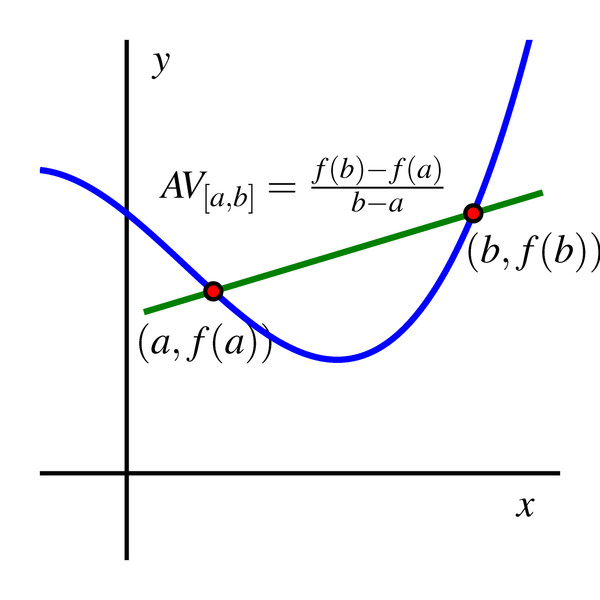
Secant line representing average rate of change on
If the secant line slopes upward, the average rate is positive. Downward means negative.
Quick example
Let . Find the average rate of change on .
That 15 is the slope of the secant line.
Common slip-ups
- Reversing the subtraction (it changes the sign).
- Forgetting the denominator is change in x, not y.
- Using derivative rules when the question only asks for average rate.
Instantaneous Rate of Change and the Derivative at a Point
Now shrink the interval. Let the second point move closer and closer to .
The instantaneous rate of change at is defined by a limit:
Equivalent form:
If this limit exists, the function is differentiable at .
What this means
- It is the slope of the tangent line at .
- It’s the exact rate of change at that single input.
- In motion language, if is position, then is velocity at time .
Geometric picture
In the diagrams below, the secant line through and a nearby point moves closer and closer to .
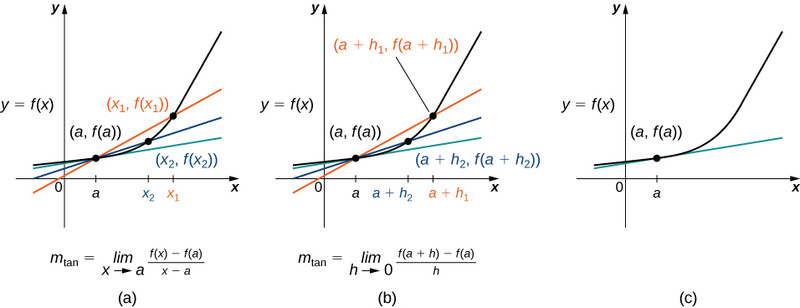
As , the secant line becomes the tangent line.
This idea is huge. The derivative is just the limit of average rates of change.
Computing a Derivative from the Limit Definition
Sometimes your teacher or the AP exam will say “use the definition.” That means no shortcut rules.
Let’s find for .
Start with
- Subtract
→ numerator becomes - Factor:
- Cancel the
- Take the limit as
Result:
Two things matter here:
- You must expand correctly.
- You must factor out and cancel the before plugging in 0.
If you plug in too early, you get and freeze.
On free-response questions, showing the limit setup and algebra earns points. Don’t skip steps.
Average vs Instantaneous Rate of Change
Here’s how to keep them straight.
| Average Rate | Instantaneous Rate |
|---|---|
| Over an interval | At a single point |
| Slope of a secant line | Slope of a tangent line |
| Two distinct x-values given | Asked for derivative or “rate at” |
When a question says:
- “Average rate of change on ” → use the slope formula.
- “Instantaneous rate at ” or “find ” → use the derivative.
They are connected, but not interchangeable.
