Topic 2.5 Notes – Applying the Power Rule
The Power Rule
If
where is any real constant, then
That’s the entire rule. The exponent moves down in front, then you subtract 1 from the exponent.
This works for:
- Positive integers
- Negative integers
- Fractions (radicals)
- Zero
The rule comes from the limit definition of the derivative, but on quizzes and the AP exam you apply it instantly.
What Counts as
The rule works cleanly when your expression is written in power form. So part of this topic is recognizing when something is , even if it doesn’t look like it at first.
Positive Integer Powers
Example:
These are straightforward and usually show up in polynomials.
Negative Exponents (Reciprocals)
Anything in the denominator can be rewritten with a negative exponent.
Now apply the rule:
You can leave it like that or rewrite:
A common multiple-choice trick is hiding the power rule inside a fraction.
Fractional Exponents (Radicals)
Radicals are just powers.
Rewrite if needed:
Cube roots work the same way:
If you can comfortably move between radical form and exponent form, you’re in good shape.
The Special Case
Derivative:
Any constant disappears when you differentiate. Every time.
Applying the Power Rule to Polynomials
Most questions combine several power-rule terms.
If
Differentiate term-by-term:
Final answer:
Why this works:
- Derivatives distribute across addition and subtraction.
- Constants multiply through normally.
- Constants alone become 0.
On a no-calculator section, this should feel automatic.
Seeing the Pattern Visually
Here’s what happens to exponents when you differentiate several powers. Scan the examples and look for what changes from the left column to the right:
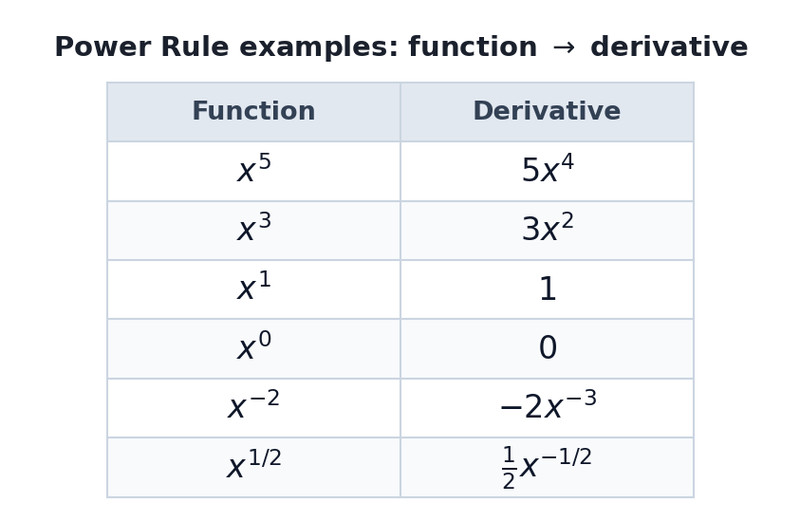
Power rule pattern across different exponents
Notice the pattern: every exponent drops by 1, and the original exponent becomes the coefficient in front. That pattern is the entire structure of the rule.
A Clean Process to Follow
When expressions get messy, slow it down mentally:
- Rewrite everything using exponents.
- Make sure each term looks like .
- Multiply by the exponent.
- Subtract 1 from the exponent.
- Simplify.
Example:
Rewrite:
Differentiate:
Then clean up if desired.
Where Students Lose Points
- Forgetting to rewrite first. Radicals and fractions hide exponents.
- Subtracting incorrectly. If the exponent is negative, subtracting 1 makes it more negative.
- Dropping the exponent too far. becomes , not .
- Differentiating constants like they contain .
One more subtle mistake: forgetting that the exponent must be a constant. The power rule does not apply to something like . That’s outside this topic.
Why This Rule Matters
Every derivative rule you learn later builds on this one. Product rule, quotient rule, Taylor polynomials, differential equations, all of it depends on being fluent with powers.
When you see something like
your brain should immediately produce
No hesitation. That speed frees you up for the harder parts of a problem.
