Topic 1.14 Notes – Connecting Infinite Limits and Vertical Asymptotes
1. Infinite Limits and What They Mean
Up to now, limits gave you real numbers. Now we allow the limit to describe unbounded behavior.
If
it means:
- As gets close to ,
- increases without bound.
Similarly,
- → values decrease without bound.
- One-sided versions:
Important ideas:
- Infinity is not a number. The limit is not equal to infinity. It describes behavior.
- If a function has an infinite limit at , it is not continuous at .
- This type of discontinuity is called an infinite discontinuity.
Think of it this way: instead of asking “What number does it approach?” you’re asking “Does it shoot upward or downward without bound?”
That behavior leads directly to vertical asymptotes.
2. Vertical Asymptotes
A vertical asymptote is a vertical line where the function becomes unbounded.
Formally:
If either one-sided limit satisfies
then is a vertical asymptote.
Notice:
- The two sides do not need to match.
- One side can go to
- The other can go to
- The function may be undefined there, but being undefined alone does not guarantee an asymptote.
Here’s the classic shape. The graph of shows what happens near a vertical asymptote.
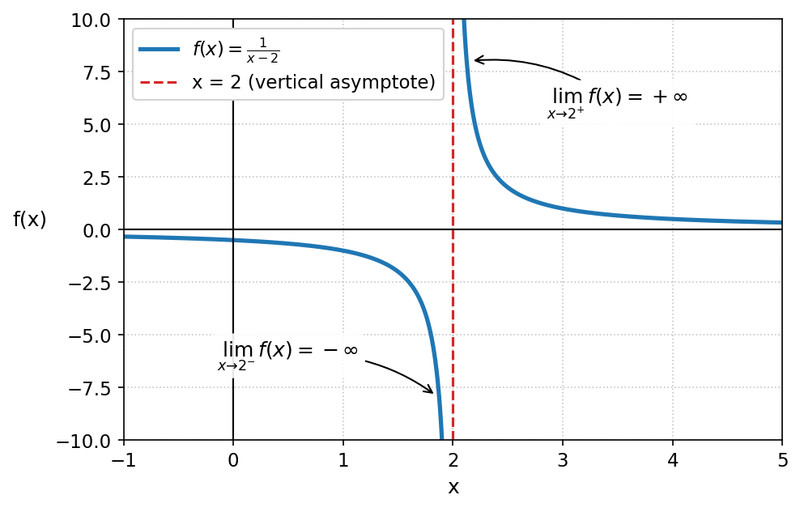
Graph of with vertical asymptote
The dashed line is . As , . As , . The graph never touches the line and the function grows without bound near it.
On FRQs, you often have to justify a vertical asymptote by writing the correct one-sided infinite limits.
3. How to Find Vertical Asymptotes Algebraically
Rational Functions
This is the most common setting on tests.
Example:
Factor the denominator:
Potential problem points: , .
Since nothing cancels, both values create vertical asymptotes.
To determine direction, test signs:
Near :
- From the right, denominator is small positive → fraction is
- From the left, denominator is small negative → fraction is
So the behavior flips across the asymptote.
Crucial detail:
If a factor cancels, you get a hole, not a vertical asymptote.
Example:
After canceling, you're left with .
There is a hole at , and a vertical asymptote at .
Students lose points all the time by skipping the simplification step.
Logarithmic Functions
Logs have vertical asymptotes where their argument approaches 0 from within the domain.
For example:
So is a vertical asymptote for .
Remember:
- Logs are only defined where their argument is positive.
- Only consider the side that’s in the domain.
Other Functions
Any function can have a vertical asymptote if it becomes unbounded.
The key question is never “Is it undefined?”
The real question is “Does the function grow without bound?”
You confirm that with limits.
4. Determining the Direction of Infinite Behavior
When evaluating
you are doing sign analysis near zero.
Quick logic table:
- Positive ÷ tiny positive →
- Positive ÷ tiny negative →
- Negative ÷ tiny positive →
- Negative ÷ tiny negative →
You don’t plug in exactly .
You think about whether each factor is slightly positive or slightly negative.
On multiple-choice, they love giving two answer choices that differ only by sign. If you skip the sign analysis, you guess.
5. Common Mistakes and Exam Traps
- Writing “the limit equals infinity” instead of stating it approaches infinity.
- Forgetting to check one-sided limits.
- Calling every undefined value a vertical asymptote.
- Not simplifying rational functions first.
- Ignoring domain restrictions in logs.
The logical chain you should always remember:
Infinite limit ⇄ Unbounded behavior ⇄ Vertical asymptote.
Limits justify asymptotes. Asymptotes describe infinite limits.
