Topic 9.1 Notes – Defining and Differentiating Parametric Equations
1. What a Parametric Curve Is
A parametric curve is defined by two equations:
Each value of gives a point in the xy-plane. As changes, that point moves along a path.
So even though everything depends on , the graph is still drawn in the regular coordinate plane. You never graph .
Here’s the key shift in thinking:
- In regular functions, depends directly on .
- In parametrics, both and depend on .
That lets curves:
- Move left and right
- Loop back on themselves
- Pass through the same point more than once
- Have motion with direction
To visualize that motion idea, look at this example curve traced as increases.
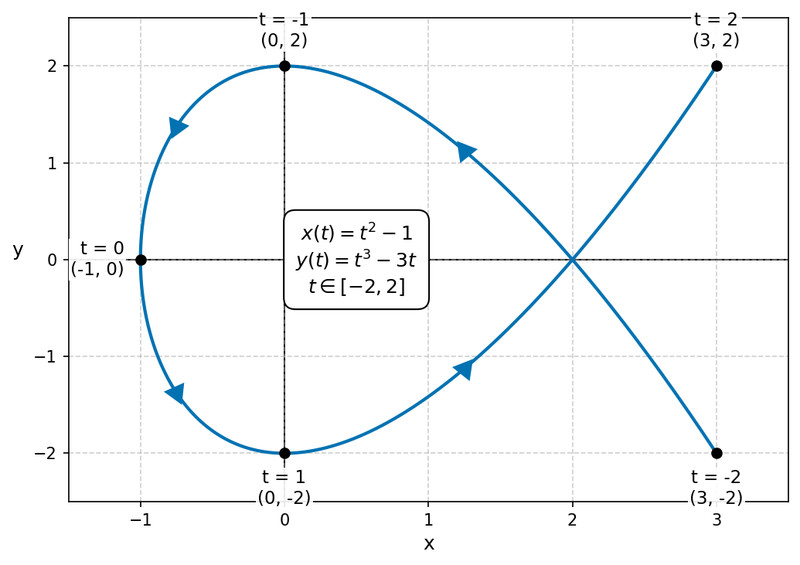
Parametric curve for , ,
Notice the arrows. Direction matters in parametrics. Two curves can look identical but be traced differently depending on how changes.
You already know how to differentiate expressions like and . We’re just going to use those same derivative rules again.
2. The Derivative of a Parametric Curve
We still want the slope of the tangent line, which is
But we don’t have written as a function of . Both depend on . So we use the chain rule idea:
This only works when .
Why this makes sense:
- tells how fast changes.
- tells how fast changes.
- Their ratio tells how fast changes with respect to .
That ratio is the slope of the tangent line.
On quizzes and FRQs, this formula is the entire point of the question. If you write only , you won’t get credit. They want the ratio.
3. How to Find the Slope at a Specific Value of t
Here’s the clean process.
- Differentiate to find .
- Differentiate to find .
- Form the ratio .
- Simplify.
- Plug in the given -value (if one is provided).
Example:
Differentiate:
Form the ratio:
If asked for the slope at :
If they ask for the equation of the tangent line, also find the point:
Then use point-slope form:
On FRQs, don’t skip writing the actual point. They often award a separate point for it.
If no value of is given, leave your answer in terms of .
4. Special Cases and What They Mean
Horizontal Tangent
Then
The curve is momentarily flat.
Vertical Tangent
The ratio is undefined. The tangent line is vertical.
Both Equal Zero
The slope is indeterminate. In this course, you usually just recognize this situation. Further analysis is beyond what you’re expected to do in this specific topic.
