Topic 9.6 Notes – Solving Motion Problems Using Parametric and Vector-Valued Functions
Position, Velocity, and Acceleration in the Plane
A particle moving in the plane is described by a vector-valued function
This is the same as giving parametric equations and .
Think of it this way:
- tells you horizontal position.
- tells you vertical position.
- Together, they give the point in the plane at time .
Derivatives give motion
- Velocity
- Acceleration
- Speed (magnitude of velocity)
Velocity is a vector. Speed is just its length.
What these mean geometrically
Here’s what velocity looks like along a path. In the diagram, points from the origin to the particle, and is drawn tangent to the curve at point .
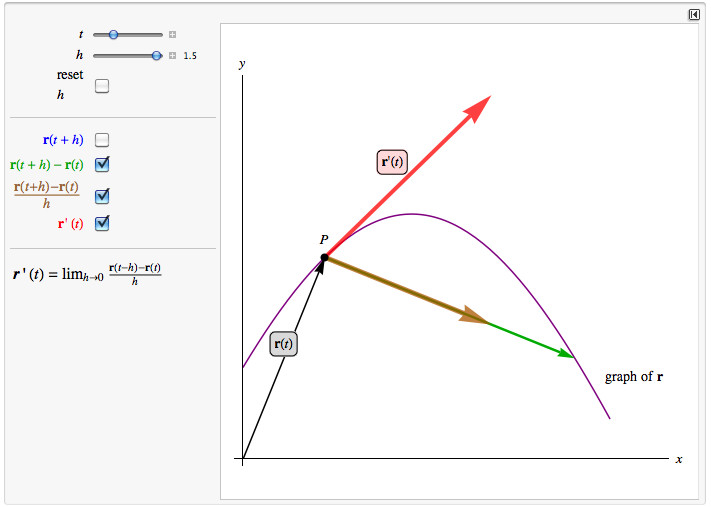
Position vector and velocity vector along a parametric curve
- is tangent to the curve.
- The particle is at rest when .
- The direction of motion comes from the velocity vector.
To find the slope of the path at a time:
This shows up often in FRQs when they want the slope of the trajectory.
Speeding Up and Slowing Down
Students mix this up every year, so lock this in.
Speed depends on how velocity and acceleration relate.
- If , speed is increasing.
- If , speed is decreasing.
Why? The dot product checks whether acceleration is helping the motion (same general direction) or opposing it.
On tests, they often give you vectors at a specific time and ask if the particle is speeding up. You do not need to compute speed explicitly. Just check the sign of the dot product.
Displacement from Velocity
Velocity measures change in position. So integrating velocity accumulates position change.
This equals:
That vector is the displacement over .
Key idea: displacement is net change in position, not how much ground was covered.
If you’re given velocity and an initial position, you can recover position:
- Integrate velocity component-wise.
- Add constants.
- Use the initial condition to solve for constants.
That’s solving an initial value problem in motion form.
Distance Traveled
Distance measures total path length. It ignores direction.
This is the arc length formula for parametric curves.
Here’s the big contrast:
| Displacement | Distance | |
|---|---|---|
| What is integrated? | ||
| Result | Vector | Scalar |
| Can be zero? | Yes (if you end where you started) | No (unless you never moved) |
If a particle loops back to where it started, displacement can be zero while distance is positive. That difference is tested constantly.
Parametric vs Vector Form
There is no real difference computationally.
If you’re given:
then treat it as:
Differentiate each component. Integrate each component. Same rules.
On calculator-active problems, distance integrals often require numerical evaluation. Be careful with parentheses when entering .
