Topic 4.3 Notes – Rates of Change in Applied Contexts Other Than Motion
What a derivative means in context
Suppose a function models some quantity over time.
- = the amount at time
- = the instantaneous rate of change of that amount with respect to time
The derivative answers:
- How fast is the quantity changing right now?
- Is it increasing or decreasing?
- In what units?
Units always follow this structure
Examples:
- If is population (people) and is years
→ is people per year - If is cost (dollars) and is items produced
→ is dollars per item - If is volume (liters) and is minutes
→ is liters per minute
The structure never changes. The interpretation does.
What the sign tells you
- → increasing at that moment
- → decreasing
- → momentarily not changing
- Larger magnitude → changing faster
On the AP exam, a number without units or interpretation will lose credit.
Finding an instantaneous rate of change
When a problem asks, “What is the instantaneous rate of change at ___?” that means take the derivative and evaluate it there.
Here’s the logic you should follow every time:
- Identify what the function represents (and its units).
- Recognize that instantaneous rate = derivative.
- Compute .
- Plug in the requested value.
- State your answer with units and meaning.
Quick example
Suppose a company’s profit (in thousands of dollars) is
where is the number of products (in hundreds).
Differentiate:
At :
Interpretation:
At a production level of 600 items, profit is increasing at 20 thousand dollars per hundred items.
Notice how we translated the scaled units correctly. That kind of detail shows up in FRQs.
Common applied contexts
The calculus is the same every time. Only the story changes.
| Function | What the derivative represents | Typical units |
|---|---|---|
| Population growth rate | people per year | |
| Marginal revenue | dollars per item | |
| Marginal cost | dollars per item | |
| Rate a substance is increasing/decreasing | grams per hour, liters per minute, etc. |
Marginal interpretation (important)
If is cost, then approximates the additional cost of producing one more unit when production is at .
On multiple choice, they love phrasing like:
- “Approximate cost of producing the 51st item.”
That means evaluate , not . Students miss that every year.
Derivatives from graphs
Sometimes they won’t give you a formula. You’ll see a graph.
For example, here’s a graph of with tangent lines drawn at different points.
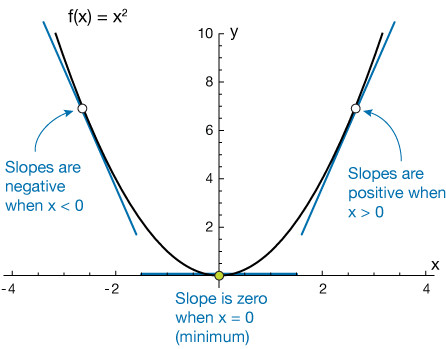
Tangent lines and derivative values for
What you’re reading from a graph like this:
- Slope of the tangent line =
- Steeper tangent = larger magnitude derivative
- Horizontal tangent = derivative is 0
- Downward slope = negative derivative
Notice in the picture: slopes are negative for , zero at the minimum, and positive for . That sign change tells you how the function is behaving.
If the graph is curved but flattening out, the derivative is getting closer to zero.
You are always reading slope, not height.
Instantaneous vs average rate
Don’t mix these up.
Average rate on :
This is slope of a secant line.
Instantaneous rate at :
This is slope of the tangent line.
If the question says:
- “Between year 2 and 5” → average rate
- “At year 5” → derivative
That wording difference matters.
Common mistakes
- Plugging in before differentiating.
- Forgetting units.
- Ignoring the sign when interpreting.
- Evaluating the derivative at the wrong value in marginal problems.
- Describing what the function value means instead of what the derivative means.
If the question gives you , don’t talk about the amount at time 3. Talk about how it’s changing at time 3.
