Topic 1.10 Notes – Energy Flow and the 10% Rule
What the 10% Rule Means
In a food chain, energy flows sun → producers → consumers → heat. One move from one trophic level to the next is one energy transfer.
The 10% rule says that only about 10% of the energy at one trophic level is passed to the next level as biomass. Biomass means the stored chemical energy in living tissue. That stored energy is what the next consumer can actually use.
- About 90% is not transferred to the next trophic level.
- That does not mean energy disappears.
- It means that energy is no longer available to the next step in that food chain.
A common mix-up is at the producer level. The energy at the base of an energy pyramid is usually chemical energy stored by photosynthesis, not all sunlight hitting the ecosystem.
There are two different efficiencies here:
- Photosynthesis efficiency: producers capture only about 1% of incoming solar energy
- Trophic transfer efficiency: about 10% passes from one trophic level to the next
Energy also differs from matter. Matter cycles through ecosystems, but energy does not. Ecosystems need a constant outside input, usually sunlight.
Why Energy Decreases at Higher Trophic Levels
Less energy is available higher in the food chain because transfer is never complete.
- Some organisms or body parts are never eaten
- Some eaten material is not digested or assimilated
- Some energy leaves as feces and other wastes
- Much assimilated energy is used for respiration, movement, maintenance, growth, repair, and reproduction
- Some organisms die without being eaten by the next consumer
The energy pyramid below ties those losses together. Most of the energy captured by producers never becomes biomass at higher consumer levels, and some is released as heat at each transfer.
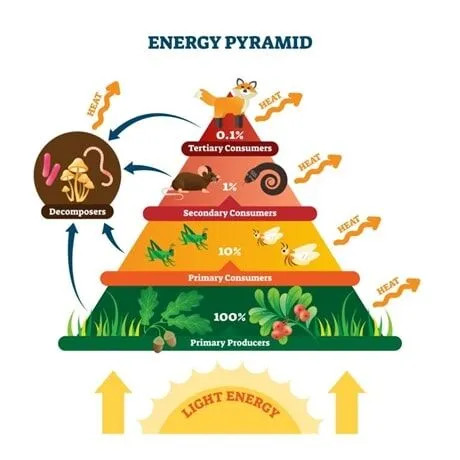
Energy pyramid
Uneaten biomass and wastes can still enter detrital pathways through decomposers and detritivores. So when APES says energy is “lost,” it means lost to the next trophic level in that pathway, not destroyed.
This connects to thermodynamics:
- First law of thermodynamics: energy is conserved. It changes form instead of being created or destroyed.
- Second law of thermodynamics: every energy transfer increases entropy, so some usable energy becomes low-quality heat. No transfer is 100% efficient.
That second law is the reason less usable energy is left to build biomass at each higher trophic level.
How to Calculate Energy Transfer
The basic equations are:
Here, is the number of transfers, not the number of trophic levels named.
Moving through trophic levels
- Going up one level → multiply by 0.10 or divide by 10
- Going down one level → divide by 0.10 or multiply by 10
A classic trap is this: a tertiary consumer is the fourth trophic level, but it is only three transfers above producers.
Energy not transferred
Under the 10% rule, that is usually 90% of the lower level.
Measured transfer efficiency
If real data is given, use it:
If the answer comes out to 15%, keep 15%. Do not force it to 10%.
Units
Common units are J, kJ, cal, kcal, often per area per time, like kJ/m²/yr. Multiplying by 0.10 does not change units. A percentage has no unit.
What Energy Pyramids Show and Why They Matter
An energy pyramid shows available energy at each trophic level. Producers form the widest base, then primary, secondary, and tertiary consumers get narrower.
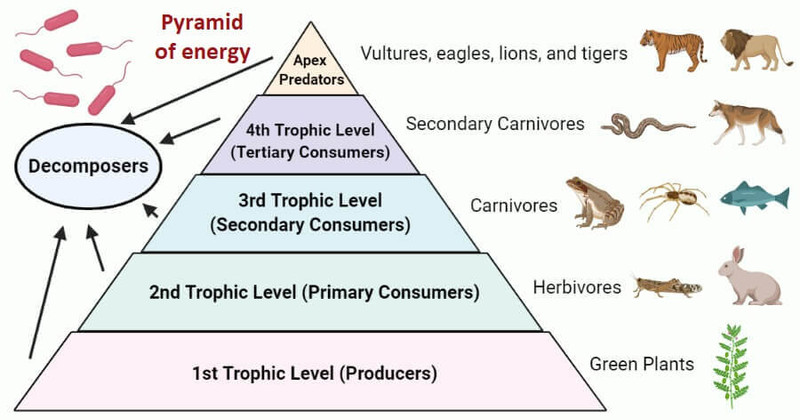
Energy pyramid and trophic levels
In this example, the side label for decomposers is a reminder that decomposers act on material from every trophic level. Energy pyramids are always upright because each transfer leaves less usable energy. Pyramid width shows amount of energy, not body size of individual organisms.
This explains a lot:
- Food chains are usually only 4 or 5 trophic levels
- Higher trophic levels usually support fewer organisms
- Top predators need large feeding territories
- Eating lower on the food chain supports more consumer biomass
Compact example:
- eelgrass → grazing invertebrates → small fish → larger predatory fish
Each arrow is one transfer, so if eelgrass has 10,000 kJ, the larger predatory fish would have kJ.
Key Takeaways
Energy Flow Through Ecosystems
One-way transfer and transformation of energy through trophic levels, eventually releasing heat and requiring continuous external energy input
10% Rule
About 10% of one trophic level’s energy passes to the next; after n transfers, Eₙ = E₀(0.10)ⁿ, where n counts transfers
Energy Pyramid
A diagram showing energy available at successive trophic levels, with an upright shape because each higher level contains less energy
Trophic Transfer Efficiency
The percentage of lower-level energy transferred upward: E_higher ÷ E_lower × 100
First Law of Thermodynamics (Law of Conservation of Energy)
Energy cannot be created or destroyed, only transferred or transformed; energy lost from a trophic pathway is unavailable, not destroyed
Second Law of Thermodynamics
Every energy transfer increases entropy and reduces energy available for useful work, with some energy becoming dispersed as heat
Notes
Energy Flow Through Ecosystems
One-way transfer and transformation of energy through trophic levels, eventually releasing heat and requiring continuous external energy input
10% Rule
About 10% of one trophic level’s energy passes to the next; after n transfers, Eₙ = E₀(0.10)ⁿ, where n counts transfers
Energy Pyramid
A diagram showing energy available at successive trophic levels, with an upright shape because each higher level contains less energy
Trophic Transfer Efficiency
The percentage of lower-level energy transferred upward: E_higher ÷ E_lower × 100
First Law of Thermodynamics (Law of Conservation of Energy)
Energy cannot be created or destroyed, only transferred or transformed; energy lost from a trophic pathway is unavailable, not destroyed
Second Law of Thermodynamics
Every energy transfer increases entropy and reduces energy available for useful work, with some energy becoming dispersed as heat
