Topic 9.8 Notes – Invasive Species
What Invasive Species Are
An invasive species is a non-native species that establishes and spreads in a new area and threatens native species. It can be a plant, animal, fungus, or microorganism.
Here are the terms that get mixed up a lot:
- Native species lives naturally in a region.
- Non-native species (also called introduced, alien, or exotic) was moved there by human activity.
- Established or naturalized species has a self-sustaining population in the new place.
- Invasive species is non-native and causes ecological harm or threatens natives.
The big trap is thinking all non-native species are invasive. They are not. Some stay confined or are useful, like crops or ornamentals. APES cares about the ones that harm ecosystems.
This usually involves crossing natural barriers because of people, not a species slowly shifting range on its own. Disturbance and human-caused environmental change also make ecosystems easier to invade.
How Invasions Happen and Why Some Species Succeed
A biological invasion tends to follow the same path:
- Transport
The organism gets moved beyond its normal range. - Introduction
It is released, escapes, or arrives in the new ecosystem. - Establishment
It survives and reproduces enough to form a stable population. - Spread
It expands into more habitat. - Impact
It begins harming native species or ecosystem processes.
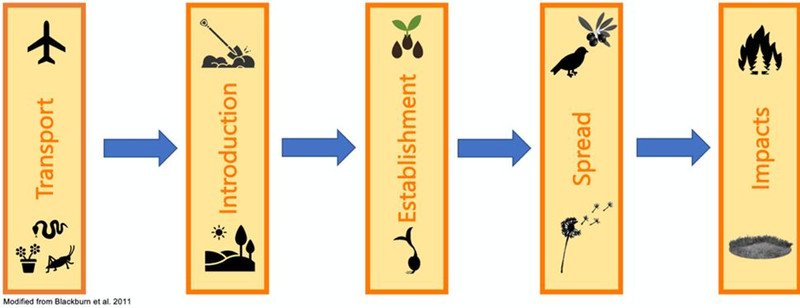
Stages of biological invasion
Common pathways
That first part of the sequence usually happens through a few major human pathways.
- Ballast water from ships
- Organisms attached to ship hulls
- Wood packaging, firewood, nursery plants, agricultural products
- Seeds in soil, feed, clothing, vehicles, machinery
- Boats, trailers, fishing gear, bait containers
- Intentional release of ornamental plants, pets, aquarium species, game species, biocontrol species
Spread gets easier with roads, canals, disturbed land, connected waterways, and repeated transport.
Why some species take over
Many invasive species are:
- Generalists
They can use many food sources or habitats and tolerate many conditions. - r-selected species
They mature early, reproduce often, have many offspring, grow fast, and disperse well.
Other helpful traits include disturbance tolerance, vegetative reproduction, and strong seed or larval dispersal.
Enemy release matters too. In the new range, the invader may leave behind predators, parasites, and pathogens that kept it in check.
Ecosystems that are especially vulnerable include:
- Disturbed habitats
- Island ecosystems
- Isolated lakes
- Systems with native species that have narrow niches, small populations, or slow reproduction
How Invasive Species Harm Ecosystems
Competition
Invaders may outcompete natives for food, water, nutrients, light, space, nesting sites, or shelter, which lowers native survival and reproduction.
Predation and Herbivory
Some invaders eat native species or heavily graze plants with few defenses.
Burmese pythons in the Florida Everglades are the classic example. They prey on native mammals and birds and are hard to control.
Disease and Parasites
Introduced species can bring pathogens or parasites that native species have little resistance to.
Habitat and Ecosystem Change
They can change:
- nutrient cycling
- decomposition
- soil chemistry
- water flow and clarity
- erosion
- fire frequency or intensity
- habitat structure
- food webs
Some create positive feedbacks that help themselves spread, such as invasive grasses that increase fire and then regrow quickly after fire.
Biodiversity Loss and Food-Web Effects
Invasive species reduce native populations and species richness. They can also trigger trophic cascades. This is one of the major causes of biodiversity loss.
Economic and Human Effects
They can damage agriculture, fisheries, forestry, infrastructure, water-intake pipes, boats, and recreation. Some spread disease or cause toxins or injuries.
Representative example
Zebra mussels were introduced to North America in ballast water. They spread through the Great Lakes, connected waterways, and on boats/equipment.
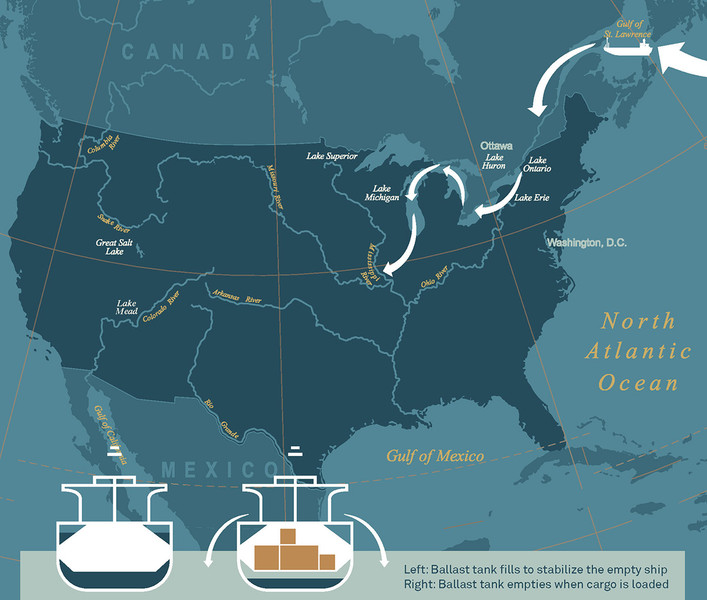
Zebra mussel introduction and spread by ballast water
The map highlights the route into the Great Lakes and then spread through inland waterways. The ship diagrams at the bottom connect that spread to ballast water transport.
Their impacts include:
- competing with native filter feeders
- smothering native mussels
- changing water clarity and food webs
- clogging pipes
- fouling boats and docks
Controlling Invasive Species
Control works best when matched to the invasion stage.
Prevention
Usually the most effective and least expensive option.
- inspections and quarantine
- import restrictions
- ballast-water treatment
- hull cleaning
- clean, drain, dry boats
- no pet, aquarium, or bait release
- limit firewood movement
- public education
Early Detection and Rapid Response
This means finding the species while the population is still small and acting immediately.
- surveys
- traps
- environmental sampling
- public reports
Once spread happens, control gets much harder and more expensive.
Control Methods
- Physical/mechanical
Hand-pulling, digging, cutting, trapping, hunting, barriers, harvesting - Chemical
Herbicides, insecticides, molluscicides, rodenticides. These can work fast but may harm non-target species or pollute. - Biological
Predators, parasites, or pathogens. These may give long-term suppression but can become a new problem.
Cane toad in Australia is the warning example of failed biocontrol. - Habitat modification/restoration
Restore native conditions, reduce reinvasion, and replant natives.
Integrated Management
The best plans combine methods based on the species, ecosystem, invasion stage, and non-target risks. For zebra mussels, that could mean inspecting and drying boats, monitoring larvae and adults, and treating small local infestations.
How to Evaluate a Control Plan
A strong plan should identify:
- the species
- how it causes harm
- the stage of invasion
- the intervention
- how the intervention reduces introduction, survival, reproduction, or spread
- effects on native species
- cost, feasibility, and unintended consequences
- a monitoring plan
Evidence that a plan is working includes:
- lower invasive abundance or density
- slower spread
- less area occupied
- reduced reproduction
- recovery of native species or species richness
- less infrastructure or economic damage
- minimal non-target effects
Short-term decline alone is not enough. APES wants long-term suppression plus ecosystem recovery.
Key Takeaways
Invasive Species
A non-native species whose establishment or spread threatens native species and causes ecological harm
Native Species
A species that occurs naturally in a region without human introduction
Non-Native Species / Introduced Species / Alien Species / Exotic Species
A species occurring outside its native range because of intentional or accidental human activity
Established or Naturalized Non-Native Species
A non-native species that has developed a self-sustaining population in its new environment
Biological Invasion
The sequence of transport, introduction, establishment, spread, and ecological impact in a new region
Enemy Release
Escape from the predators, herbivores, parasites, and pathogens that controlled a species in its native range
Prevention Through Pathway Management
Blocking transport or release by managing routes such as trade, ballast water, boats, firewood, pets, and nursery stock
Early Detection and Rapid Response (EDRR)
Monitoring for new invaders and immediately eradicating or containing them while populations remain small and localized
Eradication
Complete elimination of an invasive species from a defined area
Containment
Preventing an invasive species from spreading beyond its current distribution
Suppression or Control
Reducing an invasive species’ abundance or ecological impact without necessarily eliminating it
Long-Term Management
Repeatedly maintaining an established invasive population at a lower level when elimination is not feasible
Physical or Mechanical Control
Direct removal or killing through methods such as pulling, cutting, trapping, hunting, barriers, or harvesting
Chemical Control
Using toxic substances such as herbicides, insecticides, or molluscicides to reduce an invasive population
Biological Control
Using a living organism or biological agent to reduce an invasive population
Classical Biological Control
Introducing a tested natural enemy from an invasive species’ native range to suppress it
Habitat Modification and Restoration
Changing habitat conditions to disadvantage an invader while restoring conditions, vegetation, or competitors that favor native species
Integrated Invasive-Species Management
Combining prevention, monitoring, removal, selected controls, habitat restoration, and follow-up assessment
Notes
Invasive Species
A non-native species whose establishment or spread threatens native species and causes ecological harm
Native Species
A species that occurs naturally in a region without human introduction
Non-Native Species / Introduced Species / Alien Species / Exotic Species
A species occurring outside its native range because of intentional or accidental human activity
Established or Naturalized Non-Native Species
A non-native species that has developed a self-sustaining population in its new environment
Biological Invasion
The sequence of transport, introduction, establishment, spread, and ecological impact in a new region
Enemy Release
Escape from the predators, herbivores, parasites, and pathogens that controlled a species in its native range
Prevention Through Pathway Management
Blocking transport or release by managing routes such as trade, ballast water, boats, firewood, pets, and nursery stock
Early Detection and Rapid Response (EDRR)
Monitoring for new invaders and immediately eradicating or containing them while populations remain small and localized
Eradication
Complete elimination of an invasive species from a defined area
Containment
Preventing an invasive species from spreading beyond its current distribution
Suppression or Control
Reducing an invasive species’ abundance or ecological impact without necessarily eliminating it
Long-Term Management
Repeatedly maintaining an established invasive population at a lower level when elimination is not feasible
Physical or Mechanical Control
Direct removal or killing through methods such as pulling, cutting, trapping, hunting, barriers, or harvesting
Chemical Control
Using toxic substances such as herbicides, insecticides, or molluscicides to reduce an invasive population
Biological Control
Using a living organism or biological agent to reduce an invasive population
Classical Biological Control
Introducing a tested natural enemy from an invasive species’ native range to suppress it
Habitat Modification and Restoration
Changing habitat conditions to disadvantage an invader while restoring conditions, vegetation, or competitors that favor native species
Integrated Invasive-Species Management
Combining prevention, monitoring, removal, selected controls, habitat restoration, and follow-up assessment
