Topic 2.7 Notes – Ecological Succession
What Ecological Succession Is
Ecological succession means the species in a community change over time, along with the community’s structure. That includes:
- Producers like grasses, shrubs, and trees
- Consumers like insects, birds, and mammals
- Decomposers like fungi and bacteria
- Soil and habitat structure, which affect what can live there
One of the most testable ideas here is that each stage changes the conditions for the next. Early organisms can build soil, add nutrients, trap moisture, create shade, and change competition.
A classic example is primary succession, where a community develops over a long period from bare rock to grasses, shrubs, and eventually a mature forest.
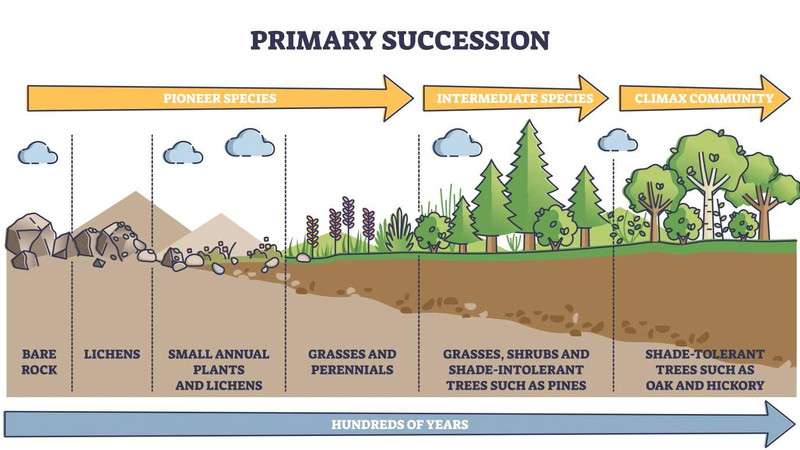
Primary succession over hundreds of years
Succession is not one fixed recipe. The path depends on climate, soil, what species arrive first, how severe the disturbance was, and chance events. A disturbance can pause succession, restart it, or send it in a different direction.
Types of Ecological Succession
The key distinction is simple. Primary succession starts without soil. Secondary succession starts with soil already present.
Primary succession
Primary succession begins on a bare or newly exposed surface with little or no soil.
Examples you should know:
- newly cooled lava or volcanic rock
- bedrock exposed by retreating glaciers
- severe landslides exposing rock
- newly exposed sand or rocky surfaces
Early conditions are harsh:
- very little organic matter
- few nutrients
- poor water retention
- few places for roots
So the first colonists are pioneer species, especially lichens, mosses, and microorganisms. They help break down rock and add organic matter, which slowly forms soil.
Typical sequence:
- bare rock
- lichens and mosses
- grasses and herbs
- shrubs
- trees or another mature community
Primary succession is usually slow because the soil has to form first.
Secondary succession
Secondary succession begins after a disturbance when soil remains.
Examples:
- wildfire
- hurricane or windstorm
- flooding
- abandoned agricultural land
- logging
- disease or insect outbreaks
- less severe volcanic or landslide disturbance where soil survives
Because soil is still there, the area may already have seeds, roots, microbes, spores, and nutrients. That makes recovery faster.
Typical sequence:
- grasses and weeds
- shrubs
- young trees
- shade-tolerant later species
A classic AP example is Mount St. Helens. Some places lost soil and had primary succession. Other places kept soil and had secondary succession. The label depends on local starting conditions, not just “it was a volcano.”
Pioneer Species and Community Change
Pioneer species are the first species to colonize empty or severely disturbed areas.
Common traits:
- tolerate harsh conditions
- grow fast
- reproduce early
- disperse easily
- do well in open habitats
Here’s how community change usually works:
- Pioneer species arrive.
- They modify the environment through facilitation.
- Soil, moisture, nutrients, and shelter improve.
- Later species arrive and often outcompete pioneers.
- The community becomes more complex.
Later-successional species often win through shading and stronger competition for resources. Herbivory, predation, disease, and seed dispersal also shape succession.
A late-successional or climax community can be fairly stable, but it is not permanent or guaranteed. It also depends on biome. Succession does not always end in a forest.
How Succession Changes Ecosystems
As succession proceeds, several ecosystem patterns usually appear:
- Total biomass starts low and usually increases as larger plants store more organic matter.
- Species richness often rises at first because soil and habitat complexity increase.
- Richness may later level off, fluctuate, or drop somewhat as pioneer species are replaced.
- Net primary productivity starts low, rises as producers establish, and may later level off or decline as respiration increases.
- Secondary succession usually recovers biomass and productivity faster than primary succession.
- Animal communities shift from open-habitat species to species that need shrubs, trees, canopy, or dense cover.
- Decomposer communities expand as litter, roots, dead wood, and soil organic matter increase.
- Repeated disturbances create a patch mosaic, with different areas at different successional stages.
Look for changes in soil development, dominant species, biomass, richness, and productivity.
Keystone Species and Indicator Species
Keystone species
A keystone species has a very large effect on community structure compared with its abundance or biomass.
Illustrative examples:
- Pisaster ochraceus (ochre sea star) controls mussels in rocky intertidal zones
- Sea otters limit sea urchins and help maintain kelp forests
These species can shape succession by preventing one species from taking over.
Indicator species
An indicator species reveals environmental conditions or ecosystem quality through its presence, absence, abundance, condition, or chemical makeup.
Illustrative examples:
- Lichens indicate air quality
- Amphibians indicate aquatic and terrestrial ecosystem quality
They can reveal pollution, oxygen conditions, habitat quality, moisture, and other stressors over time.
Keystone vs indicator
- Keystone species shape the ecosystem.
- Indicator species signal the condition of the ecosystem.
That difference shows up a lot in MCQs.
Key Takeaways
Ecological Succession
Gradual change in an ecosystem’s species composition and community structure as organisms colonize new habitat or a community recovers after disturbance
Primary Succession
Succession beginning on a newly exposed or formed surface with little or no developed soil, so soil must form before most plants establish
Secondary Succession
Succession following a disturbance where soil remains, so recovery generally proceeds faster than primary succession
Pioneer Species
The first species to colonize an unoccupied or severely disturbed habitat; they tolerate harsh conditions and often modify the habitat for later species
Facilitation
The process by which early colonists modify a habitat in ways that make establishment by later species possible or more likely
Total Biomass
The total mass of living material in an area; it generally increases during succession and eventually slows or levels off
Species Richness
The number of different species present; it generally rises during succession but may later level off, fluctuate, or decline
Net Primary Productivity (NPP)
The rate at which producers store energy or biomass after producer respiration: NPP = GPP − R; it starts low, rises as producers establish, and may later stabilize or decline
Climax Community (Mature Community)
A relatively stable late-successional community suited to local conditions, but not a permanent or inevitable endpoint
Keystone Species
A species whose activities have a disproportionately large effect on community structure relative to its abundance or biomass
Indicator Species
An organism whose presence, absence, abundance, condition, or chemical composition reveals an environmental condition or aspect of ecosystem quality
Notes
Ecological Succession
Gradual change in an ecosystem’s species composition and community structure as organisms colonize new habitat or a community recovers after disturbance
Primary Succession
Succession beginning on a newly exposed or formed surface with little or no developed soil, so soil must form before most plants establish
Secondary Succession
Succession following a disturbance where soil remains, so recovery generally proceeds faster than primary succession
Pioneer Species
The first species to colonize an unoccupied or severely disturbed habitat; they tolerate harsh conditions and often modify the habitat for later species
Facilitation
The process by which early colonists modify a habitat in ways that make establishment by later species possible or more likely
Total Biomass
The total mass of living material in an area; it generally increases during succession and eventually slows or levels off
Species Richness
The number of different species present; it generally rises during succession but may later level off, fluctuate, or decline
Net Primary Productivity (NPP)
The rate at which producers store energy or biomass after producer respiration: NPP = GPP − R; it starts low, rises as producers establish, and may later stabilize or decline
Climax Community (Mature Community)
A relatively stable late-successional community suited to local conditions, but not a permanent or inevitable endpoint
Keystone Species
A species whose activities have a disproportionately large effect on community structure relative to its abundance or biomass
Indicator Species
An organism whose presence, absence, abundance, condition, or chemical composition reveals an environmental condition or aspect of ecosystem quality
