Topic 1.6 Notes – The Phosphorus Cycle
What the Phosphorus Cycle Is
Phosphorus is matter, so it gets transferred and recycled. It does not “flow” the way energy does. In this cycle, phosphorus-containing atoms and molecules move among the geosphere, hydrosphere, and biosphere.
Most of the time, biologically available phosphorus is phosphate, .
A few key terms make the whole topic easier:
- Reservoir means a place phosphorus is stored.
- Source means a reservoir releasing phosphorus.
- Sink means a reservoir receiving and storing phosphorus.
- The same place can be either one. Soil is a source when plants absorb phosphate from it, and a sink when decomposition returns phosphorus to it.
What makes phosphorus special is the part students mix up with carbon and nitrogen:
- There is no significant atmospheric component.
- There is no major gaseous phosphorus pool cycling through the air.
- That means phosphorus returns to ecosystems slowly, so it is often scarce and can be a limiting nutrient, especially in freshwater and some terrestrial ecosystems.
Phosphorus matters biologically because organisms need it for:
- DNA and RNA
- ATP for energy transfer in cells
- Phospholipids in cell membranes
- Bones and teeth
Major Reservoirs and the Standard Cycle Model
The largest long-term reservoirs are:
- Phosphorus-bearing rocks, especially sedimentary rock
- Ocean sediments
Smaller, shorter-term reservoirs include:
- Soil phosphate
- Freshwater and dissolved aquatic phosphate
- Terrestrial producers
- Consumers
- Decomposers and detritus
- Aquatic organisms
That pattern should match the kind of overview diagram you often see for the phosphorus cycle.
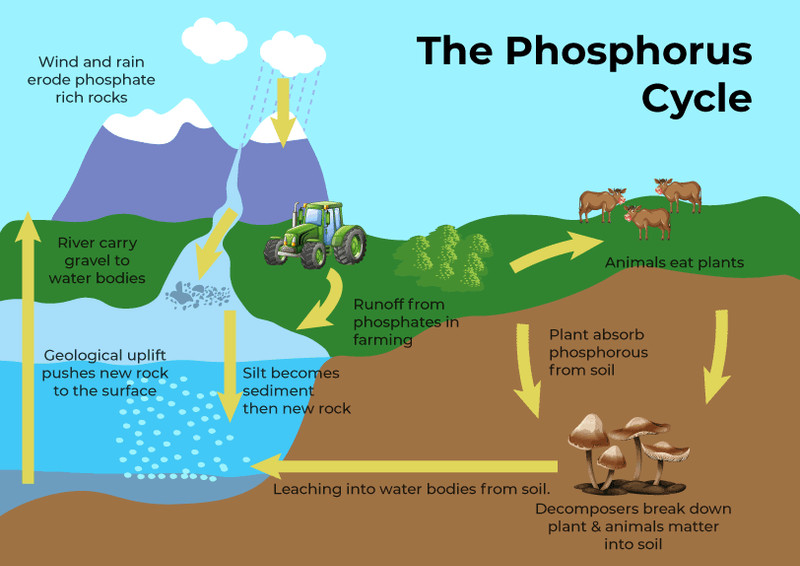
Phosphorus cycle overview
A correct diagram should show these arrows:
- Rock → soil/water by weathering
- Soil/water → producers by assimilation
- Producers → consumers by feeding
- Organisms → soil/water by waste, death, and decomposition
- Soil → water by runoff and erosion
- Water → sediment by settling, sedimentation, and burial
- Sediment → sedimentary rock by compaction and rock formation
- Buried rock → surface by geological uplift
A correct diagram should not show:
- the atmosphere as a major reservoir
- a major gaseous phosphorus phase
One common visual mistake is arrow direction. In this kind of diagram, geological uplift brings buried rock back toward the surface, then weathering releases usable phosphate from that rock.
How Phosphorus Moves Through the Cycle
Here’s the cycle in order:
- Weathering releases phosphorus from rock into soil or water.
- Producers absorb phosphate
- land plants through roots
- aquatic producers from surrounding water
- Consumers eat producers or other consumers, moving phosphorus through food webs.
- Waste, dead organisms, and detritus return phosphorus to decomposers.
- Decomposition mineralizes organic phosphorus back into inorganic phosphate.
- That phosphate can be reused, bind to soil, move in runoff, or enter sediments.
- Erosion and runoff carry dissolved phosphate and phosphorus attached to soil into rivers, lakes, and oceans.
- In water, phosphorus cycles through organisms, then may settle into sediment.
- Over geologic time, sedimentation → burial → sedimentary rock formation → uplift → renewed weathering.
The fast parts are uptake, feeding, excretion, decomposition, local recycling, and runoff.
The slow parts are weathering, burial, rock formation, and uplift.
Why Phosphorus Is Often a Limiting Nutrient
A limiting nutrient is an essential nutrient in short supply that restricts producer growth.
Phosphorus is often limiting because:
- phosphorus-bearing rock weathers slowly
- there is no large atmospheric reservoir
- phosphate often binds strongly to soil and sediment
- some phosphorus gets buried for long periods
The testable distinction here is important. Total phosphorus can be high, but biologically available phosphorus can still be low.
Classic example:
- Freshwater lakes are often phosphorus-limited
- adding phosphate can increase algal growth until something else becomes limiting
How Humans Alter the Phosphorus Cycle
Humans speed up the movement of phosphorus from long-term rock storage into short-term biological and aquatic reservoirs.
Major human inputs include:
- phosphate fertilizers
- animal manure
- human sewage and wastewater
- phosphate-containing detergents and cleaning products
- eroded soil from disturbed or cultivated land
In freshwater systems, the main sequence is:
- Excess phosphorus enters water.
- Nutrient limitation is reduced or removed.
- Algae and aquatic plants grow rapidly.
- Biomass dies.
- Decomposers break it down.
- Dissolved oxygen drops.
- Hypoxia or anoxia can kill aquatic organisms.
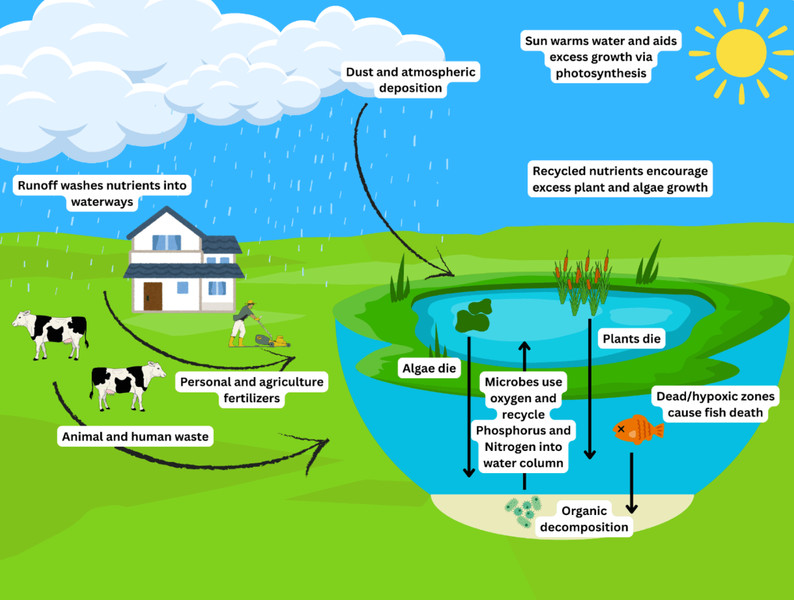
Eutrophication in a freshwater pond or lake
That APES framing matters. Phosphorus is not mainly dangerous because it is directly toxic. The major problem is eutrophication from extra productivity followed by decomposition.
A classic application is an agricultural watershed draining into a phosphorus-limited freshwater lake. The diagram shows that pattern clearly. Runoff carries nutrients from fertilizers and animal or human waste into the water, algal and plant growth increases, and decomposition lowers oxygen. In APES terms, phosphorus has moved quickly from a geologic reservoir into a biologically available aquatic reservoir.
Key Takeaways
Phosphorus Cycle
Movement of phosphorus among rocks, soil, water, organisms, and sediments through weathering, uptake, feeding, decomposition, runoff, sedimentation, rock formation, and uplift, with no significant atmospheric phase
Phosphorus Reservoir
A location where phosphorus is stored; the major long-term reservoirs are phosphorus-bearing rocks and ocean sediments
Source vs. Sink
A source releases phosphorus to another part of the cycle, while a sink receives and stores it; the same reservoir can act as either
Phosphate
PO₄³⁻, the simplified available inorganic form in which phosphorus moves through soils, waters, and producer uptake
Weathering vs. Erosion
Weathering breaks down or alters rock in place and releases phosphate; erosion transports weathered, phosphorus-bearing material
Phosphate Assimilation (Producer Uptake)
Absorption of inorganic phosphate by producers and its incorporation into organic molecules and living tissue
Phosphorus Mineralization
Decomposition of organic phosphorus compounds that returns inorganic phosphate to soil or water
Sedimentation
Settling of phosphorus-bearing particles or remains to lake or ocean bottoms; subsequent burial stores phosphorus in sediment and removes it from rapid circulation
Geological Uplift
Slow movement that exposes buried phosphorus-bearing rock at the surface, where later weathering can release its phosphorus
Limiting Nutrient
An essential nutrient whose low availability restricts producer growth or primary production; phosphorus is often limiting in freshwater and some terrestrial ecosystems
Notes
Phosphorus Cycle
Movement of phosphorus among rocks, soil, water, organisms, and sediments through weathering, uptake, feeding, decomposition, runoff, sedimentation, rock formation, and uplift, with no significant atmospheric phase
Phosphorus Reservoir
A location where phosphorus is stored; the major long-term reservoirs are phosphorus-bearing rocks and ocean sediments
Source vs. Sink
A source releases phosphorus to another part of the cycle, while a sink receives and stores it; the same reservoir can act as either
Phosphate
PO₄³⁻, the simplified available inorganic form in which phosphorus moves through soils, waters, and producer uptake
Weathering vs. Erosion
Weathering breaks down or alters rock in place and releases phosphate; erosion transports weathered, phosphorus-bearing material
Phosphate Assimilation (Producer Uptake)
Absorption of inorganic phosphate by producers and its incorporation into organic molecules and living tissue
Phosphorus Mineralization
Decomposition of organic phosphorus compounds that returns inorganic phosphate to soil or water
Sedimentation
Settling of phosphorus-bearing particles or remains to lake or ocean bottoms; subsequent burial stores phosphorus in sediment and removes it from rapid circulation
Geological Uplift
Slow movement that exposes buried phosphorus-bearing rock at the surface, where later weathering can release its phosphorus
Limiting Nutrient
An essential nutrient whose low availability restricts producer growth or primary production; phosphorus is often limiting in freshwater and some terrestrial ecosystems
