Topic 7.3 Notes – Thermal Inversion
What Thermal Inversion Is
In the troposphere (the lowest layer of the atmosphere), air normally gets cooler as you go higher. That usual pattern helps warm surface air rise, which creates convection and mixes the air.
A thermal inversion is the reverse pattern. The air near Earth’s surface is cooler, and a warmer layer sits above it.
- That warm layer acts like a lid or cap
- It suppresses convection and vertical mixing
- Pollution stays in a shallow layer near the ground
The inversion itself is not a pollutant and it does not produce pollution. Its effect is on dispersion, which means how pollution spreads out through the atmosphere.
The APES cause-and-effect idea is simple:
- Emissions stay the same
- Dispersion decreases
- Pollutant concentration increases
On a temperature-vs-altitude graph, an inversion is the part where temperature increases with altitude. In the diagram, that is the orange curve near the ground before it returns to the normal pattern above the top of the inversion.
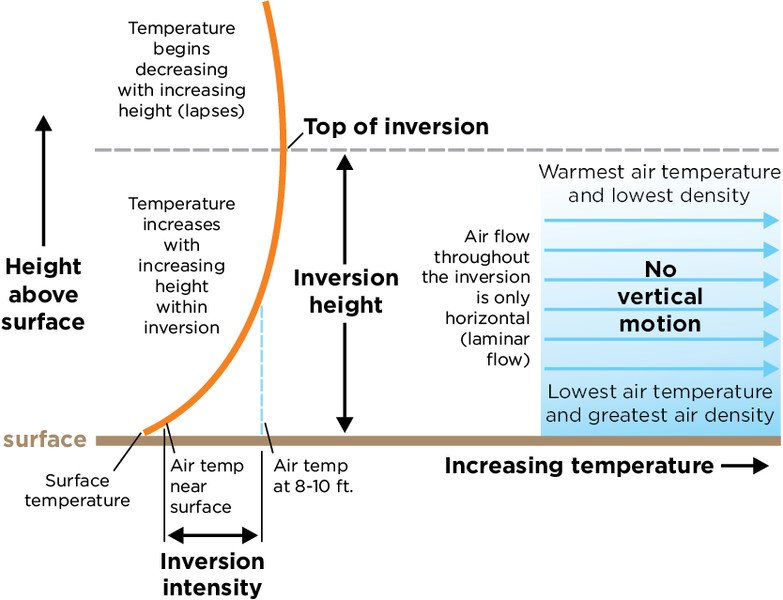
Thermal inversion on a temperature-vs-height graph
One common trap on tests is this. Warm air at the surface is not automatically an inversion. The defining pattern is cool air below warm air aloft.
How Thermal Inversion Traps Pollution
This usually gets tested as a chain of events, so keep the order clear:
- Cool, dense air settles near the ground.
- Warmer, less-dense air sits above it.
- The cool surface air cannot rise through that warmer layer.
- The atmosphere becomes stable, so vertical mixing is weak.
- Pollutants released near the ground stay in a smaller volume of air.
- Pollution spreads mostly sideways, not upward.
- Local pollution concentrations rise.
Pollutants commonly trapped include:
- Smog
- Particulates such as soot, smoke, ash, and dust
- Vehicle exhaust such as carbon monoxide, nitrogen oxides, hydrocarbons, and particles
- Industrial and power-plant emissions
- Smoke from wildfires and residential heating
One of the most important distinctions in this topic is that inversion does not create smog or particulate matter. It allows existing pollutants and pollutant precursors to accumulate near the surface.
Conditions That Form or Strengthen Inversions
Surface cooling
After sunset, the ground loses heat by radiating infrared energy. The air touching the ground cools too, so it can become colder than the air above it.
This is more likely with:
- long nights
- clear skies
- calm winds
- winter conditions
These inversions often form overnight and may break after sunrise as the surface warms again.
Valleys, basins, and cold-air drainage
Cold, dense air flows downhill and pools in low places. The image below shows that cold-air drainage into a valley, with the coldest air trapped near the valley floor and warmer air above it.
- Valleys and basins trap that cold air
- Mountains and hills reduce ventilation
- Pollution can build up for several days
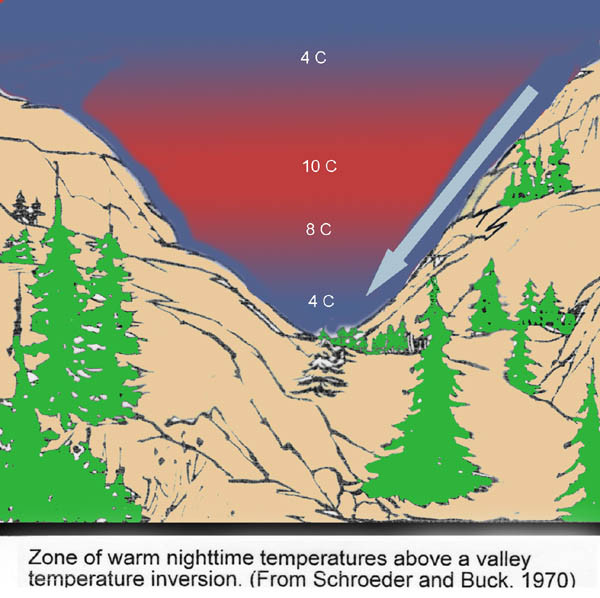
Valley temperature inversion
Sinking air under high pressure
In a high-pressure system, air sinks. As it sinks, it compresses and warms, which can create a warm layer above cooler surface air. High pressure also brings light winds and clear skies, which make stagnation worse.
When pollution episodes are most severe
The worst events happen when several things combine:
- strong or long-lasting inversion
- weak winds
- shallow trapped-air layer
- valley or basin topography
- high emissions from transportation, industry, combustion, or fires
Why Thermal Inversion Matters
The biggest reason it matters is exposure. Pollutants stay where people and land organisms are breathing them.
Effects include:
- higher ground-level ozone and particulate matter
- haze, smoke, smog, and lower visibility
- eye and throat irritation
- asthma flare-ups
- respiratory and cardiovascular stress
- more illness and sometimes premature death during severe events
The inversion itself does not directly damage tissue. The pollutants do that. The inversion changes where those pollutants go and how concentrated they become.
Because you cannot realistically eliminate inversions, the main solutions are:
- air-quality alerts
- temporary limits on industrial activity or open burning
- reduced vehicle use
- long-term emission controls
Examples and Visuals to Recognize
Los Angeles is the classic APES example. Its basin topography, surrounding mountains, heavy vehicle emissions, strong sunlight, cool marine air, and high pressure can combine to trap photochemical smog.
Great Smog of London, 1952 involved coal burning, smoke, sulfur dioxide, fog, calm high-pressure conditions, and an inversion. This is a key reminder that inversions can trap pollution even without photochemical smog.
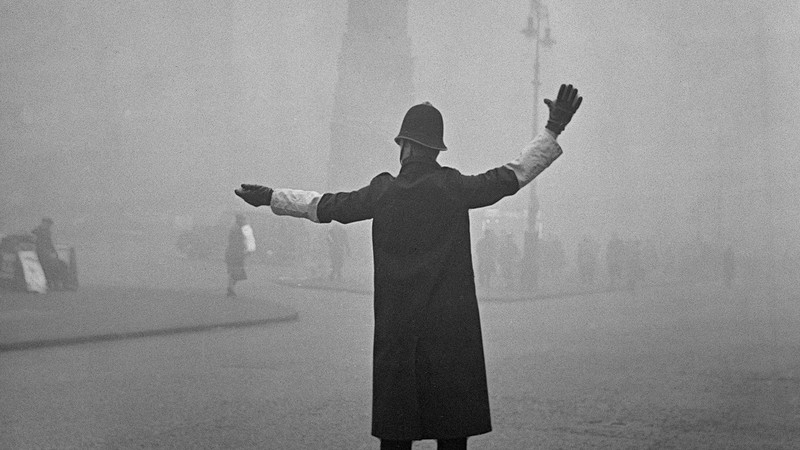
Great Smog of London, 1952
In visuals, be ready to spot:
- a temperature profile where temperature rises with altitude in one layer
- a valley with cold air pooled below warm air
- pollution concentrated under the inversion layer
- a graph where pollutant levels rise during stagnant conditions and fall when wind, warming, or a front breaks the inversion
Key Takeaways
Thermal Inversion
Reversal of the normal temperature gradient in which cool surface air lies beneath warmer air, suppressing vertical mixing and trapping smog, particulates, and other pollutants near the ground
Notes
Thermal Inversion
Reversal of the normal temperature gradient in which cool surface air lies beneath warmer air, suppressing vertical mixing and trapping smog, particulates, and other pollutants near the ground
