Topic 6.10 Notes – Geothermal Energy
What Geothermal Energy Is
Geothermal energy is thermal energy stored in Earth’s interior. That heat comes from two sources:
- Radioactive decay inside Earth
- Leftover heat from Earth’s formation
In APES, geothermal is classified as renewable because Earth keeps supplying internal heat. But be careful with that word. Renewable does not mean unlimited at every site. A specific underground reservoir can cool down or lose pressure if people remove hot water or steam faster than it is naturally replenished.
One distinction students mix up a lot:
- Geothermal power plant = uses underground heat to generate electricity
- Ground-source heat pump = uses the fairly stable shallow ground temperature to heat or cool buildings and usually does not generate electricity
So this topic is about electricity generation, not home heating systems.
How Geothermal Power Plants Generate Electricity
The basic energy conversion is:
Here’s the usual sequence in a geothermal power plant:
- A production well is drilled into a reservoir of hot water or steam.
- The hot fluid rises to the surface.
- If the reservoir contains very hot water under pressure, the pressure drop at the surface can make it flash into steam.
- The steam spins the turbine.
- The turbine drives the generator.
- The generator produces electricity.
- The steam is cooled and condensed back into water.
- The cooled water is sent back underground through an injection well.
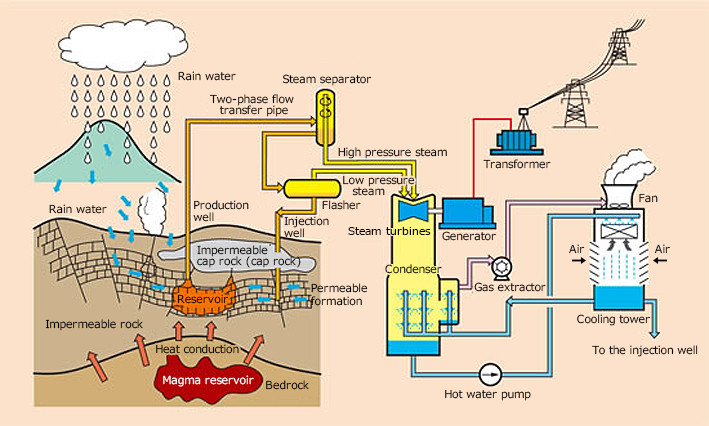
Geothermal power plant diagram
In the diagram, focus on the main flow from the underground reservoir to the turbine and generator, then back to the injection well.
Know the plant parts in one group:
- Underground reservoir
- Production well
- Turbine
- Generator
- Condenser or cooling system
- Injection well
That turbine-generator split is a favorite quiz detail. Steam does not spin the generator directly. It spins the turbine, and the turbine turns the generator.
Plant types vary:
- Some reservoirs provide natural steam
- Some provide hot water that flashes into steam
- Some use geothermal heat to warm a second fluid with a lower boiling point, which then vaporizes and spins the turbine
Reinjection matters because it helps maintain pressure, conserves water, and reduces contaminated fluid discharge at the surface.
Where Geothermal Energy Works Best
Geothermal electricity is geographically limited. It works best where hot rock or magma is close to the surface, especially in:
- Plate boundary regions
- Volcanic areas
- Hot spots
A place can have underground heat and still not be practical to use. Development depends on:
- Temperature
- Rock conditions
- Water or steam availability
- Permeability of the rock, meaning how easily fluids can move through it
Drilling is expensive and risky. A site may turn out to be cooler, smaller, or less productive than expected.
Geothermal has one major reliability advantage over solar and wind. It is not controlled by daylight or short-term weather, so it can provide steady, dispatchable baseload electricity where a good reservoir exists.
Iceland is the classic example. Its volcanic activity and location on the Mid-Atlantic Ridge put heat close to the surface, which makes geothermal development much easier.
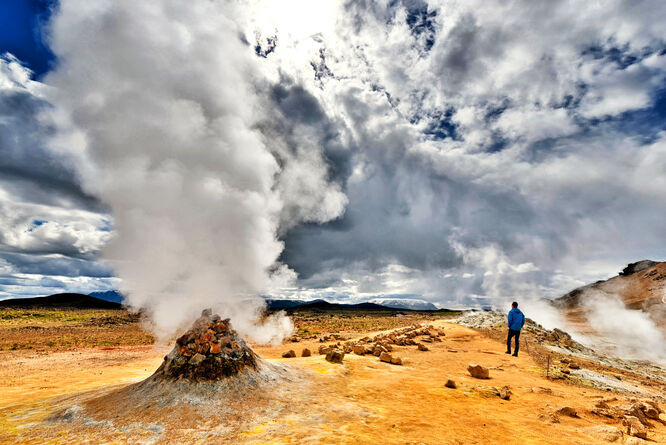
Geothermal area in Iceland
Advantages of Geothermal Power
Why it’s attractive:
- No fuel combustion is needed to create the heat
- Much lower greenhouse gas emissions than coal, oil, or natural gas plants
- Avoids most combustion air pollutants
- Can provide reliable continuous electricity
- Reinjection can support long-term reservoir management
- Usually has a smaller land footprint than many spread-out energy systems
- No continuous mining or fuel transport
- No coal ash or spent nuclear fuel
Costs and Environmental Drawbacks
The biggest economic problem is high upfront cost. Surveys, drilling, wells, pipelines, and plant equipment all cost a lot, and some exploration fails.
Environmental drawbacks include:
- Hydrogen sulfide, can be released from geothermal fluids
- smells like rotten eggs at low concentrations
- is toxic at higher concentrations
- can contribute to air pollution
- Geothermal fluids may contain dissolved salts and minerals
- if not contained and reinjected, they can contaminate soil or surface water
- Overuse can reduce reservoir pressure and cool the site
- Subsidence can happen if fluid removal causes ground compaction
- Induced seismicity can occur when reinjected water changes underground pressure and triggers small earthquakes
- Construction can cause habitat disruption, road building, noise, dust, and water use
The trade-off is clear. Geothermal is a low-emission, reliable energy source, but it is limited by location, cost, and local environmental risks.
Key Takeaways
Geothermal Energy
Thermal energy stored within Earth; in power generation, it produces vapor that spins a turbine connected to an electrical generator
Flashing
Rapid vaporization of high-pressure geothermal water into steam when its pressure decreases near the surface
Hydrogen Sulfide (H₂S)
A toxic, rotten-egg-smelling gas that geothermal fluids can release when brought to the surface
Land Subsidence
Sinking of the ground when geothermal fluid removal lowers pressure and allows underground pore spaces to compact
Induced Seismicity
Small earthquakes caused when injected geothermal water changes pressure in fractured underground rock
Production Well
A well that carries hot water or steam from an underground geothermal reservoir to the surface
Injection Well
A well that returns cooled geothermal water underground to conserve water and help maintain reservoir pressure
Reservoir Depletion
Loss of heat or pressure when water and heat are removed from a geothermal reservoir faster than they are replenished
Notes
Geothermal Energy
Thermal energy stored within Earth; in power generation, it produces vapor that spins a turbine connected to an electrical generator
Flashing
Rapid vaporization of high-pressure geothermal water into steam when its pressure decreases near the surface
Hydrogen Sulfide (H₂S)
A toxic, rotten-egg-smelling gas that geothermal fluids can release when brought to the surface
Land Subsidence
Sinking of the ground when geothermal fluid removal lowers pressure and allows underground pore spaces to compact
Induced Seismicity
Small earthquakes caused when injected geothermal water changes pressure in fractured underground rock
Production Well
A well that carries hot water or steam from an underground geothermal reservoir to the surface
Injection Well
A well that returns cooled geothermal water underground to conserve water and help maintain reservoir pressure
Reservoir Depletion
Loss of heat or pressure when water and heat are removed from a geothermal reservoir faster than they are replenished
