Topic 8.6 Notes – Thermal Pollution
What Thermal Pollution Is
Thermal pollution happens when humans add enough heat to a body of water that the temperature increase causes ecological harm. The pollutant is heat itself. No chemical has to be added.
A couple of boundaries matter here:
- Natural seasonal warming is normal and does not count as thermal pollution unless human activity is causing the harmful change.
- A warmer temperature by itself is not automatically pollution. It becomes pollution when organisms or ecosystem function are negatively affected.
The key relationship you need:
- Dissolved oxygen (DO) is the oxygen available in water for aerobic respiration.
- Warmer water holds less DO
- Colder water holds more DO
That inverse relationship shows up all over this topic and in graph questions. In the graph here, focus on the overall downward trend as temperature increases.
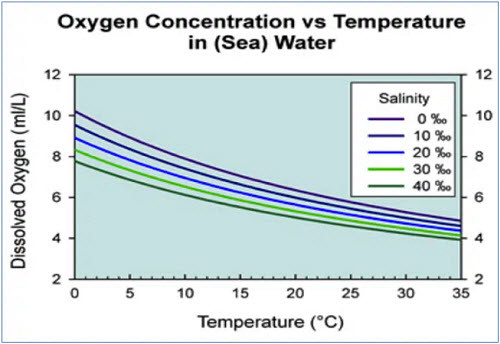
Dissolved oxygen vs. water temperature
Major Sources of Thermal Pollution
You need to know all four common sources because AP questions can name any of them.
Power plants and industrial discharge
This is the classic APES example.
- Power plants and industrial facilities often use water for cooling.
- That water absorbs waste heat from the system.
- It is then discharged back into a river, lake, or ocean at a higher temperature.
This is usually a point source because the warm water comes from an identifiable pipe or outlet. Near that outlet, the warm area is called a thermal plume.
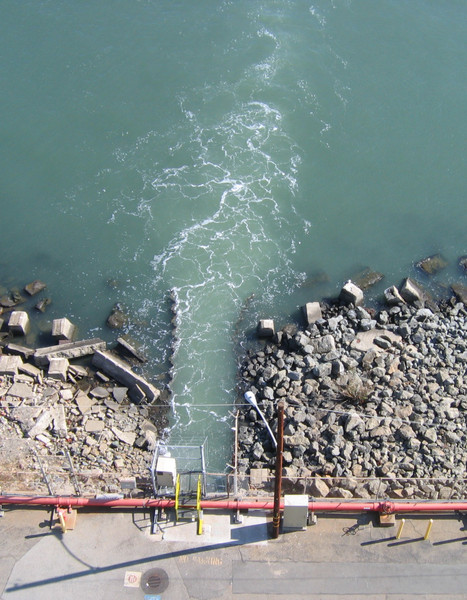
Thermal plume from a discharge outlet
Heated runoff and reduced shading
Some thermal pollution is more spread out.
- Heated urban runoff happens when rain flows over hot pavement and rooftops, then enters streams warmer than before.
- Loss of streamside shade happens when riparian vegetation is removed, letting more sunlight heat the water directly.
These are often nonpoint sources, even though storm drains may funnel the runoff into one place.
How Thermal Pollution Harms Aquatic Ecosystems
The main cause-and-effect chain is very testable:
- Heated discharge or runoff raises water temperature.
- Warmer water has lower oxygen-holding capacity.
- DO decreases.
- Aquatic organisms become stressed, leave, or die.
One wording point matters a lot. Heat does not “use up” oxygen directly. The better explanation is that warming lowers oxygen solubility.
On top of that:
- Many aquatic organisms are ectotherms, so warmer water raises their metabolic rate.
- That means they may need more oxygen at the same time less oxygen is available.
- Microbial respiration and decomposition can also speed up, which raises oxygen demand even more.
Low-oxygen water is called hypoxic. Severe hypoxia can cause fish kills. Effects are strongest near or just downstream from the discharge point, then may weaken as water mixes and cools.
Direct Biological Effects and Community Changes
Temperature can harm organisms even before you talk about DO, because species have a range of tolerance.
Direct effects on organisms
- Thermal shock from sudden temperature change
- Disrupted enzyme activity and body processes
- Higher respiration and energy use
- Lower feeding, growth, and reproduction
- Problems with egg development, hatching, and juvenile survival
- Changes in migration, spawning, and seasonal behavior
- Greater disease susceptibility
Which organisms are most vulnerable
- Cold-water species such as trout and salmon are especially sensitive.
- Eggs, larvae, and juveniles are often the most vulnerable life stages.
- Species that tolerate warm, low-oxygen water may survive and even increase.
Ecosystem-level results
That leads to:
- Shifts in community composition
- Lower biodiversity
- Altered food webs
- Mobile organisms leaving the area, while immobile ones die
Patterns in Data and Ways to Reduce It
What to expect in graphs or field comparisons
Typical pattern near a heated discharge:
- Upstream water is cooler and has higher DO
- Near the outlet temperature is highest and DO is lowest
- Farther downstream temperature drops and DO recovers
That is the pattern shown in the graph here. Temperature rises sharply at the discharge point, dissolved oxygen dips, and both gradually return toward baseline downstream.
So a graph of temperature vs. DO should show a negative relationship.
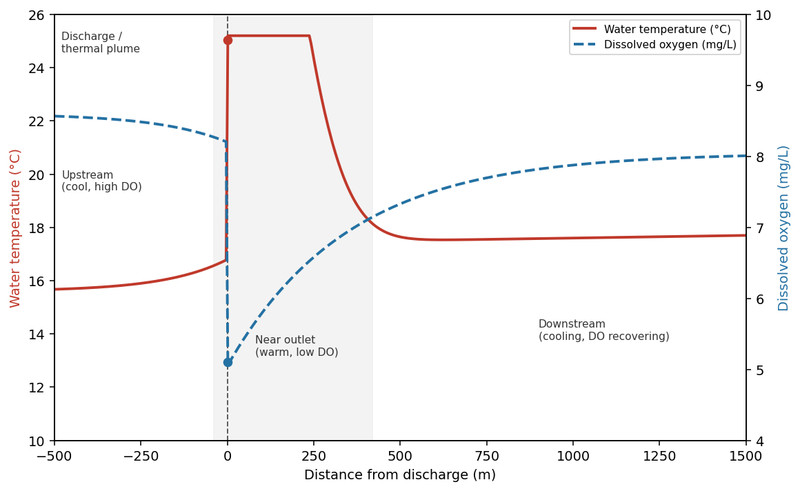
Thermal pollution pattern upstream, at discharge, and downstream
Prevention and mitigation
Common solutions:
- Cooling towers
- Cooling ponds
- Closed-cycle or recirculating cooling systems
- Releasing water only after cooling
- Diffusing discharge to reduce an intense local plume
- Restoring riparian vegetation
- Reducing heated urban runoff with vegetation, permeable surfaces, and infiltration systems
What makes a solution effective
A good solution:
- Lowers the temperature increase
- Helps maintain adequate DO
- Protects temperature-sensitive organisms
Key Takeaways
Thermal Pollution
Human-released heat that raises a body of water’s temperature enough to harm aquatic organisms, often by lowering oxygen solubility and dissolved oxygen
Dissolved Oxygen (DO)
Molecular oxygen available in water for aerobic respiration; warmer water has a lower capacity to hold it than colder water
Thermal Plume
A localized region of unusually warm water created by a heated discharge, usually hottest near the outlet and cooler farther away
Hypoxia
A condition of low dissolved oxygen that can stress, displace, or kill aquatic organisms
Thermal Shock
Abrupt exposure to water outside an organism’s temperature-tolerance range, causing physiological stress and potentially death
Notes
Thermal Pollution
Human-released heat that raises a body of water’s temperature enough to harm aquatic organisms, often by lowering oxygen solubility and dissolved oxygen
Dissolved Oxygen (DO)
Molecular oxygen available in water for aerobic respiration; warmer water has a lower capacity to hold it than colder water
Thermal Plume
A localized region of unusually warm water created by a heated discharge, usually hottest near the outlet and cooler farther away
Hypoxia
A condition of low dissolved oxygen that can stress, displace, or kill aquatic organisms
Thermal Shock
Abrupt exposure to water outside an organism’s temperature-tolerance range, causing physiological stress and potentially death
