Topic 5.16 Notes – Aquaculture
What Aquaculture Is
Aquaculture or aquafarming means raising aquatic organisms in controlled systems, kind of like agriculture in water. Farmers may control feeding, stocking density, breeding, water quality, and harvest.
That makes it different from capture fisheries, which harvest wild organisms from oceans, lakes, or rivers.
The main APES idea is this tradeoff:
- Benefit: concentrated food production can be efficient and productive
- Cost: concentration also means concentrated waste, disease risk, and escape risk
Common farmed organisms include:
- Finfish such as salmon, tilapia, catfish, and carp
- Shellfish/mollusks such as oysters, mussels, and clams
- Crustaceans such as shrimp
- Aquatic plants/algae such as seaweed
Major Aquaculture Systems
Aquaculture systems range from more open systems, which exchange a lot with natural water, to more closed systems, which keep organisms and waste more contained.
Ponds
Ponds are stocked, managed bodies of water used for fish or shrimp. They are simple and productive, but wastewater leaving the pond can be rich in nutrients. In coastal areas, building ponds can also replace wetlands or mangroves, which are valuable habitats.
Raceways and flow-through systems
These are long channels with continuously moving water. The flowing water brings oxygen and carries away waste, which helps support dense populations.
The downside is the outflow. If it is not treated, it can carry:
- feces
- uneaten feed
- nutrients
- pathogens
- chemicals
downstream into natural waters.
Net pens and cages
These are mesh enclosures placed in lakes, bays, or the ocean. A major example is marine salmon farming.
They are a very open system, since the fish are contained but the surrounding water still moves freely through the mesh.
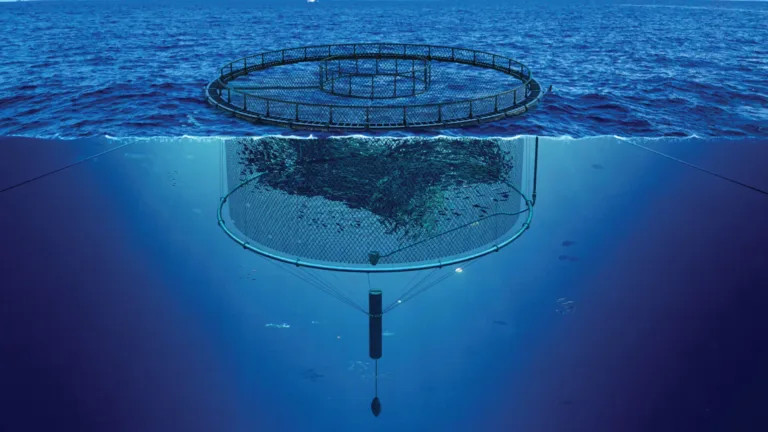
Marine net pen aquaculture
This is one of the most testable systems because the risks are easy to picture:
- Waste passes directly into surrounding water
- Pathogens and parasites can move between farmed and wild fish
- Escapes can happen if nets are damaged
Tanks and recirculating aquaculture systems
These are land-based tanks where water is filtered, treated, oxygenated, and reused. They make it much easier to collect waste, prevent escapes, and control oxygen, temperature, and disease.
The tradeoff is higher construction cost and energy use.
Shellfish and aquatic plant cultivation
Oysters, mussels, clams may be grown on ropes, racks, or beds. Seaweed is often grown on lines.
These are often lower-impact because:
- many shellfish filter-feed naturally
- seaweed absorbs dissolved nutrients
Still, they can alter habitat, interfere with navigation or wildlife, and spread nonnative species or pathogens.
Why Aquaculture Has Expanded
Aquaculture has grown because it can produce a lot of food efficiently.
Efficient food production
Fish are ectotherms, so they do not spend as much energy keeping body temperature constant. Buoyancy also means less energy is spent supporting body weight. More feed energy can go into growth.Small area requirement
High-density farming produces a lot of food in a relatively small space. Be careful here. A small farm footprint does not mean small environmental impact.Low fuel use
Farmers do not have to search huge areas for fish the way commercial fishing boats do. The organisms stay in one place until harvest.Food supply and economic value
Aquaculture gives a more predictable seafood supply and supports jobs and local production.Limits on reducing pressure on wild fish
This benefit is strongest when farmed seafood replaces wild-caught seafood. It is weaker for carnivorous fish that are fed fish meal or fish oil made from wild forage fish.
Main Environmental Drawbacks
Wastewater and eutrophication
Aquaculture effluent can contain feces, uneaten food, ammonia, other nitrogen compounds, phosphorus, suspended solids, pathogens, parasites, antibiotics, pesticides, and disinfectants.
When these nutrients enter water, they can cause eutrophication. That means excess nutrients fuel algal growth, and decomposition later lowers dissolved oxygen, harming aquatic life. Solid waste can also build up below ponds or net pens and damage bottom habitats.
Crowding, disease, and parasites
High stocking density makes disease spread faster. Stress and poor water quality can weaken immunity too. In open systems, disease and parasites can spread from farmed fish to wild fish, which is a classic APES drawback.
Escaped organisms
Fish may escape through torn nets, storms, flooding, or handling mistakes. Escaped organisms may:
- compete with wild fish for food, habitat, or spawning sites
- become invasive if nonnative
- disrupt food webs
- breed with wild fish and reduce local adaptation and genetic distinctiveness
How Aquaculture Becomes More Sustainable
Better management can reduce the biggest problems:
- treat or capture effluent before discharge
- use recirculating systems to reduce wastewater, escapes, and disease exchange
- lower stocking density
- improve sanitation and use vaccination to reduce antibiotic use
- use secure containment and avoid nonnative species or use sterile stocks
- place farms away from mangroves, wetlands, migration routes, and poorly flushed waters
- reduce dependence on wild fish in feed
- favor lower-impact species like shellfish and seaweed
- use integrated multi-trophic aquaculture, where waste from finfish becomes a resource for shellfish or seaweed
Key Takeaways
Aquaculture (Aquafarming)
Cultivation of aquatic organisms under managed conditions, including control of stocking, feeding, breeding, water conditions, or harvesting
Pond Aquaculture
Raising stocked fish or shrimp in managed ponds, which may discharge nutrient-rich water or replace coastal wetlands and mangroves
Raceway Aquaculture
Raising dense fish populations in long, narrow channels with continuously flowing water that supplies oxygen and carries away waste
Net-Pen (Cage) Aquaculture
Raising fish in mesh enclosures in natural waters, allowing water, waste, pathogens, and parasites to pass through while creating escape risks
Recirculating Aquaculture System
A contained tank system that filters, treats, oxygenates, and reuses water, reducing waste discharge, disease exchange, and escapes but requiring substantial energy and investment
Genetic Introgression
Entry of farmed genes into a wild population through interbreeding, potentially reducing local adaptation, genetic distinctiveness, or fitness
Integrated Multi-Trophic Aquaculture
Farming multiple trophic groups so that wastes from one crop become resources for another, such as seaweed absorbing finfish nutrients
Notes
Aquaculture (Aquafarming)
Cultivation of aquatic organisms under managed conditions, including control of stocking, feeding, breeding, water conditions, or harvesting
Pond Aquaculture
Raising stocked fish or shrimp in managed ponds, which may discharge nutrient-rich water or replace coastal wetlands and mangroves
Raceway Aquaculture
Raising dense fish populations in long, narrow channels with continuously flowing water that supplies oxygen and carries away waste
Net-Pen (Cage) Aquaculture
Raising fish in mesh enclosures in natural waters, allowing water, waste, pathogens, and parasites to pass through while creating escape risks
Recirculating Aquaculture System
A contained tank system that filters, treats, oxygenates, and reuses water, reducing waste discharge, disease exchange, and escapes but requiring substantial energy and investment
Genetic Introgression
Entry of farmed genes into a wild population through interbreeding, potentially reducing local adaptation, genetic distinctiveness, or fitness
Integrated Multi-Trophic Aquaculture
Farming multiple trophic groups so that wastes from one crop become resources for another, such as seaweed absorbing finfish nutrients
