Topic 1.9 Notes – Trophic Levels
What Trophic Levels Are
A trophic level is an organism’s feeding position in a pathway of who eats whom. It shows how energy and matter move through an ecosystem.
Here’s the big distinction that shows up on tests all the time:
- Energy flows one way
- It enters ecosystems as high-quality energy, usually from the sun.
- Organisms transfer it through feeding.
- Some is lost as low-quality heat at every step, so ecosystems need a continuous energy input.
- Matter cycles
- Atoms like carbon, nitrogen, phosphorus, and hydrogen in water are conserved.
- They move between organisms and the environment through biogeochemical cycles.
In terrestrial and near-surface marine ecosystems, energy starts with sunlight and moves upward through trophic levels. That steady energy input is what keeps ecosystems functioning and supports the movement of matter through cycles.
The Main Trophic Levels
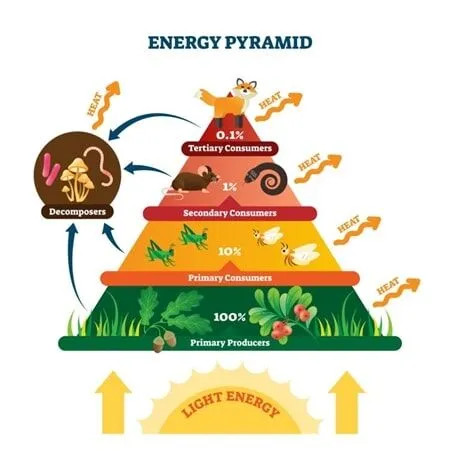
You can picture these feeding roles as trophic levels in an energy pyramid.
Producers
Producers are autotrophs. They make organic compounds from inorganic materials, usually by photosynthesis.
- They convert solar energy into chemical energy stored in sugars and other organic molecules.
- They are the first and lowest trophic level because they introduce usable chemical energy into the biological community.
- Examples:
- grasses, trees, other terrestrial plants
- algae, aquatic plants
- phytoplankton
- photosynthetic bacteria
One exception matters. Chemoautotrophic bacteria can also be producers in some ecosystems, using chemical energy instead of sunlight.
Primary consumers
Primary consumers eat producers.
- Usually herbivores, or organisms that feed on algae/phytoplankton
- Examples:
- caterpillars
- deer
- zooplankton
Secondary consumers
Secondary consumers eat primary consumers.
- Often carnivores or omnivores
- Example: a spider eating a plant-eating insect
Tertiary and higher consumers
These consumers eat secondary consumers or other consumers above them.
- A tertiary consumer eats a secondary consumer.
- An apex predator is the top predator in a pathway or web.
- Those are not always the same thing. An apex predator might be tertiary, or it might be even higher depending on the food web.
Decomposers and the detrital pathway
Dead organisms and waste become detritus.
- Scavengers eat large dead material.
- Detritivores break dead organic matter into smaller pieces.
- Decomposers like fungi and bacteria chemically break it down.
This is a common mistake: decomposers are not just one final top trophic level. They act on material from all trophic levels, which is why the diagram shows them connected to the whole pyramid.
How to assign trophic level
An organism’s trophic level depends on what it eats in that specific pathway.
- Omnivores can occupy more than one trophic level.
- You assign the level from feeding relationships, not from size or how “dangerous” the organism seems.
How Energy Moves Through Trophic Levels
A simple pathway looks like this:
- Sunlight
- Producer
- Primary consumer
- Secondary consumer
- Tertiary consumer
One example is an oak leaf eaten by a caterpillar, then a small bird, then a hawk.
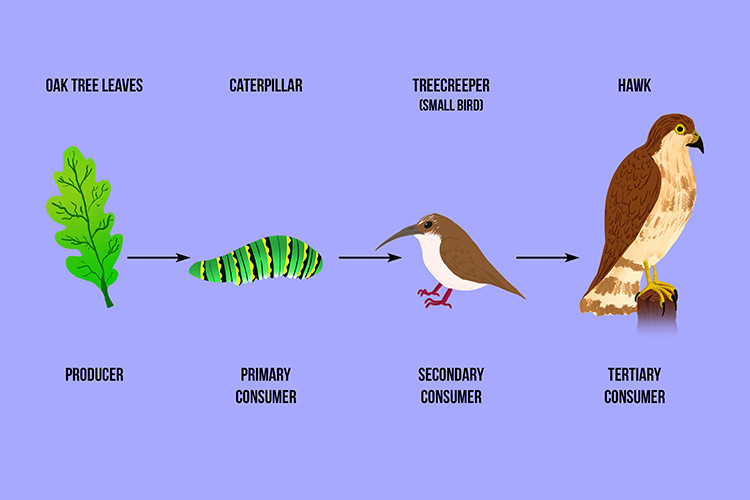
Example: sunlight → oak tree → caterpillar → insect-eating bird → hawk
A key idea here is that producers do not create energy. They convert solar energy into chemical energy. Each feeding event passes some of that chemical energy upward.
At every transfer, organisms use much of the energy for:
- respiration
- movement
- growth
- reproduction
- repair
- active transport
Some energy also stays in uneaten or undigested material. So less usable energy is available at higher trophic levels. That’s why:
- long food chains are uncommon
- upper trophic levels usually have less biomass and fewer individuals
- ecosystems need constant new energy input
How Matter Cycles Through Trophic Levels
The same feeding events that transfer energy also transfer matter. Consumers get carbon, nitrogen, phosphorus, water, and other materials from food.
Matter follows the conservation of matter. Atoms are not created or destroyed. They are rearranged and transferred.
A compact carbon example:
- Carbon dioxide is in the atmosphere.
- A plant uses photosynthesis to put that carbon into tissue.
- An herbivore eats the plant.
- A predator eats the herbivore.
- Respiration, waste, and decomposition return carbon to the atmosphere, soil, or water.
So local ecosystems can gain or lose matter, but across the larger Earth system, matter is conserved. The main cycles tied to this idea are carbon, nitrogen, phosphorus, and water.
How to Read Trophic Diagrams Fast
A trophic pyramid has a broad producer base and higher consumer levels above it. Its shape shows the general decrease in available energy upward.
One easy trap on tests: energy pyramids are not the same as numbers pyramids or biomass pyramids.
In food chains and food webs:
- Arrows point from the food to the consumer
- They show the direction of energy and matter transfer
So if the arrow goes from grass to rabbit, the rabbit eats the grass.
When you read a diagram:
- find the producer first
- trace the arrows
- assign trophic levels from feeding relationships, not from page position
Key Takeaways
Trophic Level
An organism’s feeding position in a pathway of energy and matter transfer, numbered upward from producers
Producer (Autotroph)
An organism that makes organic compounds from inorganic materials and occupies the first trophic level
Photoautotroph
A producer that uses sunlight to make energy-rich organic compounds through photosynthesis
Chemoautotroph
A producer that uses energy from inorganic chemical reactions rather than sunlight to make organic compounds
Primary Consumer
An organism that eats producers and occupies the second trophic level
Secondary Consumer
An organism that eats primary consumers and occupies the third trophic level
Tertiary Consumer
An organism that eats secondary consumers and occupies the fourth trophic level in that feeding pathway
Apex Predator
A predator at the top of a particular food pathway or web with few or no natural predators there
Energy Flow vs. Matter Cycling
Energy requires continuous input, flows one way through trophic levels, and is ultimately dispersed as heat; matter is conserved and cycles between organisms and the environment
Conservation of Matter
Atoms are neither created nor destroyed in ordinary ecosystem processes but are rearranged and transferred
Biogeochemical Cycle
The repeated movement of matter between organisms and abiotic reservoirs such as air, water, soil, rocks, and sediments
Detritus
Dead organisms, shed tissue, and wastes that provide organic matter and energy to detrital feeders and decomposers
Scavenger
An organism that consumes relatively large pieces of dead organisms
Detritivore
An organism that ingests and fragments dead organic material and waste
Decomposer
An organism, especially a fungus or bacterium, that chemically breaks down organic matter and releases simpler substances
Detrital Pathway
The transfer of energy and matter from dead material and waste through scavengers, detritivores, and decomposers
Trophic Pyramid
A diagram with producers at the broad base and consumers in higher tiers, representing decreasing available energy at higher trophic levels
Trophic-Level Diagram Arrows
Arrows point from the organism or material being consumed toward the consumer, showing the direction of energy and matter transfer
Consumer
An organism that obtains chemical energy and organic matter by consuming producers or other consumers
Notes
Trophic Level
An organism’s feeding position in a pathway of energy and matter transfer, numbered upward from producers
Producer (Autotroph)
An organism that makes organic compounds from inorganic materials and occupies the first trophic level
Photoautotroph
A producer that uses sunlight to make energy-rich organic compounds through photosynthesis
Chemoautotroph
A producer that uses energy from inorganic chemical reactions rather than sunlight to make organic compounds
Primary Consumer
An organism that eats producers and occupies the second trophic level
Secondary Consumer
An organism that eats primary consumers and occupies the third trophic level
Tertiary Consumer
An organism that eats secondary consumers and occupies the fourth trophic level in that feeding pathway
Apex Predator
A predator at the top of a particular food pathway or web with few or no natural predators there
Energy Flow vs. Matter Cycling
Energy requires continuous input, flows one way through trophic levels, and is ultimately dispersed as heat; matter is conserved and cycles between organisms and the environment
Conservation of Matter
Atoms are neither created nor destroyed in ordinary ecosystem processes but are rearranged and transferred
Biogeochemical Cycle
The repeated movement of matter between organisms and abiotic reservoirs such as air, water, soil, rocks, and sediments
Detritus
Dead organisms, shed tissue, and wastes that provide organic matter and energy to detrital feeders and decomposers
Scavenger
An organism that consumes relatively large pieces of dead organisms
Detritivore
An organism that ingests and fragments dead organic material and waste
Decomposer
An organism, especially a fungus or bacterium, that chemically breaks down organic matter and releases simpler substances
Detrital Pathway
The transfer of energy and matter from dead material and waste through scavengers, detritivores, and decomposers
Trophic Pyramid
A diagram with producers at the broad base and consumers in higher tiers, representing decreasing available energy at higher trophic levels
Trophic-Level Diagram Arrows
Arrows point from the organism or material being consumed toward the consumer, showing the direction of energy and matter transfer
Consumer
An organism that obtains chemical energy and organic matter by consuming producers or other consumers
