Topic 8.12 Notes – Lethal Dose 50% (LD50)
What LD50 Is
LD50 stands for lethal dose 50%. You may also see it called the median lethal dose.
Here’s the full idea. It is the dose of a chemical that kills 50% of a population of a particular species under specific test conditions. APES uses it as a standardized measure of acute toxicity, which means short-term poisoning effects.
A quick unpacking of the term helps:
- Lethal means the response being measured is death.
- Dose means the amount of chemical received by the organism.
- 50% means half the test population dies.
That last part matters a lot. LD50 is a population statistic, not a prediction for one organism. Individuals vary. At the same dose, some organisms may die and others may survive because susceptibility differs.
How LD50 Is Reported and Compared
LD50 is usually reported in milligrams of chemical per kilogram of body mass, written as mg/kg.
Body mass matters because the same amount of poison is a much larger exposure for a small organism than for a large one.
The calculation you may need is
Example
If a chemical has an LD50 of and the organism has a mass of , then
So 10 mg is the amount corresponding to the LD50 for that organism mass.
Common test mistake: if mass is given in grams, convert to kilograms first.
Comparing toxicity
- Lower LD50 = higher acute toxicity
- Higher LD50 = lower acute toxicity
Comparison set:
- Chemical A = 8 mg/kg
- Chemical B = 75 mg/kg
- Chemical C = 1,200 mg/kg
So A is most acutely toxic and C is least acutely toxic.
Be careful with comparisons. Only compare LD50 values when these match:
- species
- route of exposure
- units
- test conditions
A higher LD50 does not mean the chemical is safe.
How LD50 Is Determined
Scientists test groups of organisms from one species at different doses. A control group gets no chemical, or only the carrier substance.
Conditions are kept the same so the dose is the main difference:
- same species
- similar age or life stage and health
- same exposure route
- same observation period
Basic procedure
- Select comparable test groups.
- Give different measured doses to treatment groups.
- Observe for a set time.
- Record how many die in each group.
- Estimate the dose linked to 50% mortality.
A dose-response graph helps visualize that estimate.
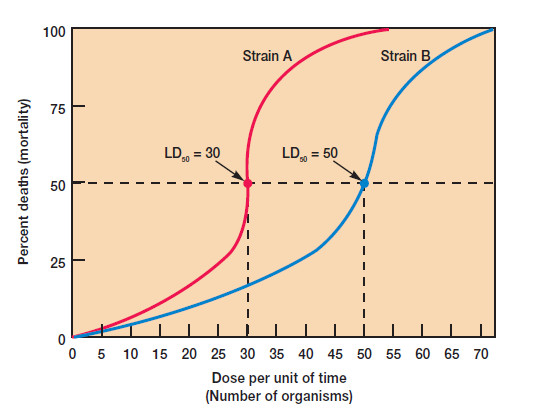
Dose-response curves and LD50
On the graph, dose is on the x-axis and percent deaths is on the y-axis. The LD50 is the dose lined up with 50% mortality.
One thing students miss is that you do not need one test group with exactly 50% deaths. The LD50 can be statistically estimated from the overall data.
What Affects an LD50 Value
An LD50 is not one universal number for a chemical. Its meaning includes the chemical, the value and units, the species, and the exposure route.
Species
Different species absorb, break down, store, and remove chemicals differently. So an LD50 from rats or fish does not directly equal a human LD50.
Route of exposure
The route changes toxicity:
- oral = swallowed
- dermal = through skin
- inhalation = breathed in
The same chemical can have different LD50 values for each route.
Exposure conditions
LD50 usually describes acute exposure, meaning one dose or short-term exposure. Age, sex, health, genetics, and chemical formulation can also change results.
What LD50 Can and Cannot Tell You
LD50 tells you one measure of hazard. It is good for comparing acute lethal toxicity.
It does not tell you about:
- chronic low-level exposure effects
- cancer risk
- endocrine disruption
- reproductive or developmental harm
- organ or nervous-system damage without immediate death
- bioaccumulation
- biomagnification
- broader ecological impacts
This is where toxicity and risk get separated. LD50 describes toxicity. Risk also depends on exposure amount, frequency, duration, route, and susceptibility.
LD50 and LC50
- LD50 = dose received by an organism, usually mg/kg
- LC50 = concentration in air or water that kills 50% of a population during a set time
LC50 is often used for aquatic organisms or inhalation studies.
Interpretation mistakes
LD50 does not mean:
- every organism below that dose survives
- every organism above that dose dies
- the chemical is harmless below that value
- the number transfers directly across species or exposure routes
Key Takeaways
Lethal Dose 50% (LD50) / Median Lethal Dose
The dose of a chemical that kills 50% of a test population of a particular species under specified exposure conditions, usually reported in mg/kg
Lethal Concentration 50% (LC50)
The concentration of a substance in air, water, or another medium that kills 50% of a test population during a specified exposure period
Notes
Lethal Dose 50% (LD50) / Median Lethal Dose
The dose of a chemical that kills 50% of a test population of a particular species under specified exposure conditions, usually reported in mg/kg
Lethal Concentration 50% (LC50)
The concentration of a substance in air, water, or another medium that kills 50% of a test population during a specified exposure period
