Topic 3.2 Notes – K-Selected r-Selected Species
What K-Selected and r-Selected Species Are
Every species faces the same problem. It has limited energy. Energy spent on one thing, like producing lots of offspring, cannot also be spent on making each offspring larger or protecting it.
That trade-off creates two general patterns.
- r means intrinsic capacity for increase. It connects to how fast a population could grow.
- K means carrying capacity, which is the maximum population size an environment can support over time.
So the big contrast is this:
- K-selected species put more energy into fewer offspring.
- r-selected species put less energy into many offspring.
These are ends of a continuum, not strict boxes. A species is classified by a cluster of traits, not by one detail alone. A large body size can hint at K-selection, for example, but size by itself is never enough. Some species are intermediate, and some shift depending on conditions.
Traits of K-Selected and r-Selected Species
Here’s the comparison APES wants you to know.
| Trait | K-selected | r-selected |
|---|---|---|
| Body size | Relatively large | Relatively small |
| Offspring per event | Few | Many |
| Energy per offspring | High | Low |
| Parental care | Considerable | Little or none |
| Development | Slow | Rapid |
| Age at maturity | Late | Early |
| Life span | Long | Short |
| Reproduction over lifetime | More than once common | May reproduce once |
| Maximum reproductive rate | Low | High |
| Typical environment | Stable | Disturbed, temporary, unpredictable |
| Competition | High | Relatively low, especially during colonization |
K-selected species
Examples you should recognize are elephants, humans, whales, bears, bison, eagles, and parrots. These species usually live where resources are already being used, so competition is intense.
r-selected species
Examples include insects, bacteria, small rodents, annual grasses, and dandelions. These species do well when open space or newly available resources appear.
What to use to classify a species
Use several traits together:
- number of offspring
- investment per offspring
- age at maturity
- life span
- frequency of reproduction
- environmental stability
- degree of competition
- maximum potential reproductive rate
A related pattern you may also see is a survivorship curve. K-selected species often resemble Type I, with high survival until old age, and many r-selected species resemble Type III, with heavy early mortality.
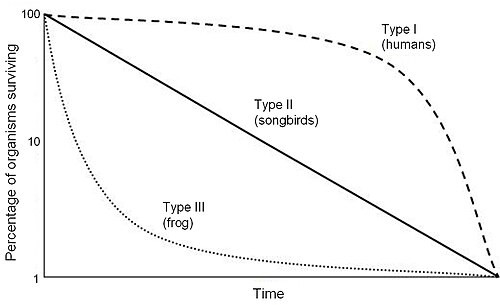
Survivorship curves: Types I, II, and III
Why These Strategies Work in Different Environments
In stable environments, populations often stay near carrying capacity. That means space, food, light, or nesting sites are already occupied. Offspring need to be competitive, so K-selected traits are favored. Fewer offspring survive better because each gets more investment.
In disturbed or unpredictable environments, there may suddenly be open habitat and available resources after fire, flood, clearing, or other change. In that setting, early reproduction and many offspring help a species spread quickly. That favors r-selected traits.
The trade-off to lock in is simple:
- K-selected populations grow slowly but invest in offspring quality.
- r-selected populations can grow fast but many offspring die early.
There’s also a survivorship connection:
- K-selected species usually show Type I or Type II survivorship.
- r-selected species usually show Type III survivorship.
That pattern helps support classification, but survivorship does not define it.
Biotic Potential and Population Recovery
Biotic potential is the maximum reproductive rate of a population under ideal conditions, meaning lots of resources and few limiting factors.
It is not the same as actual growth in nature. Real ecosystems have predation, disease, competition, and limited resources.
Traits linked to high biotic potential include:
- early maturity
- short generation time
- frequent or rapid reproduction
- many offspring
So r-selected species usually have higher biotic potential than K-selected species.
On graphs or in data, watch for these patterns:
- more offspring usually means less parental investment per offspring
- later maturity usually means lower maximum reproductive rate
- after disturbance, the more r-selected species usually rebounds faster
- long generation time, low reproductive output, and slow recovery point to K-selection
Invasive Species and Exceptions to the Pattern
Most invasive species are r-selected because they mature quickly, reproduce a lot, disperse widely, and colonize disturbed habitat fast. A classic example is the zebra mussel.
K-selected species are usually harmed more by invasive species because they cannot replace lost individuals quickly. Late maturity and low reproductive output slow recovery. r-selected species are generally less affected because they can replace individuals faster.
Still, don’t force every organism into a box.
- not every invasive species is r-selected
- not every mammal is K-selected
- not every plant or insect is r-selected
When the evidence is mixed, call the species intermediate on the continuum.
Key Takeaways
K-Selected Species (K-Selection)
Species that tend to be large, mature late, live long, produce few offspring, invest substantial energy and parental care in each, and reproduce repeatedly in stable, highly competitive environments; their low biotic potential makes recovery slow and increases vulnerability to invasive species
r-Selected Species (r-Selection)
Species that typically mature early, produce many offspring with little parental investment, have short life spans, and increase rapidly in disturbed or unpredictable, low-competition environments; most invasive species display these traits
Biotic Potential
The maximum reproductive rate of a population under ideal conditions
r–K Selection Continuum
The spectrum of reproductive strategies between r- and K-selected endpoints; species may combine traits, occupy intermediate positions, or change strategies with conditions
Notes
K-Selected Species (K-Selection)
Species that tend to be large, mature late, live long, produce few offspring, invest substantial energy and parental care in each, and reproduce repeatedly in stable, highly competitive environments; their low biotic potential makes recovery slow and increases vulnerability to invasive species
r-Selected Species (r-Selection)
Species that typically mature early, produce many offspring with little parental investment, have short life spans, and increase rapidly in disturbed or unpredictable, low-competition environments; most invasive species display these traits
Biotic Potential
The maximum reproductive rate of a population under ideal conditions
r–K Selection Continuum
The spectrum of reproductive strategies between r- and K-selected endpoints; species may combine traits, occupy intermediate positions, or change strategies with conditions
