Topic 6.1 Notes – Renewable and Nonrenewable Resources
What Renewable and Nonrenewable Resources Are
The whole distinction comes down to replenishment rate.
- A nonrenewable resource exists in a finite stock on a human timescale.
- People use it much faster than nature replaces it.
- Once used, the original fuel is not easily re-created by the same process.
- A renewable resource is replenished naturally at or near the rate people consume it.
- It can keep being used if use stays within that renewal rate.
The phrase on a human timescale matters a lot. Fossil fuels do form naturally, but over millions of years. For a society using them over years or decades, that is far too slow, so they count as nonrenewable.
A common test trap is thinking renewable means unlimited. It doesn’t. A resource can be renewable and still be used unsustainably if people take it faster than it comes back.
Major Energy Sources and How They Are Classified
Here are the main sources you need to know for this topic.
Nonrenewable sources
- Fossil fuels
- Coal
- Petroleum (crude oil)
- Natural gas
- These formed from ancient organic matter over millions of years.
- When burned, their chemical energy becomes heat and combustion products, so the original fuel is gone.
- Even large deposits are still finite stocks.
- Nuclear fuel
- Uranium, especially uranium-235
- Uranium is mined from finite ore deposits.
- Fission releases energy, but it does not recreate usable uranium fuel.
- Nuclear is nonrenewable, even though it does not burn fossil fuel during electricity generation.
Renewable sources
- Solar energy
- Sunlight continually reaches Earth, and using it does not reduce future sunlight supply.
- Wind energy
- Wind is driven by uneven solar heating and atmospheric motion.
- It uses a recurring flow, not a fuel deposit.
- Hydroelectric and tidal energy
- Hydroelectric depends on the hydrologic cycle.
- Tidal energy depends on the gravity of Earth, Moon, and Sun.
- Geothermal energy
- Uses Earth’s internal heat.
- Renewable overall, but a local reservoir can be overused.
- Biomass
- Includes wood, crop material, and plant-based fuels.
- Potentially renewable because it can regrow.
- In practice, it is renewable only when harvest does not exceed regrowth.
One category that often confuses students is biomass. It is renewable when managed sustainably, but it is also burnable, which is why it overlaps with fossil fuels in the diagram below.
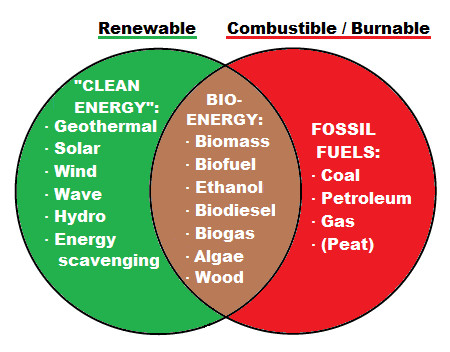
Renewable, burnable, and bioenergy categories
Stocks, Flows, and the Replenishment Rule
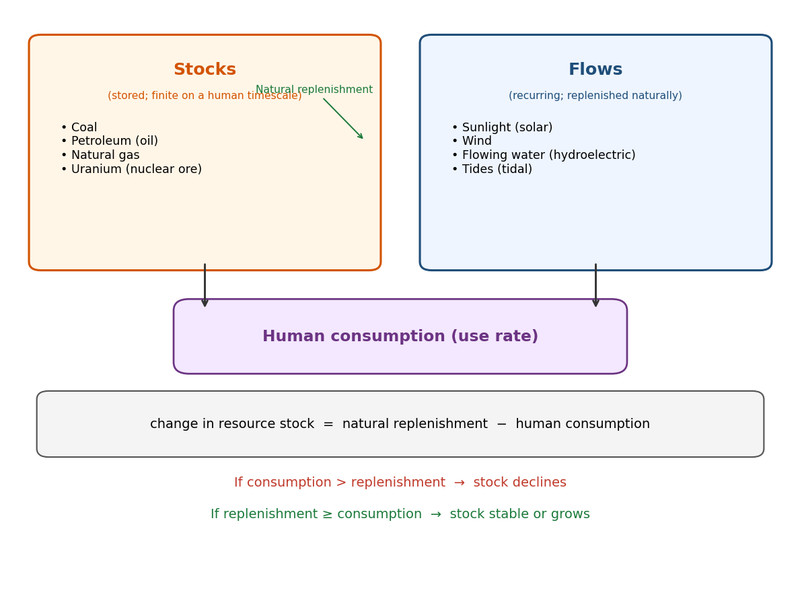
A helpful way to picture this is stocks vs. flows.
- Stocks are stored-up quantities that can be drawn down.
- Coal seams, oil fields, natural-gas deposits, uranium ores
- Flows are energy sources that continually arrive or recur.
- Sunlight, wind, flowing water, tides
That basic split is shown in the diagram here, and it ties directly to the replenishment rule.
Some cases are mixed.
- Biomass has a standing stock, like a forest, but it can regrow.
- Geothermal uses stored heat that may recharge over time.
The key relationship is:
- If consumption > replenishment, the stock declines.
- If replenishment consumption, the stock can stay stable or grow.
How to Classify a Resource in Context
When you classify a resource, look at the primary energy source, not the image of the technology.
- Identify what resource is actually being used.
- Ask whether it is a finite stock or a recurring/replenishable source.
- Compare replenishment rate with consumption rate.
- Classify it from that comparison.
Examples:
- Coal-fired power plant → nonrenewable
- Nuclear power plant → nonrenewable
- Wind farm → renewable
- Wood-burning plant from a managed forest → renewable only if regrowth matches harvest
The big mistake is confusing renewable with clean. Biomass can be renewable and still create air pollution. Nuclear can have low direct air emissions during operation and still be nonrenewable.
What the Classification Does and Does Not Tell You
Renewable does not mean impact-free.
- Solar and wind need land and materials.
- Hydroelectric can alter rivers.
- Wind turbines can kill wildlife.
- Biomass burning causes air pollution.
- Mining is still involved in many systems.
Nonrenewable does not always mean worst direct emissions. Nuclear is the main example.
Also, electricity is an energy carrier, not a primary energy source. Its classification depends on how it was generated.
- Electricity from wind, solar, or flowing water → renewable electricity
- Electricity from coal, natural gas, or uranium → nonrenewable electricity
Key Takeaways
Nonrenewable Energy Resource
An energy resource in finite supply that is consumed much faster than natural processes can replace it on a human timescale
Renewable Energy Resource
An energy resource naturally replenished at or near its rate of consumption, allowing repeated use without exhausting a fixed stock
Fossil Fuels
Coal, petroleum, and natural gas formed from ancient organic matter over millions of years; finite fuels consumed far faster than they form
Nuclear Energy (Nuclear Power)
Energy released by splitting uranium nuclei; nonrenewable because reactors consume uranium from finite ore deposits
Solar Energy
Renewable energy from continually arriving solar radiation, whose capture does not meaningfully reduce future sunlight
Wind Energy
Renewable energy from moving air continually generated by uneven solar heating and influenced by Earth’s rotation
Hydroelectric Power
Renewable energy from flowing water replenished by the solar-driven hydrologic cycle
Tidal Energy
Renewable energy from recurring tidal motion caused by gravitational interactions among Earth, the Moon, and the Sun
Geothermal Energy
Energy from Earth’s internal heat; renewable on human timescales, though a local reservoir can be depleted by excessive use
Biomass
Recently living material used for energy; potentially renewable when biological regrowth replaces it at or near the harvesting rate
Energy Stock
An accumulated quantity of an energy resource that can be drawn down, such as a coal deposit, oil field, or uranium ore
Energy Flow
Energy that continually arrives or recurs, such as sunlight, wind, flowing water, or tides
Energy Carrier
A form that transports usable energy rather than supplying primary energy; electricity’s renewable status depends on the source that generated it
Notes
Nonrenewable Energy Resource
An energy resource in finite supply that is consumed much faster than natural processes can replace it on a human timescale
Renewable Energy Resource
An energy resource naturally replenished at or near its rate of consumption, allowing repeated use without exhausting a fixed stock
Fossil Fuels
Coal, petroleum, and natural gas formed from ancient organic matter over millions of years; finite fuels consumed far faster than they form
Nuclear Energy (Nuclear Power)
Energy released by splitting uranium nuclei; nonrenewable because reactors consume uranium from finite ore deposits
Solar Energy
Renewable energy from continually arriving solar radiation, whose capture does not meaningfully reduce future sunlight
Wind Energy
Renewable energy from moving air continually generated by uneven solar heating and influenced by Earth’s rotation
Hydroelectric Power
Renewable energy from flowing water replenished by the solar-driven hydrologic cycle
Tidal Energy
Renewable energy from recurring tidal motion caused by gravitational interactions among Earth, the Moon, and the Sun
Geothermal Energy
Energy from Earth’s internal heat; renewable on human timescales, though a local reservoir can be depleted by excessive use
Biomass
Recently living material used for energy; potentially renewable when biological regrowth replaces it at or near the harvesting rate
Energy Stock
An accumulated quantity of an energy resource that can be drawn down, such as a coal deposit, oil field, or uranium ore
Energy Flow
Energy that continually arrives or recurs, such as sunlight, wind, flowing water, or tides
Energy Carrier
A form that transports usable energy rather than supplying primary energy; electricity’s renewable status depends on the source that generated it
