Topic 5.1 Notes – The Tragedy of the Commons
What the Tragedy of the Commons Is
The tragedy of the commons happens when a shared resource gets overused because each person acts in their own short-term interest.
A commons is a resource used by many people. In APES, this is usually a common-pool resource, which means:
- it is hard to keep people out
- one person’s use leaves less quantity or quality for others
The core idea is simple:
- the private benefit goes to the user
- the environmental cost gets spread across everyone
That is why this is such a classic APES idea. Individually rational decisions can create a collectively harmful outcome. The resource does not have to disappear completely. It can also be degraded, less productive, or less able to recover.
Commons Most Vulnerable to Overuse
Some shared resources are much more likely to face this problem. Risk is highest when:
- access is open or weakly controlled
- many independent users draw from the same resource
- extra use gives an immediate personal gain
- environmental costs are delayed, shared, or hard to see
- the resource is finite, or renewable but only up to a certain regeneration rate
- ownership and responsibility are unclear
- rules, monitoring, or enforcement are weak
- users do not trust others to conserve
- demand is high compared with supply or renewal
Open-access resources
These have few or no effective restrictions. Anyone can use them, so they face the highest risk of overuse.
Common-property resources
These are shared by a defined group. They do not automatically end in tragedy if the group has clear rules, monitoring, and penalties.
Private ownership
Private ownership can encourage stewardship because the owner may want long-term value. It still does not guarantee sustainability if the owner can push costs onto others through externalities.
How the Tragedy Happens
This usually follows the same pattern.
- A shared resource provides benefits to many users.
- One user gets an immediate benefit from taking or using more.
- That user pays only part of the long-term environmental cost.
- Other users face the same incentive and also increase use.
- Total use exceeds the resource’s ability to recover or absorb damage.
- The resource declines in quantity, quality, or both.
- Everyone loses benefits in the long run.
The pasture diagram below shows that progression from use below carrying capacity to overuse and eventual degradation.
A negative externality is a cost imposed on others that the user does not fully pay. That is the engine of the tragedy.
Common reasoning traps show up on tests because they explain why overuse continues:
- “My one extra use won’t matter.”
- “If I conserve, others will just take it.”
- “I should use it now before someone else does.”
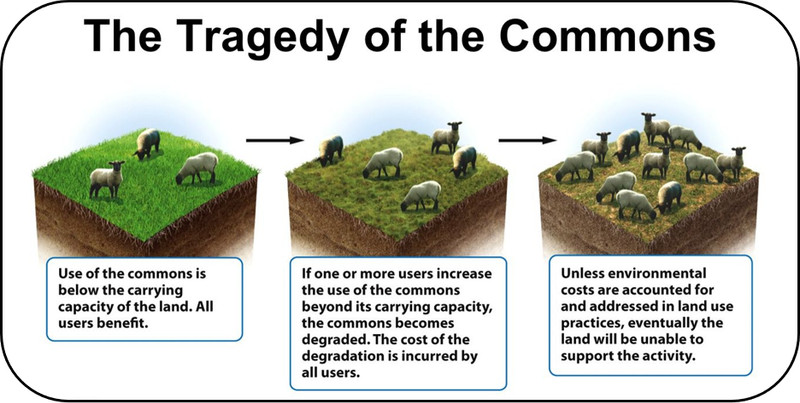
Tragedy of the commons in a shared pasture
Classic Example and Other APES Examples
Shared pasture example
Garrett Hardin’s classic model uses shared grazing land. Each herder gets the full benefit of adding one more animal, but the damage from overgrazing is shared by all.
If livestock numbers exceed carrying capacity, plants cannot regrow fast enough. Then:
- plant cover declines
- erosion risk increases
- soil compaction reduces infiltration
- pasture productivity falls for everyone
The tragedy is not grazing itself. It is grazing beyond sustainable limits.
Other environmental applications
- Ocean fisheries: overharvest lowers the breeding population.
- Rivers and lakes: overwithdrawal or waste discharge harms downstream users.
- Aquifers: pumping faster than recharge lowers the water table.
- Forests open to harvest: too much logging reduces long-term productivity.
- Wildlife populations: shared populations can be overharvested.
- Atmosphere’s capacity to receive pollutants: emissions can exceed what the atmosphere can absorb without harm.
How a Commons Can Be Managed
Management works by changing incentives so individual choices match long-term sustainability better.
Laws and regulations
Quotas, catch limits, hunting seasons, grazing limits, pollution standards, and protected areas can keep use within ecological limits. They only work if they are based on good data and actually enforced.
Assigned rights or privatization
Water rights, grazing rights, fishing rights, and harvest shares can reduce open-access pressure. They can still create unfair access or leave externalities in place.
Taxes, fees, and tradable permits
These make users bear more of the cost they create. They can also fund monitoring and restoration.
Community-based management
Local users can make and enforce rules. This works best with clear boundaries, communication, monitoring, and penalties.
Education and voluntary cooperation
Awareness and social pressure can help, but by themselves they are often too weak when strong economic incentives push people to overuse the resource.
Key Takeaways
Tragedy of the Commons
Depletion or degradation of a shared resource when users pursue individual short-term benefits while distributing the environmental costs among everyone
Commons
A resource shared by multiple users
Common-Pool Resource
A shared resource from which users are difficult to exclude and where one person’s use reduces its quantity or quality for others
Negative Externality
A cost of an activity that is not fully paid by the person or organization creating it
Open-Access Resource
A resource lacking effective restrictions on who may use it or how much each user may take
Common-Property Resource
A resource owned or governed collectively by a defined community, which may establish rules to prevent overuse
Notes
Tragedy of the Commons
Depletion or degradation of a shared resource when users pursue individual short-term benefits while distributing the environmental costs among everyone
Commons
A resource shared by multiple users
Common-Pool Resource
A shared resource from which users are difficult to exclude and where one person’s use reduces its quantity or quality for others
Negative Externality
A cost of an activity that is not fully paid by the person or organization creating it
Open-Access Resource
A resource lacking effective restrictions on who may use it or how much each user may take
Common-Property Resource
A resource owned or governed collectively by a defined community, which may establish rules to prevent overuse
