Topic 9.6 Notes – Ocean Warming
What Ocean Warming Is
Ocean warming means ocean temperatures increase over time because human activities raise greenhouse gas levels.
A quick reminder on the greenhouse effect helps this make sense. Greenhouse gases absorb and reemit infrared radiation, which creates an energy imbalance. Earth keeps more heat than it would otherwise lose to space.
That gives you the main chain:
- Human activities increase greenhouse gases
- The enhanced greenhouse effect traps more heat
- The ocean absorbs most of the excess heat
- Ocean temperatures rise
The ocean has absorbed more than 90% of the excess heat in recent decades. That is a huge APES point.
Why doesn’t the ocean heat up as fast as land?
- Water has high specific heat. It takes a lot of energy to raise its temperature.
- So oceans can store a lot of heat without warming as quickly as land surfaces.
Warming also is not even everywhere:
- Surface water usually warms faster than deep water
- Currents and mixing move heat from place to place
- Some regions warm faster than others
A sea-surface temperature anomaly map makes that uneven warming easier to see.
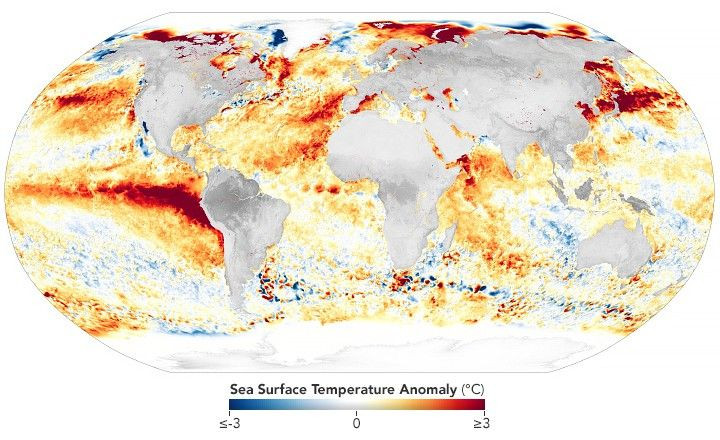
Sea-surface temperature anomaly map
You may see this data shown as:
- Sea-surface temperature anomaly
Anomaly means the difference from a baseline average, not the actual temperature. - Ocean heat content
This shows how much thermal energy is stored in the ocean.
Short-term events can change temperatures too, but they are not the same as the long-term trend.
- El Niño can temporarily raise sea-surface temperatures in some regions
- El Niño does not cause long-term global ocean warming
- Marine heat waves are short periods of unusually warm ocean water that can cause major stress to organisms
How Ocean Warming Affects Marine Organisms
Marine species have tolerance ranges. They do best within a certain temperature range and get stressed outside it. Some warm-adapted species may benefit, but many species are harmed once temperatures pass their limits.
Metabolic changes
Many marine organisms are ectotherms, which means their body processes depend on surrounding water temperature.
As water warms within a tolerable range:
- Metabolism and respiration usually increase
- Feeding and energy demand usually increase
Once temperature rises above the optimum range:
- Growth drops
- Immune function weakens
- Reproduction declines
- Survival can decrease
Prolonged heat stress can kill organisms. It gets worse because warmer water holds less dissolved oxygen, so organisms may need more oxygen at the same time less is available.
Reproductive changes
Warming can change:
- Spawning and migration timing
- Egg and larval development
- Fertility and growth rate
- Age at maturity
A common effect is a timing mismatch. Young may hatch when their food source is not available. Some adults survive heat stress but produce fewer offspring, so population declines can show up later.
Habitat loss and range shifts
Habitat is not just a place. It also includes conditions like temperature.
- If water becomes too warm, thermal habitat is lost
- Mobile species may move poleward, deeper, or into cooler-current regions
- Moving does not always solve the problem if food or breeding sites are missing
The most vulnerable species are:
- Species with narrow tolerance ranges
- Species with limited dispersal
- Sessile organisms like corals, which cannot relocate quickly
Coral Bleaching
Coral reefs are the main case study for this topic. Corals are animals made of polyps that secrete calcium carbonate skeletons. Reef-building corals depend on mutualistic photosynthetic algae called zooxanthellae.
Those algae:
- Provide much of the coral’s energy
- Give coral much of its normal color
Bleaching happens in a sequence:
- Water temperature rises above coral tolerance
- Heat stress disrupts the coral-algae relationship
- Coral expels algae or loses algal pigments
- The white skeleton shows through
- Coral loses a major energy source
The image below shows that progression from healthy coral to bleached coral, and then to dead coral if stress continues.
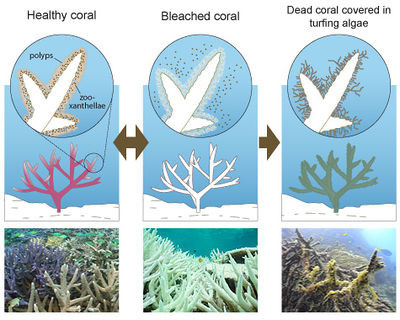
Coral bleaching sequence
Bleaching is not the same as death. A bleached coral is still alive at first. If temperatures return to tolerable levels soon enough, it may recover. Severe or repeated bleaching can lead to death.
Illustrative example:
- Great Barrier Reef bleaching during the 2015-2016 El Niño period
El Niño intensified the short-term heat stress, but the long-term warming trend made bleaching more likely.
Why Coral Bleaching and Ocean Warming Matter
When coral declines, the whole reef ecosystem changes.
- Reef structure becomes less complex as skeletons erode
- Fish and invertebrates lose shelter, feeding areas, and nursery habitat
- Food webs and species composition shift
- Algae may replace coral, which makes recovery harder
Important ecosystem services can decline:
| Service | Why it matters |
|---|---|
| Fisheries | Reefs support fish populations people harvest |
| Tourism | Healthy reefs attract visitors and support local economies |
| Biodiversity support | Reefs provide habitat for many species |
| Shoreline protection | Reefs reduce wave energy and coastal erosion |
Local stressors make reefs less resilient:
- Pollution
- Sedimentation
- Overfishing
Responses include:
- Reducing greenhouse gas emissions overall
- Reducing nutrient pollution and sewage discharge
- Limiting sediment runoff
- Protecting herbivorous fish
- Using marine protected areas
- Supporting reef restoration and monitoring
Local actions help reefs recover better, but they do not stop ocean warming itself.
Distinctions to Keep Straight
A few mix-ups show up all the time on tests.
- Ocean warming means higher ocean temperature from absorbed heat
- Ocean acidification means lower pH from dissolved
- Ocean warming is different from ozone depletion
- Ozone depletion raises UV exposure. It does not cause ocean warming.
- Ocean warming contributes to thermal expansion and sea-level rise, but those are separate effects.
- Coral bleaching is different from coral death
- Bleached coral may recover
- Dead coral cannot
Key Takeaways
Ocean Warming
Long-term increase in ocean temperature as rising atmospheric greenhouse gases retain heat and the ocean absorbs most of the excess energy
Ocean Heat Content
The amount of thermal energy stored in the ocean; it can rise even while atmospheric temperature fluctuates
Temperature Anomaly
The difference between an observed temperature and the average for a designated reference period
Marine Heat Wave
A period of unusually high ocean temperature in a region that can push organisms beyond their thermal tolerance
Temperature Tolerance Range
The range of temperatures within which a species can function successfully; temperatures outside it reduce growth, reproduction, or survival
Zooxanthellae (Coral Symbiotic Algae)
Photosynthetic algae that live in coral tissues and provide the coral with energy and color in exchange for habitat and nutrients
Coral Bleaching
The whitening of heat-stressed coral after it loses its symbiotic algae or their pigments; bleached coral may recover or may die if stress persists
Notes
Ocean Warming
Long-term increase in ocean temperature as rising atmospheric greenhouse gases retain heat and the ocean absorbs most of the excess energy
Ocean Heat Content
The amount of thermal energy stored in the ocean; it can rise even while atmospheric temperature fluctuates
Temperature Anomaly
The difference between an observed temperature and the average for a designated reference period
Marine Heat Wave
A period of unusually high ocean temperature in a region that can push organisms beyond their thermal tolerance
Temperature Tolerance Range
The range of temperatures within which a species can function successfully; temperatures outside it reduce growth, reproduction, or survival
Zooxanthellae (Coral Symbiotic Algae)
Photosynthetic algae that live in coral tissues and provide the coral with energy and color in exchange for habitat and nutrients
Coral Bleaching
The whitening of heat-stressed coral after it loses its symbiotic algae or their pigments; bleached coral may recover or may die if stress persists
