Topic 5.15 Notes – Sustainable Agriculture
What Sustainable Agriculture Is
Sustainable agriculture means growing food while protecting the land and soil that future farming depends on. The core idea is simple. If farming damages the resource base, it will not stay productive over time.
A quick reminder you need here is topsoil. It forms very slowly, and it is the most valuable soil layer for farming. If erosion removes topsoil faster than nature replaces it, that system is unsustainable.
The three main goals in this topic are:
- Prevent soil erosion so topsoil is not blown or washed away.
- Maintain or restore soil fertility so plants keep getting the nutrients and soil conditions they need.
- Prevent overgrazing so pasture plants have time to regrow.
One easy trap is mixing up sustainable and organic. They are not the same thing. Organic farming has its own rules about inputs. Sustainable agriculture is broader and asks whether the practice protects land long term.
Intensive agriculture can create the problems these methods try to solve:
- Erosion when land is tilled or left bare
- Nutrient depletion from repeated monocropping
- Overgrazing damage when too many animals remove vegetation
Soil Conservation Methods
Soil conservation means preventing soil erosion by wind or moving water. This matters because topsoil holds the most organic matter, nutrients, roots, and soil organisms.
When topsoil erodes, you get:
- Lower fertility
- Lower water-holding capacity
- Sedimentation in streams and lakes
- Turbidity and transport of attached nutrients or pesticides into water
Contour plowing
Rows are plowed across a slope along contour lines, not straight downhill. The field below shows how planting follows the land’s natural curves instead of running straight down the hill. Those rows slow runoff, increase infiltration, and reduce soil loss. This works best on moderate slopes.
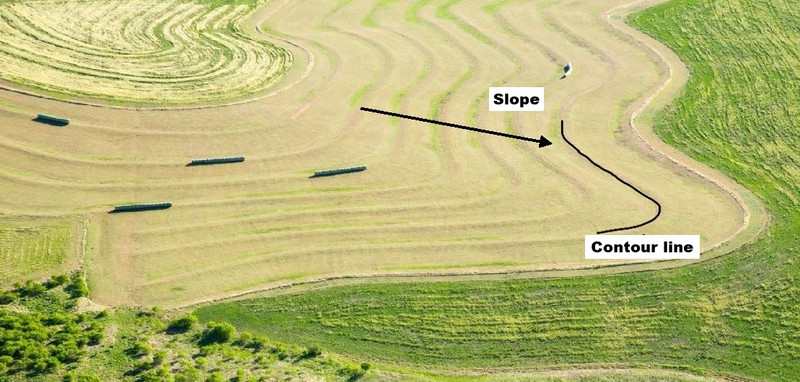
Contour plowing on a slope
Terracing
Terraces turn steep slopes into step-like flat sections. That shortens slope length and slows water, so less soil washes away. Very useful on steep land, but it needs maintenance.
Windbreaks
Windbreaks are rows of trees or shrubs planted across the prevailing wind. They lower wind speed, reduce wind erosion, cut drying, and can provide habitat.
Perennial crops
Perennials live for several years, so roots stay in the soil year-round. That helps hold soil in place, reduces disturbance, and improves infiltration.
No-till agriculture
In no-till, seeds are planted without full-field plowing. Old crop residue stays on the surface, which protects soil from raindrop impact and slows runoff and wind. A common tradeoff is more herbicide use.
Strip cropping
Strip cropping uses alternating bands of crops or cover vegetation. These strips slow runoff and trap sediment. On slopes, the bands usually run across the slope.
The classic example is the Dust Bowl. Drought plus plowing up Great Plains grasslands left dry soil exposed, which caused severe wind erosion.
How to Match Erosion Solutions to the Problem
This is where APES often tests you. Do not just name a practice. Explain how it solves the specific erosion problem.
- Water erosion on moderate slopes
contour plowing, strip cropping, no-till - Water erosion on steep slopes
terracing - Wind erosion
windbreaks, no-till residue - Repeated soil exposure
perennial crops, no-till
Farms often combine these. A sloped field might use contour plowing and strip cropping and no-till.
Maintaining Soil Fertility
Soil fertility is the soil’s ability to provide nutrients and the right chemical conditions for plant growth. Harvesting crops removes nutrients. Monocropping removes the same nutrients again and again.
Crop rotation
Crop rotation means planting different crops in the same field over time. This reduces repeated nutrient depletion. If a legume is part of the rotation, nitrogen-fixing bacteria in its root nodules can add usable nitrogen. Rotation can also break pest and disease cycles.
Green manure
Green manure is plant material, often a legume cover crop, turned into the soil while still green. As it decomposes, it returns nutrients and organic matter. It also improves soil structure, water-holding capacity, and nutrient retention.
Limestone
Limestone is added to acidic soil to raise pH. That improves nutrient availability and helps soil organisms. It is used to fix acidity, not mainly to supply N, P, or K. Too much can raise pH too far.
Rotational Grazing
Rotational grazing means moving livestock regularly among pasture sections, or paddocks, so one area is not grazed continuously.
The basic idea is simple. Animals graze one paddock, then are moved so the grazed area can rest and regrow.
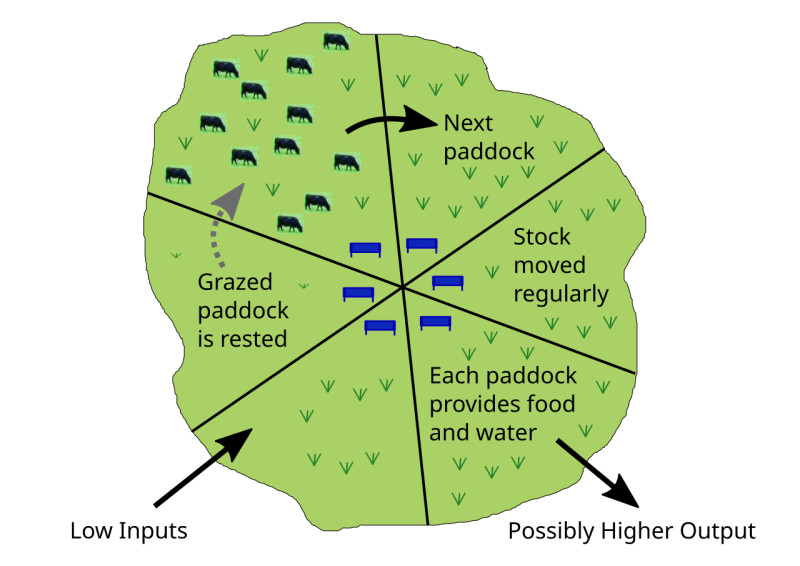
Rotational grazing system
Overgrazing happens when plants are eaten faster than they can regrow. That causes:
- less plant cover and fewer roots
- more wind and water erosion
- more soil compaction
- less infiltration and more runoff
With rotational grazing, grazed paddocks rest and recover. Vegetation regrows, roots recover, soil stays protected, and manure gets spread more evenly. One limit matters a lot here. It only works if the stocking rate is sustainable. Too many animals can still overgraze every paddock.
Key Takeaways
Sustainable Agriculture
Food production that protects the land’s capacity to remain productive in the future
Soil Conservation
Protection of soil from erosion so topsoil remains on the land
Contour Plowing / Contour Farming
Plowing and planting along a slope’s contour lines so rows slow runoff and reduce water erosion
Terracing
Reshaping a steep slope into broad, level steps that interrupt runoff and reduce water erosion
Windbreak / Shelterbelt
Trees, shrubs, or other tall vegetation planted across prevailing winds to slow wind and reduce soil erosion
Perennial Crops
Crops that live for multiple years, providing persistent roots and cover that reduce soil disturbance and erosion
No-Till Agriculture
Growing a new crop without full-field plowing by planting through retained crop residue with minimal soil disturbance
Strip Cropping
Planting alternating bands of crops or protective vegetation to slow runoff or wind and trap eroded soil
Soil Fertility
A soil’s capacity to provide the nutrients and chemical conditions needed for plant growth
Crop Rotation
Planting different crops in the same field in a planned sequence to reduce repeated nutrient depletion and potentially add nitrogen through legumes
Green Manure
A crop, often a legume, grown and incorporated into soil while green to add nutrients and organic matter
Agricultural Limestone
A soil amendment added to acidic soil to neutralize acidity and raise pH, improving nutrient availability and growing conditions
Rotational Grazing
Regularly moving livestock among pastures or paddocks so grazed vegetation can recover and overgrazing is avoided
Notes
Sustainable Agriculture
Food production that protects the land’s capacity to remain productive in the future
Soil Conservation
Protection of soil from erosion so topsoil remains on the land
Contour Plowing / Contour Farming
Plowing and planting along a slope’s contour lines so rows slow runoff and reduce water erosion
Terracing
Reshaping a steep slope into broad, level steps that interrupt runoff and reduce water erosion
Windbreak / Shelterbelt
Trees, shrubs, or other tall vegetation planted across prevailing winds to slow wind and reduce soil erosion
Perennial Crops
Crops that live for multiple years, providing persistent roots and cover that reduce soil disturbance and erosion
No-Till Agriculture
Growing a new crop without full-field plowing by planting through retained crop residue with minimal soil disturbance
Strip Cropping
Planting alternating bands of crops or protective vegetation to slow runoff or wind and trap eroded soil
Soil Fertility
A soil’s capacity to provide the nutrients and chemical conditions needed for plant growth
Crop Rotation
Planting different crops in the same field in a planned sequence to reduce repeated nutrient depletion and potentially add nitrogen through legumes
Green Manure
A crop, often a legume, grown and incorporated into soil while green to add nutrients and organic matter
Agricultural Limestone
A soil amendment added to acidic soil to neutralize acidity and raise pH, improving nutrient availability and growing conditions
Rotational Grazing
Regularly moving livestock among pastures or paddocks so grazed vegetation can recover and overgrazing is avoided
