Topic 6.11 Notes – Hydrogen Fuel Cell
What a Hydrogen Fuel Cell Is
A hydrogen fuel cell is an electrochemical device. That means it uses chemical reactions to make electricity directly, without burning fuel. Hydrogen is the fuel, and oxygen usually comes from the air.
The overall reaction is
A fuel cell’s direct product is water. That is why it can be an alternative to systems powered by nonrenewable fuels like coal, oil, or natural gas.
One quick thing students mix up a lot. Hydrogen is an energy carrier, not a primary energy source. You do not just collect useful hydrogen from nature in large amounts. You have to use energy first to make it.
The diagram below gives you the big picture. Hydrogen enters on one side, oxygen enters on the other, electrons move through an external circuit, and hydrogen ions pass through the middle membrane.
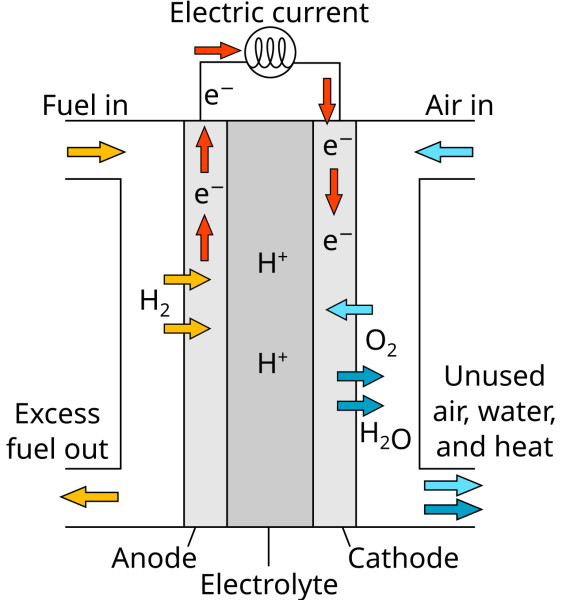
Hydrogen fuel cell diagram
Parts of the Fuel Cell and How It Produces Electricity
A fuel cell has four main parts: anode, cathode, electrolyte, and external circuit.
At the anode
Hydrogen enters the anode. A catalyst splits hydrogen molecules into hydrogen ions and electrons.
Through the cell
The electrolyte lets hydrogen ions pass through, but it blocks electrons. Since the electrons cannot cross the electrolyte, they travel through the external circuit instead. That electron flow is the electric current you can use.
At the cathode
At the cathode, oxygen combines with the hydrogen ions and the returning electrons to make water.
Why the setup matters
This separation is the whole point:
- Hydrogen is split into ions and electrons.
- Ions go through the electrolyte.
- Electrons are forced through the circuit.
- Their movement provides usable electricity.
As long as hydrogen and oxygen keep being supplied, the cell keeps generating electricity. This is electrochemical, not combustion. The fuel cell does not burn hydrogen.
Fuel cell vs. battery
- Both use electrochemical reactions.
- A battery stores a limited amount of reactants inside itself.
- A fuel cell keeps working as long as fuel and oxygen keep coming in.
How Hydrogen Is Produced and Why the Source Matters
Before a fuel cell can use hydrogen, someone has to make it.
One method is electrolysis, which splits water using electricity:
If that electricity comes from wind, solar, hydroelectric, or other low-carbon sources, the hydrogen can have very low carbon emissions. If the electricity comes from coal or natural gas, pollution and carbon dioxide are created upstream.
Hydrogen can also be made from fossil fuels, especially natural gas, and that can release carbon dioxide too.
The test-worthy idea is this. “No CO2 emissions” is true for the fuel cell itself at point of use, not automatically for the whole hydrogen system. Energy is also lost during hydrogen production, storage, transport, and conversion back into electricity.
Environmental Benefits and Major Limitations
Environmental benefits
- Low local environmental impact because the cell itself releases water.
- No direct carbon dioxide emissions during operation.
- No direct combustion pollutants like carbon monoxide, sulfur dioxide, or particulate matter.
- Useful in vehicles, buildings, and stationary power systems.
- Can reduce local air pollution in crowded urban areas.
- Can store energy indirectly as hydrogen for later use.
Limitations and trade-offs
- Expensive technology
- Energy is still needed to create hydrogen gas
- Catalysts and specialized parts raise costs
- Hydrogen is hard and costly to store and distribute
- Widespread use needs infrastructure like production facilities, storage tanks, pipelines or delivery systems, and fueling stations
- The true environmental benefit depends on how the hydrogen is produced
Point-of-Use Emissions vs. Life-Cycle Effects
Keep these two boundaries separate.
- At the fuel cell
Hydrogen + oxygen → electricity + water
No direct carbon dioxide emission - Across the full system
Hydrogen production, storage, and transport may use energy and cause pollution
A good example is hydrogen fuel-cell buses replacing diesel buses. Along the route, the direct benefit is cleaner air and water as exhaust. If the hydrogen came from wind-powered electrolysis, greenhouse gas emissions can also drop. If it came from a fossil-fuel-based grid or natural gas, pollution is shifted upstream instead of disappearing.
Key Takeaways
Hydrogen Fuel Cell
An electrochemical device that combines hydrogen and oxygen to produce electricity, water, and heat without directly emitting carbon dioxide
Anode in a Hydrogen Fuel Cell
The negative electrode where hydrogen enters and is separated into hydrogen ions and electrons
Cathode in a Hydrogen Fuel Cell
The positive electrode where oxygen, hydrogen ions, and returning electrons combine to form water
Electrolyte
The fuel-cell material that allows ions to cross the cell but forces electrons to travel through the external circuit
Electrolysis
The use of electrical energy to split water into hydrogen and oxygen: 2H₂O + electrical energy → 2H₂ + O₂.
Hydrogen as an Energy Carrier
Hydrogen must be manufactured using energy, stores part of that input energy, and later transfers it through a fuel cell rather than acting as a primary energy source
Point-of-Use Emissions vs. Life-Cycle Effects
A fuel cell directly emits water and no carbon dioxide, but producing, storing, and transporting its hydrogen may consume energy and cause upstream pollution
Notes
Hydrogen Fuel Cell
An electrochemical device that combines hydrogen and oxygen to produce electricity, water, and heat without directly emitting carbon dioxide
Anode in a Hydrogen Fuel Cell
The negative electrode where hydrogen enters and is separated into hydrogen ions and electrons
Cathode in a Hydrogen Fuel Cell
The positive electrode where oxygen, hydrogen ions, and returning electrons combine to form water
Electrolyte
The fuel-cell material that allows ions to cross the cell but forces electrons to travel through the external circuit
Electrolysis
The use of electrical energy to split water into hydrogen and oxygen: 2H₂O + electrical energy → 2H₂ + O₂.
Hydrogen as an Energy Carrier
Hydrogen must be manufactured using energy, stores part of that input energy, and later transfers it through a fuel cell rather than acting as a primary energy source
Point-of-Use Emissions vs. Life-Cycle Effects
A fuel cell directly emits water and no carbon dioxide, but producing, storing, and transporting its hydrogen may consume energy and cause upstream pollution
